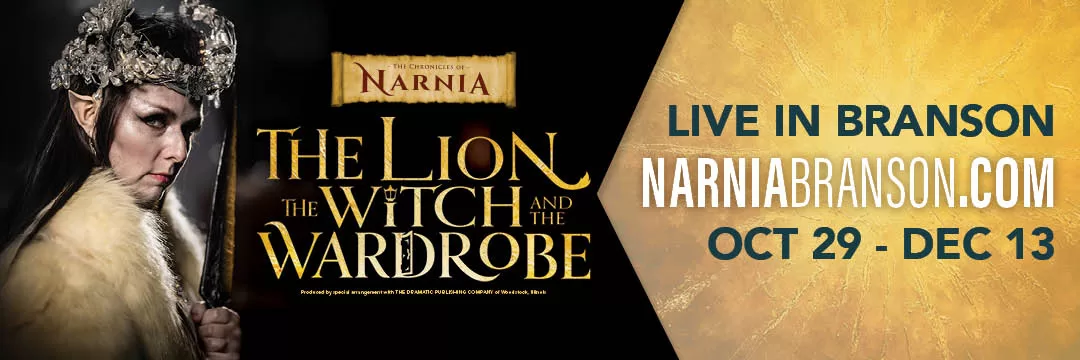
Tonight heralds the grand premiere of a captivating theatrical adaptation of C.S. Lewis’s timeless classic, The Lion, the Witch and the Wardrobe, brought to life in the heart of Branson, Missouri. This production promises an immersive journey into the enchanted world of Narnia, blending faithful storytelling with innovative stagecraft. Below, we’ve compiled all the essential details to help you plan your visit—whether you’re a lifelong devotee of Lewis’s works or introducing the tale to a new generation.
Show Details
-
Venue: Williams Event Center (formerly the Welk Resort Theatre), located at 1984 State Hwy 165, Branson, MO 65616.
-
Opening Night: Wednesday, October 29, 2025—marking the premiere performance.
-
Run Dates: The production continues through December 13, 2025, with multiple performances scheduled across October, November, and December. Check the official site for the full calendar.
-
Runtime: Approximately 2 hours and 50 minutes, including a 20-minute intermission.
Ticket Information and Booking
-
Availability: Tickets are on sale now and can be purchased online through the official website at https://narniabranson.com/ or by phone.
-
Box Office Contact: Call (417) 419-9229 for inquiries or bookings.
-
Seating Options: Choose from Premium (front and center sections) or Standard seating levels.
-
Special Add-Ons: Enhance your experience with the Backstage Pass, available after select shows. This includes a meet-and-greet with the cast and puppets, plus behind-the-scenes insights. Pricing: $20 for adults, $15 for children ages 5–12, and free for children under 5.
-
Group Bookings: Groups are welcome; reservations can be made up to two weeks in advance with a $50 deposit required to hold seats.
-
Important Policy Note: Tickets are non-refundable but may be transferable, subject to a fee.
Why This Production Stands Out for Narnia Fans
-
Production Team: Presented by Logos Theatre on Tour in partnership with Truth Traveler, this adaptation emphasizes a large-scale, immersive experience.
-
Unique Elements: Featuring masterful puppetry, elaborate set designs, and a commitment to family-friendly values, the show invites audiences to step directly into Narnia rather than merely observe it.
-
Appeal: Ideal for both seasoned fans of Lewis’s novel and newcomers alike, with a flexible run through the holiday season offering plenty of opportunities to attend.
Planning Tips for Fans
-
Book in Advance: Premium seats for opening night and holiday performances sell out quickly—secure yours early.
-
Arrival Recommendations: Plan to arrive ahead of time to soak in the pre-show atmosphere, including lobby displays and potential photo opportunities.
-
Date Selection: For a quieter, more adult-focused evening, opt for weekday matinees to avoid larger family crowds.
-
Full Immersion: Don’t miss the Backstage Pass for an added layer of magic and interaction.
-
Travel Considerations: If journeying to Branson specifically for the show, book nearby accommodations early, as this production is drawing visitors from afar.
This is more than a performance—it’s an invitation to rediscover the wonder of Narnia on stage. We at NarniaFans.com and our Facebook community encourage you to join the adventure!
Further Up & Further In:
The Enduring Magic of Narnia on Stage—Why This Adaptation Matters
As a sub-creative musician and content creator steeped in the worlds of Lewis and Tolkien, as well as the ancient tapestries of epics like Beowulf—which I maintain is no “mere” fiction, but a historical saga laced with the grandeur of heroic deeds and the occasional hyperbolic feat of long-distance ocean swimming—and the mythic realms that inspired C.S. Lewis and his dear friend J.R.R. Tolkien, I find myself profoundly stirred by the thought of seeing this latest dramatic incarnation of The Lion, the Witch and the Wardrobe.
In an age where stories flicker fleetingly on screens, why does a stage version like this one from Logos Theatre hold such significance for the Narnia fandom and the broader world of Lewis’s imagination? Allow me to delve into this, both as a fan and drawing from scholarly lenses on myth, faerie, and the sub-creative artistry that Lewis and Tolkien so cherished.
At its core, this production reaffirms the vitality of Lewis’s Narnia as a living mythos, one that transcends the printed page to engage the senses in a communal ritual. For the fandom, it’s a beacon of fidelity amid a sea of adaptations. Reviews from past iterations of Logos Theatre’s Narnia works—such as their acclaimed Prince Caspian and The Horse and His Boy—praise the company’s commitment to “breathtaking visuals, powerful performances, and a faithful retelling,” as noted in a recent critique of their Branson run, where audiences described it as “phenomenal” and “the best show I’ve seen in Branson.”
Noah Stratton, a producer and actor with Logos Theatre, emphasized in a podcast interview how their adaptations aim to “bring the wonder of Narnia from the page to the stage” through puppetry and immersive elements, honoring Lewis’s vision while glorifying deeper truths. Even Douglas Gresham, Lewis’s stepson, has endorsed their work on related productions, calling it a faithful extension of the chronicles. In Branson, producers highlight the show’s ability to draw families into a shared experience, with statements like “this inspirational tale” being brought to life through collective efforts, evoking comments from attendees such as “mind-blowing” and “loved by the whole family.”
From a scholarly vantage, this stage version beautifully embodies Lewis’s philosophies on the “world of Faerie”—that enchanted realm where myth awakens the soul to profound realities. Lewis, in his essay On Stories, argued that fairy tales are not mere escapism but a means to glimpse eternal truths: “We do not retreat from reality: we rediscover it.”
Here, the puppetry and set designs—praised for their “technical coolness” and “quality” in reviews—serve as portals, much like the Wardrobe itself, inviting audiences to rediscover wonder in a disenchanted world. It celebrates what Tolkien termed the “sub-creative” role of the artist: humans as co-creators with the divine, fashioning secondary worlds that echo the primary creation.
Lewis echoed this in The Weight of Glory, writing, “We are far too easily pleased,” urging us toward myths that stir longing for the divine. This production, with its emphasis on Aslan’s redemptive arc, aligns with Lewis’s Christian allegory, where myth becomes a vessel for truth—as he confided in a letter to Arthur Greeves: “Myth is the isthmus which connects the peninsular world of thought with that vast continent we really belong to.”
For the hearer—or in this case, the viewer—the play fosters that sub-creative participation. As audience members step into Narnia via stagecraft, they become co-storytellers, their imaginations ignited in ways a book or film might not achieve. Logos Theatre’s director, in interviews, speaks to this interactive magic, noting how puppets and live action create “true theatrical magic” without dull moments. It’s a nod to Lewis’s belief in the importance of myth for all ages, as encapsulated by Mr. Beaver’s line in the tale: “Safe? Who said anything about safe? ‘Course he isn’t safe. But he’s good.”
This production reminds us that engaging with Faerie isn’t tame—it’s transformative, challenging us to confront winter’s chill and embrace spring’s renewal.
In sum, this Branson adaptation isn’t just entertainment; it’s a scholarly salute to Lewis’s mythic legacy, bridging ancient folklore with modern sub-creation to nourish the soul.
So, Narnia Fans—will you be entering the Wardrobe in Branson? Please let us know if you embark on this adventure, and be sure to bring back tales to share with your friends at NarniaFans.com and on our Facebook page!
Yours in mythic pursuits,
John Di Bartolo
NarniaFans.com