


Netflix released a documentary detailing the making of the final season of Stranger Things called One Last Adventure: The Making of Stranger Things 5.
Be warned: the conversation includes a pretty major spoiler… If you haven’t watched Stranger Things 5 yet, and are interested in doing so, stop reading now. I will note when the spoiler is coming up, but again… if you haven’t watched Stranger Things, and are interested in it, stop reading and start watching. I’ll clearly mark when the spoiler discussion begins, but consider this your final warning.
Let’s get to it.
Early Influences and World-Building Parallels
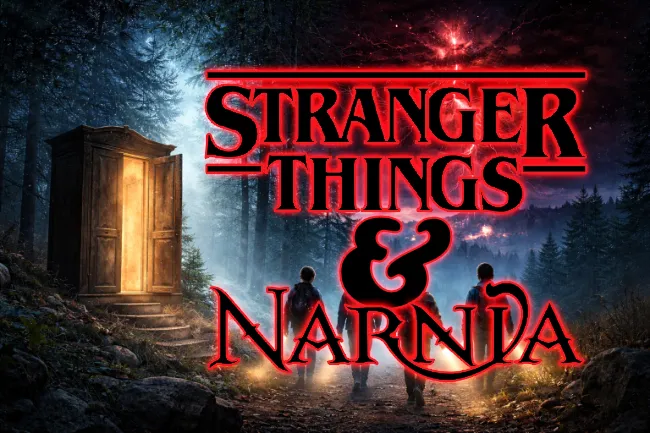
Over the past ten years, I’ve frequently heard Stranger Things mentioned alongside The Chronicles of Narnia. From the beginning, the Duffer Brothers have acknowledged that they grew up on stories where ordinary children stumble into extraordinary worlds, much like the Pevensie siblings entering Narnia.
In interviews, they often cite Stephen King and Steven Spielberg as influences, but they’ve also nodded to classic fantasy tales. For instance, a Rolling Stone profile noted the brothers loved “worlds you fall into, ready or not,” referencing books like The Chronicles of Narnia.
This influence is evident in Stranger Things’ world-building: the concept of the Upside Down – a hidden otherworld accessible from a mundane place in Hawkins – clearly parallels the wardrobe portal to Narnia. The show’s storytelling tropes (kids on a grand adventure in a secret realm) draw on the same sense of wonder and danger found in Lewis’s novels.
By intentionally comparing the Upside Down to Narnia’s magical world in their commentary, the creators and crew underscore how Narnia helped shape the tone and themes of Stranger Things.
A Conversation in the Writer’s Room during Production
(Major Spoilers Begin Here)
What follows is a transcript of a conversation from One Last Adventure. This discussion took place at some point in late 2023 or during 2024, while the final season was in production.
Ross Duffer: “There’s a slightly larger discussion to be had, just as we think about this, that’s even beyond the character arc, which is the series arc. This show is about how life does throw this stuff at you, the hard stuff, but you overcome it.”
Matt Duffer: “But it’s not just about overcoming these obstacles.”
Kate Trefry: “No, it’s like the joy of the adventure.”
Matt Duffer: “And that’s what people don’t understand when we’re not killing people off because we’re always like, ‘We have to maintain this sense of fun in the show or it doesn’t become the show anymore.’ So… Or, you know, it just becomes depressing.”
Ross Duffer: “Which is why I think Eleven… I know we all talked about the trauma that she’s experienced, and I think that you have to be able to move on from that.”
Matt Duffer: “Um, like, I always thought that she kind of represents magic. And so she has to leave. She has to be gone in order for them to move on.”
Paul Dichter: “Like the door to Narnia closes for you, and then some other kids are gonna find another door to Narnia later. But you’re never going back.”
Matt Duffer: “You never lose this piece of you, but you have to grow and move on from it.”
Matt Duffer on ‘Closing the Door on Narnia’
In an interview with TheWrap published on January 1, 2026, Matt Duffer revisits this same idea—essentially summarizing the writers’ room discussion from One Last Adventure.
What stands out to me is how clearly aligned the creative team was on this point. While it was Paul Dichter who explicitly referenced Narnia during the documentary conversation, Matt Duffer articulates the same idea a year or two later, using almost identical language.
Matt Duffer: “Thematically, she represents, at least to us, the magic of childhood. She possesses these incredible powers. It’s all fantastical. So you’re leaving that behind, even though it’s always going to be a part of you. She’s the fantasy aspect of the show in so many ways, and you’re closing the door on Narnia, right? That’s what it is in a lot of ways.”
For me, this is where the Narnia comparison really lands. Not as a clever metaphor, and not as a way to explain the mythology of Stranger Things, but as a way to talk about growing up. Narnia isn’t taken away from the Pevensies because it stops mattering; the door closes because it already did what it was meant to do. Hearing the Duffer Brothers and their writers use that same language—without irony, without over-explaining it—tells me they understand that distinction. The adventure doesn’t disappear. It becomes part of who you are. And then, whether you’re ready or not, you move on—hopefully never losing that piece of you, the part that still believes anything is possible.