

Ancient Rhythms, Lunar Standstills, and the Deep Magic Written in Stone
From C.S. Lewis’s The Planets (his ode to the medieval character of Jove):
“Moved with music–measureless the waves’
Joy and jubilee. It is JOVE’s orbit,
Filled and festal, faster turning
With arc ampler. From the Isles of Tin
Tyrian traders, in trouble steering
Came with his cargoes; the Cornish treasure
That his ray ripens. Of wrath ended
And woes mended, of winter passed
And guilt forgiven, and goof fortune
Jove is master; and of jocund revel,
Laughter of ladies. The lion-hearted,
The myriad-minded, men like the gods,
Helps and heroes, helms of nations
Just and gentle, are Jove’s children,
Work his wonders. On his white forehead
Calm and kingly, no care darkens
Nor wrath wrinkles: but righteous power
And leisure and largess their loose splendours
Have wrapped around him–a rich mantle
Of ease and empire.”—C.S. Lewis, The Planets
In the quiet hush of this December evening, as the chill winds whisper through the bare branches and the stars begin their vigil, the heavens prepare a spectacle of rare grandeur. Tonight, the full moon—traditionally christened the Cold Moon by the indigenous peoples of North America—ascends not merely as a luminous orb, but as a supermoon at perigee, its closest earthly approach in this orbit. Illuminating the sky at precisely 6:14 p.m. Eastern Time, it shall appear some 14% larger and 30% brighter than an ordinary full moon, a majestic beacon amid the lengthening winter nights. Yet this is no commonplace lunar plenitude; it marks the denouement of an 18.6-year cycle known as the major lunar standstill, wherein the Moon’s declination reaches its utmost extremes, rising and setting at the horizon’s most northerly and southerly bounds. This cycle, peaking across 2024 and 2025, renders tonight’s Moon the lowest full moon in the firmament for nigh two decades—a rarity not to recur in such extremity until 2043. We stand, then, at the end of a cosmic rhythm, a turning point in the Moon’s stately dance with Earth, where perigee aligns with this cyclical apogee of declination, bestowing upon us a vision of amplified splendor.
To the average denizen of our modern age, ensconced in the glow of electric lamps and the ceaseless hum of machinery, such an event might pass as little more than fodder for a fleeting smartphone snapshot—a luminous backdrop to the evening’s mundane pursuits. How seldom do we pause to consider that the Moon adheres to this 18.6-year cadence, a subtle oscillation born of the precession in its orbital plane, tilting at 5 degrees to the ecliptic. Yet to the ancients, this cycle held profound import, woven into the very fabric of their monumental endeavors. Like ancient ‘stone tables’ from some mythical tale; behold the megaliths and earthworks scattered across the globe: from the brooding stones of Stonehenge, attuned to lunar extremes, to the vast Newark Earthworks in Ohio, a marvel of the “Hopewell” culture erected some two millennia past. These earthen octagons and circles, spanning hundreds of acres, align with exquisite precision to the Moon’s 18.6-year oscillations, marking the points of lunar rise and set at their most distant horizons. What astronomical acumen must these mysterious builders have possessed! Theories proliferate like stars in the Milky Way: were these structures observatories for eclipse prediction, calendars for agrarian rites, or sacred precincts for communing with the divine? In his treatise The Genius of Ancient Man, Don Landis posits that such alignments reflect an innate genius bestowed upon early humanity, countering mainstream notions of mankind crawling from caves of primitive simplicity with evidence abounding across the globe – literally written in stone – of sophisticated knowledge—tracking not only solar but lunar cycles, including the Saros for eclipses. Indeed, these edifices bespeak a reverence for the heavens that our era has largely eclipsed beneath artificial lights.
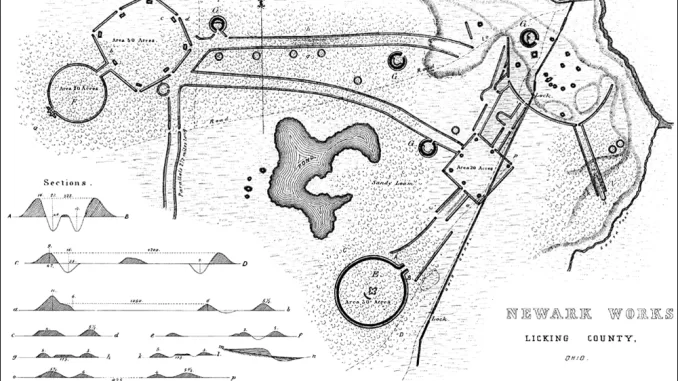
While contemporary folk may dismiss the Moon as a mere aesthetic diversion, its cycles exert a profound, oft-unnoticed sway over our terrestrial realm. The tides swell and ebb in obedience to its gravitational embrace, sculpting coastlines and nourishing marine life; weather patterns shift under its subtle influence, as scientists probe correlations with precipitation and atmospheric tides. Even our biorhythms may echo its phases, a vestige of Creation’s intricate design. If we could but attune our ears to the echoes of ancient voices—those builders of Newark or Stonehenge—might we discern a deeper significance in this cycle’s closure? A threshold, perhaps, where one era wanes and another dawns, laden with portents or renewals lost to our hurried gaze.
This lunar event does not stand alone in the week’s celestial pageant; mere days hence, on the 7th of December, the waning Moon shall draw nigh to Jupiter in a striking conjunction, the two luminaries appearing as close companions in the predawn sky. Jupiter, that colossal gas giant and brightest of planets after Venus, shall shine with regal brilliance, its retrograde motion amid the Gemini twins enhancing the spectacle. Such alignments, where the Moon occults or nears the Jovian king, evoke the harmonious interplay of heavenly bodies, a cosmic duet that amplifies the sense of transition at this cycle’s end.
In the sacred pages of Scripture, we find no explicit ledger of the 18.6-year lunar cycle, yet its essence resonates with the divine ordinance. As Genesis declares, God set the lights in the firmament “for signs, and for seasons”—the Hebrew moedim, appointed times that punctuate His redemptive calendar. The Moon, a “faithful witness in heaven” (Psalm 89:37, KJV), governs the feasts of Israel, its new moons heralding the sacred assemblies (Numbers 10:10). Though the Hebrew calendar aligns more overtly with the 19-year Metonic cycle to harmonize solar and lunar years, the broader principle invites contemplation: these celestial rhythms mirror the precision of the Creator’s hand, where sun and moon oppose in harmonious counterpoint— the full moon’s zenith in winter echoing the sun’s in summer, a symphony of balance amid the seasons’ flux. Ancient writers, from Babylonian astronomers to the chroniclers of Genesis, perceived the Moon as humanity’s earliest calendar, its phases marking time before solar reckonings prevailed. Among modern expositors, Dr. Chuck Missler, in his explorations of biblical cosmology, notes disruptions in lunar cycles—such as those inferred from Joshua’s long day—hinting at cosmic interventions in sacred history. Similarly, G.H. Pember, in Earth’s Earliest Ages, weaves astronomical cycles into his discourse on pre-Flood worlds and prophetic timelines, viewing the heavens as a divine chronometer. Sir Isaac Newton, that polymath of faith and science, employed lunar data in refining biblical chronologies, seeing in the stars a testament to Providence.
Yet, for those attuned to the ‘sub-creations’ of C.S. Lewis—our Oxford don whose chronicles bridge the chasm between myth and gospel—this lunar standstill and Jovian rendezvous evoke a deeper enchantment, one that shall particularly captivate devotees of The Chronicles of Narnia. Lewis, ever the medievalist, harbored a profound affinity for the planets, drawing upon Ptolemaic cosmology wherein each sphere imparts its influence upon earthly affairs. Jupiter, or Jove, held especial allure for him; as the “kingly” planet, it symbolized festivity, magnanimity, and the overthrow of winter’s tyranny—themes central to The Lion, the Witch and the Wardrobe, which scholars posit as Lewis’s Jovian tale. In this volume, Aslan’s arrival heralds the end of the White Witch’s eternal winter, a jovial spring bursting forth in mirth and renewal. The Moon, too, weaves through Narnia’s tapestry; like our world, that enchanted realm boasts a single luminous satellite, its phases casting ethereal glows upon quests and battles. In The Silver Chair, aligned with lunar motifs, the narrative descends into subterranean realms of illusion and lunacy—silver mines, marsh-wiggles under moonlit moors—evoking the Moon’s archetypal associations with madness and mystery. Lewis employs the Moon metaphorically to illumine the soul’s wanderings: in Prince Caspian, stars gleam “like two small moons,” their brightness a harbinger of hope amid Telmarine oppression.
Consider, too, the creation scene in The Magician’s Nephew, where Aslan’s song summons the stars and Moon into being, a cosmic hymn that resonates with the celestial rhythms of our own Creator’s hand—or even the singing of the Lion Himself. As the great Beast intones, “Narnia, Narnia, Narnia, awake. Love. Think. Speak. Be walking trees. Be talking beasts. Be divine waters.” Yet Uncle Andrew, the meddlesome magician, recoils from this melody: “A most disagreeable place. I wish I hadn’t come,” he mutters, blinded by his own hubris to the deep magic unfolding. Herein lies Lewis’s wisdom: the heavens are not mute mechanisms but a chorus declaring divine purpose, much as in Narnia, where planetary influences subtly shape the tales. Our world’s lunar cycles and Jovian alignments sing with just as much deep magic— that “deeper magic from before the dawn of time” which redeems and renews. For Narnia enthusiasts, this December’s spectacles offer a portal: gaze upon the Cold Moon and Jupiter’s embrace, and ponder how Lewis might have marveled, his telescope trained on Jove from his Oxford balcony, weaving such wonders into apologetics for joy. In The Discarded Image, he reminds us that the medieval cosmos was no cold void but a “festal dance,” alive with meaning—a view that counters our modern disenchantment.
Ah, but in our bustling age, where city lights drown the Milky Way and screens eclipse the stars, these cycles slip unnoticed, their majesty muted. Yet pause, dear reader, and ponder the precision: how sun and moon, in their eternal pas de deux, sustain life’s rhythms with unerring grace—a wonder that bespeaks not chance, but a masterful Artisan. As this 18.6-year cycle draws to its close tonight, one cannot help but feel a frisson of mystery: What ancient wisdom fades with its waning? What new dawn breaks upon the horizon? In the words of the Psalmist, “The heavens declare the glory of God; and the firmament sheweth his handywork” (Psalm 19:1, KJV). Let us, then, lift our eyes to this Cold Supermoon, reclaiming a sliver of that primal awe, and whisper a prayer for discernment in these appointed times—times that echo the enchanted harmonies of Narnia itself.
About Tabula Obscura
In this series, we explore the hidden links between C.S. Lewis’s stories—especially Narnia, but also his other writings on faith, space adventures, and old myths—and topics like ancient history, archaeology, the Bible, art, literature, and unsolved puzzles. You might read about how the hills of Worcestershire inspired Narnian scenes, as noted in a recent BBC article on Lewis and Tolkien’s walks; or how Bible stories shape Aslan’s role, like in early church writings; or discover Roman-British finds that recall the Stone Table; or trace story influences from Norse tales to children’s books from Lewis’s time.
The series will also sometimes include excerpts from the journal of a mysterious professor, sent to us anonymously years ago—an English expert in ancient history who worked in England from the 1920s through the 1940s, and whose notes show a deep search for doors between the real world and the imagined.
These are not just daydreams; the articles track the real-world roots of fantasy, from carved stones of the past to illustrated books that sparked Lewis and his friends—Tolkien included, whose shared hikes in England’s countryside created lasting magic.
But mysteries remain: expect side trips into puzzles like old English earth lines, perhaps like wardrobe doors; or secret ideas in Lewis’s Perelandra, tied to old science; or art echoes in 19th-century paintings that color Narnia’s world. Each piece, posted regularly on NarniaFans.com, invites fans to think, talk, and spot hints of bigger truths, much like a quiet evening in a library.
Join this friendly group! Chat with other fans on the NarniaFans Facebook page, where talks grow, fan projects are shared, and trips to Lewis-related spots are planned.

Be the first to comment