

As the New Year began, I decided to go on another journey through the daily devotional book A Year with Aslan. This coupled with beginning the Lenten season with the devotional Preparing for Easter: Fifty Devotional Readings from CS Lewis, it got me thing deeper about one key character from the Narnia books. One that has perhaps been on our minds the most this past year, since an unfortunately timed breaking news story regarding this character’s casting almost a year ago. And if we’re honest, perhaps there’s a good reason for this concern.
Did you know that there are perhaps only three storied franchises from which devotional books tend to flow naturally? While it’s true that “The Gospel According to” books have been about every IP under the sun from Star Wars, to The Matrix, to superheroes, to Barbie, these three have that story backed into their mythology. The first is The Peanuts comic strip. The second is Tolkien’s stories of Middle-Earth. The third, and perhaps best known, is The Chronicles of Narnia by CS Lewis.
But while Charlie, Linus, and the gang have been known to wax poetic about on scripture, and Tolkien admitted that his story became more fundamentally “religious and Catholic” upon revision, for Narnia this all comes down to one character at the very center of the mythology.
Lewis himself said of this character in “It All Began with a Picture” collected in the book On Stories.
“The Lion all began a picture of a faun carrying an umbrella and parcels in a snowy world. This picture had been in my mind since I was about sixteen. Then one day when I was about forty, I said to myself ‘Let’s try to make a story about it.’” …At first I had little idea how the story would go. But then suddenly, Aslan came bounding into it. I think I had been having a good many dreams of lions at that time. Apart from that, I don’t know where the Lion came from or why He came. But once He was there, He pulled the whole story together….”
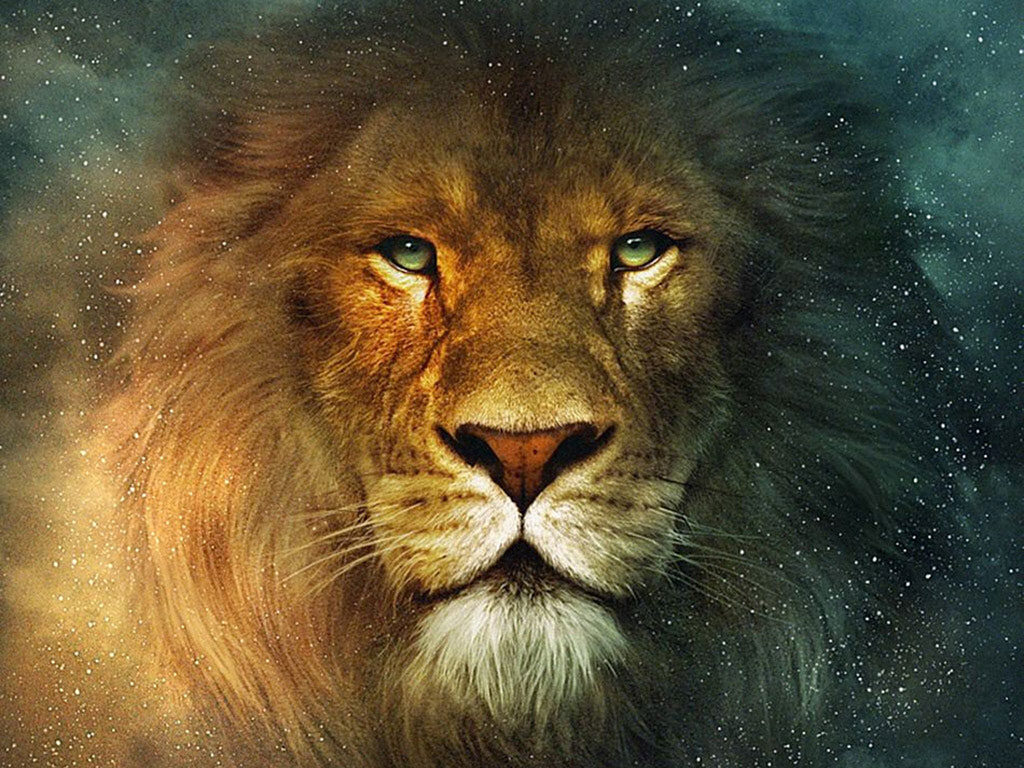
And indeed, before we ever meet Aslan in Lion, he shines an immediate light on the seemingly endless winter of Narnia. He isn’t even mentioned until chapter seven, long after all four children have ambled into Narnia. Lewis, a master story teller, used a gentle build, first introducing us to our heroes, the Pevensies. Then to the land of Narnia itself, and it’s villain, the White Witch, Jadis. Aslan, is the final piece of the puzzle.
Thus when Mr. Beaver first mentions him, it isn’t with excitement, but in hushed tones as we like the Pevensies know Narnia is under the grip of the witch as he acknowledges even the trees are on the side of the witch. What he has to say isn’t communicated like a magic word, but more like important confidential information an Allied Spy might attempt to share with a commander in occupied Dunkirk regarding the evacuation effort. It is at this moment Mr. Beaver reveals that not only is Aslan on the move, but like Allied forces at D-Day in Normandy, he may have already landed. This isn’t magic: it’s a strategic counter offensive to free a world.
Lewis tells us this revelation has a profound impact on the children. As he describes,
“And now, a curious thing happened. None of the children knew who Aslan was any more then you do, but the moment the Beaver had spoken these words, everyone felt quite different. Perhaps it has sometimes happened to you in a dream that someone says something which you don’t understand but in that dream it feels as if it had some enormous meaning-either a terrifying one which turns the whole dream into a nightmare, or else a meaning to lovely to put into words, which makes the dream so beautiful that you remember it all your life, and are always wishing you could go into that dream again. It was like that now. At the name of Aslan each one of the children felt something jump in his inside .Edmund felt a sensation of mysterious horror. Peter felt suddenly brave and adventurous. Susan felt as if some delicious smell or some delightful strain of music had just floated by her. And Lucy got the feeling you have when you wake up on the morning and realize that it is the beginning of the holidays or the beginning of summer.”
It’s a cliché nowadays to use this term, but in the context of Lewis’ novel it is truly a “spiritual” experience. One that begins the personal journey of each child as they cross the threshold of adventure into something far more then looking at a beautiful sunset or a waterfall and something that touches the very core of their beings, and hints at the implication that this is something much more pivotal for the world of Narnia. This is far more transcendent encounter then Alice tumbling down the rabbit hole or Dorothy arriving in Oz through a cyclone.
This is an experience more like God appearing to Moses on Mount Sinai, speaking to Elijah in the wildness, sending the Angel Gabriel to the Virgin Mary or appearing to the Apostle Paul on the road to Damascus.
Mr. and Mrs. Beaver even imply as much. Upon learning that Aslan is not a human but an actual Lion, Susan and Lucy admit they won’t feel safe meeting one.
“That you will…and no mistake…if there’s anyone who can appear before Aslan with out their knees knocking, their either braver than most or else just silly…safe? Don’t you hear?…Who said anything about safe? Course he isn’t safe. But he’s good. he’s the King, I tell you.”
Even father Christmas bids them greetings in Aslans name. Tellingly when they meet the Lion not only are they awestruck, but when he bids them welcome and inquires of Edmund, it is in the Lions presence Peter confesses the mistakes he made that he felt sent his brother to the witch. There is no judgment form the Lion, but the confession, plus the request from Lucy to save him beings the path for redemption for the wayward Pevensie.
it is one that will take more than a rescue attempt by fantasy creatures to fulfill. When the witch arrives and demands under the Deep Magic, Edmund be forfeit to her, Aslan;s strikes a bargain His life for Edmund’s. He is killed on the stone table to satisfy the Deep Magic, mocked, jeered, and tortured and ridiculed by her forces as she approaches the table. However, this is not the end. The witch has not the battle, only a round, as early in the morning, the table cracks and Lucy and Susan see Him a live and well.
As He tells them,
“It means…that though the witch knew the deep magic, there is a magic deeper still which she did not know. Her knowledge goes back only to the Dawn of time. But if she could have looked a little further back, into the stillness and darkness before Time dawned, she would have seen a different incantation. Then She would have known that when a willing Victim who had committed no treachery was killed in a traitor’s stead the table would crack and Death itself would stare working backwards.”
Through conquering death, Edmund is not the only one Aslan restores. He races over the land with the two girls on his back and frees the Witch’s captives with the breath of his nostrils. This is but the beginning of the journey upon which readers embark with The Lion of Narnia, and a glimpse of his power. We watch in awe in Prince Caspian as he frees the river dammed by Miraz with a command and see Him free Eustace from a Dragon’s cruse. We even witness as he sings Narnia into existence in The Magician’s Nephew.
But more than his power, we also witness his mercy and compassion. When Edmund is restored to his siblings, he tells them not to mention the sins of Edmund’s past. In Horse and His Boy, Shasta learns how even when he didn’t know it, Aslan was guiding him on his journey and protecting him so he may one day save his people. But none of this compares to what Digory experiences in The Magicians Nephew. Digory and Polly approach the Lion and in this moment, Digory, as Peter would later do, confesses how he is responsible for bringing Jadis, and with her evil itself, into Narnia. While initially reluctant, Digory, upon being asked by Aslan to help protect Narnia, blurts out an earnest request for Aslan to help him cure his mother.
That is when we see what is perhaps one of Aslan’s most defining moments in the series.
“Up till then he had been looking at the Lion’s great front feet and the huge claws on them, now in his despair he looked up at his face. What he saw surprised him, as much as anything in his whole life. For the tawny face was bent down near his own and (wonder of wonders) great shining tears stood in the Lion’s eyes. They were such big, bright tears compared with Digory’s own that for a moment he felt as if the Lion must be sorrier about his Mother then he was himself.”
This is something incredible profound about the Lion and what sets him apart from a mere ”Nature spirit” like Grandmother Willow in Disney’s Pocahontas, or Ewya in the Avatar movies and elevates him far above a typical animal sidekick”. Nature spirits may offer guidance but they don’t grieve for the heroes while on the converse talking animal sidekick may provide the languages or support, but they don’t give them the advice the guidance they need that can change their lives forever.
For as Aslan says in the conclusion of The Voyage of the “Dawn Treader” when Lucy and Edmund ask about how they can get into Aslans’ kingdom from their world.
“I shall be telling you all the time..but I will not tell you how long or short the way will be, only that it lies across a river. But do not fear that, for I am the Great Bridge builder.”
But then when Aslan tells them that they, like Peter and Susan before them, had made their last trip into Narnia, they are heartbroken and Lucy makes what is the most profound statement in the series, one that designates how much more important Aslan is to the story then say the White Rabbit in Alice in Wonderland, or Glinda and the Good and the Wizard in the Wizard of Oz. We loved those lands, yes, but for Narnia, it was something far more than that.
As Lucy says,
“It isn’t Narnia, you know…it’s you. We shan’t meet you there. And how can we live, never meeting you?”
But it is here when he reveals the very reason for which her family was brought into Narnia and thus established the standard by which Friends of Narnia have weigh all adaptations regarding the spirit of the story.
“But you shall meet me, dear one…But there I have another name. You must learn to know me by that name. That was the very reason why you where brought to Narnia, that by knowing me here for a little, you may know me better there.”
Now some might suggest that this statement could apply to any and everything possible. One could argue that like in stage productions of Peter Pan, wherein Mr. Darling also plays Captain Hook, that Aslan is representative of the father figure. But this notion is immediately mooted due to Aslan’s power to not only create but destroy entire worlds. Some on the internet have even suggested this could apply to Balder, Osiris, Dionisis, or any other deity.
However, while to a child Lewis sent a reader more of a riddle to help point them in the right direction of Aslan’s identity, for a mother, he was a bit more direct. The woman identified merely as “Mrs. K”, had a son, Laurence, who was worried he might love Aslan more than Jesus and to that Lewis wrote,
“Laurence can’t really love Aslan more then Jesus, even if he feels it’s what he is doing. For the things he loves Aslan for doing or saying are simply the things Jesus really did and said. So that when Laurence thinks he is loving Aslan he is really loving Ejsus, and perhaps loving him more then he ever did before.”
I know this was certainly the case for me when I first meet the Great Lion. I was in fourth grade at the time and was struggling with a four-headed hydra beast of my own in the form of dyscalculia, anxiety, depression and undiagnosed Asperger’s syndrome.* I struggled not just in classes, but to make friends, and as a result often times I felt all alone.
But if there was one constant in my life at that point, it was my parents. Dad understood that to bond with me it might mean more then sports so along with superhero comic books, he introduced me to movies and TV shows, like Star Trek, Jurassic Park, Raiders of the Lost Ark, Back to the Future, and Star Wars. It was a pivotal year for my cinematic imagination, but Mom, from whom I derived my love of books, was about to take it one step further.
Of the books she read as a kid, there was one that she knew would be right up my alley. As it happened this series was available in my school book order for a special low price, and despite whatever brain candy I may have circled in the order, she put in an order for a set of The Chronicles of Narnia.
Then later, after the books had arrived, once my younger sisters were in bed Mom came into my basement bedroom, settled into the comfy arm chair in the corner and began reading to me form The Lion, The Witch and The Wardrobe. Of the books I read, or were read, as a kid, it can truly be said that for me, The Lion, The Witch and The Wardrobe truly marked the “baptism of my imagination” as Mom and I followed my new friend Lucy through the wardrobe. And for me, like for Edmund and Lucy it wasn’t just about the land, as enchanting as it was, but Aslan himself. I knew, the moment He approached the stone table who he really was.
Director Greta Gerwig has said in an interview with Time’s Sam Lansky when she received the “Woman of the Year” award for her incredible critical and commercial success for Barbie that, her goal for adapting the Narnia books to film,
“ CS Lewis said that the goal of writing fantasy-you know something from his imagination-he’d say, let’s say you wrote about an enchanted forest. The goal should be that then every time you walk into a forest after you read it, you’d say to yourself result, ‘Maybe this is an enchanted forest.” So that’s a tall order, but I guess reenchantment of the word.”
But for me, Narnia didn’t just re-enchant the woods near my house. It re-inchanted my faith. I had grown up on a Christian home and I knew all the Bible stories. Thanks to videos like Superbook, Veggie Tales, radio shows like Adventures in Odyssey, and even flannelgraphs, there was no shortage of sources from which I could hear those stories and teachings form the Bible again and understand them at a more fundamental l level so they weren’t just head knowledge, but heart knowledge. Even music, like by Psalty the Signing Song Book, could help me hide God’s word in my heart by using music to help engrave the words of the Bible on my heart and mind.
But Aslan’s death and resurrection was a different matter. Through Aslan I couldn’t just read or see, but genuinely feel and experience his sacrifice. The first time Mom read The Lion, The Witch and The Wardrobe to me, I felt about Aslan’s death the same was I felt when Superman died battling Doomsday, Spock sacrificed himself to save the crew of the Enterprise, Mufasa risked his life to save Simba or even Darth Vader giving his life to save Luke Skywalker from the Emperor’s wrath. But Aslan’s sacrifice was greater, as it wasn’t just for a city, a ship, or even a son…
It represented my Savior’s love for me.
And so began my journey with Aslan. With my new friends Peter, Susan, Edmund, Lucy, Eustace, Jill, Shasta, Aravis, Caspian, Digory and Polly I witnessed the birth of and death of Narnia and saw my Savior’s power. I felt his compassion and love for the children, and his wisdom and mercy. I even saw his providence for Shasta and how he is truly in control of all things.
Thus, as he told Jill,
“I have swallowed up girls and boys, men and women, kings and emperors, cities and realms,” said the lion. It didn’t ‘say this as if I were boasting, or as if it were sorry, nor as if it were angry, it just said it.”
Now, I love Star Wars. I like the Jedi Knights, the lightsabers and The Force. But I love Narnia and Aslan more and for good reason. The Force is a vague concept at best and a very cool trick. But it is still just a thing. Aslan is a very real person with a sense of weight and power. The force can be controlled by both the Jedi and Sith and Yoda, Luke, Vader and Palpatine have the same power source as each other.
Not so with Aslan, He can’t be controlled or contained. As Eustace tells Jill when she asks if to get into Narnia they have to draw a circle on the ground with strange shapes and letters and chant, responds,
“Well…I believe that was the sort of thing I was thinking of, though I never did it. But now that it comes to the point, I’ve had an idea that all those circles and things are rather rot. I don’t think he’d like them. It would look as if we thought we could make him do things. But really, we can only ask him.”
And this sense of power, this sense he can’t be controlled tamed or contained is felt in his Voice. The Force only has a “voice” when Obi-Wan, Qui-Gon or Yoda speak through it. Aslan whoever is more, so much more.
As Jill notices in The Silver Chair,
“(S)he remembered what Scrubb had said about animals talking in that other world and realized that it was the Lion speaking. Any way she had seen its lips move this time, and the voice was not like a man’s. It was deeper, wilder, and stronger, a sort of heavy, golden voice It did not make her any less frightened than she had before, but it made her frightened in a rather different way.”
Thus, like any good fan boy I did a fan casting in my head and told mom that I thought if the ever-made Narnia into a movie that I thought James Earl Jones would be the perfect voice for Aslan thanks to Mufasa and Vader. Then after The Prince of Egypt was released my second choice was Val Kilmer after hearing his voice for God speaking from the Burning Bush to Moses.
As I grew older and learned Lewis was from the British Isles I understood that perhaps, Aslan should share a voice form that region of the world. I wasn’t sure who would fit the bill, and thus when Brian Cox was cast as Aslan in 2005, I figured that would be the end of it. After he dropped out, I wondered who just might be a better choice for the role, and upon seeing Batman Begins with my dad in Imax a voice echoed off the walls of the theater from the shadows of Bruce Wayne’s Prison cell.
As Liam Neeson’s Henri Ducard/Ra’s Al Ghul stepped into the light I thought to myself, “That’s it. That’s who should voice Aslan. He has a voice who can command light from darkness.”
Then upon seeing he had been officially cast in the role at home I watched the first two Star Wars prequels and paid attention to his performances as Qui-Gon. In the Phantom Menace, he could sound wise, and authoritative with Obi-Wan, while necessarily confrontational with Yoda and Windu, and warm and fatherly with Padme and Anakin. Then in Attack of Clones when he had a brief cameo speaking to Yoda through the force as Anakin slew the Tusken raiders, all I thought was, “that sounds like a voice that can pierce the veil between life and death itself.”
It’s one thing to simply read in scripture about God’s voice it’s another to experience it through Aslan, especially a well-defined one. This is character who is supposed to echo the Voice that spoke light from the darkness, parted the Red Sea for Moses and gave him the Ten Commandments, comforted Elijah in the wilderness, and called forth Lazarus form the grave. This is a voice that should not only be able to call out to Job from the whirlwind and ask,
“Where were you when I laid the earth’s foundation? Tell me, if you understand. Who marked off its dimensions? Surely you know! Who stretched a measuring line across it? On what were its footings set, or who laid its cornerstone— while the morning stars sang together and all the angels shouted for joy?”
And more to the point it is the voice of The One who stood up amidst a maelstrom on the sea of Galilee and commanded the wind and the waves be still, and told His followers to let not their hearts be troubled and urged them, and us,
“Come to me, all you who are weary and burdened, and I will give you rest. Take my yoke upon you and learn from me, for I am gentle and humble in heart, and you will find rest for your souls. For my yoke is easy and my burden is light.”
Other adaptions seem to understand just who Aslan really is and find subtle ways to enhance Aslan’s deeper magic. Where it’s Bill Melendez adding a thunder clap when the Witch kills Aslan evoking Christ on Calvery, or Aslan after defeating the White Witch in the Walden Media adaptation of Lion, the Witch and the Wardrobe, saying the last three words of Christ on the Cross, “it is finished” viewers come away feeling like there is more to Aslan then just being a big magical kitty cat with Messianic overtones.
This is perhaps why fans are so concerned about the rumored casting choice for Aslan in the upcoming film adaptation of The Magician’s Nephew. No one can deny that Meryl Streep is an incredible talented actress, but the problem still remians that her voice is soft and gentle, punctuated by a sultry playful purr, then it doesn’t have that sense that it could pierce the veil between life and death, calm a storm or call forth light from the darkness. At best listening to her, I haven’t felt like I’ve heard the Fundamental Force of Creation, as much as I’ve felt like I’ve heard the voice of my Home Economics teacher in junior high advising students on baking a cake without burning down the class room.
Some have suggested that perhaps they’ll simply augment the voice or have Aslan be an “abstract” like with the voice of God in Prince of Egypt. Some have even referenced it saying how God was voiced by multiple actors in that movie, but that is only half the story,
As Nick Fletcher sound designer for The Prince of Egypt related,
‘That was a particularly interesting challenge for me, and something that I was very fond of working on,’ comments Nick Fletcher. ‘I remember we tried so many different versions of that. Being that it had the theological aspect to it that you don’t really get in most movies, some brilliant ideas just didn’t work on religious grounds. For instance, in terms of the effects that we tried out to manipulate the voice, if you want to make someone sound like an alien or the Devil it’s relatively easy, but of course that was a no-go for us. I did a version myself using the actors, actresses and children within the film, kind of morphing from one voice to another, which for me was great fun to do and produced a pretty amazing sound. But it crossed the line theologically and so we had to abandon that idea.’
Ultimately, they decided to have Val Kilmer perform a dual role and voice God as well as Moses, using a register closer to his Batman voice from Batman Forever. This gave the voice of God a tangible anchor that gave it weight, texture, mystery and a hint warmth that would have otherwise been missing. A cold, distant, detached and heavily augmented voice works perfectly for Galactus, Devourer of Worlds in Fantastic Four, but not for Aslan, Creator of Worlds and Savior of Souls.
But nowadays movies tend to focus on “Vibes’ and “Energy” and “positive messages’” then trying to capture that tangible nature to the Presence of God. Even Gerwig’s own Barbie one of the central slogans was “I am Ken-Ough”., and a motivational guru Aslan would fit the bill. If the Streep rumors are true, why not simply have Aslan be a source of positive energy and good feelings? An Aslan who is more like Barney or Daniel Tiger and helps kids feel good about themselves.
There certainly is precedence for this. Afterall in the recent film adaption of a Wrinkle in Time the deleted all the Christian references from L’Engle’s text and made Mrs Who, Mrs Whatisit and Mrs Which more like quirky cosmic Aunties then angels in disguise. Afterall, they had Oprah Winfrey, Reese Witherspoon and Mindy Kaling playing them, so perhaps it made sense to make them fun and quirky advice gurus who help Meg with her self-esteem through positive quotes. But in the process, a book that put to action what was written in Scripture about how God can use the weak and broken things of this world to confuse the wise and powerful, a truth I desperately needed to hear as a kid, was given all the depth and weight of a motivational cat poster.
But to do that with Aslan makes Him just another voice to listen to, not a source of strength and comfort. Battling my four headed hydra beast as a kid, I knew, like Edmund freeing himself from the witch or Eustace breaking the dragons curse that it didn’t matter how much positive thinking or “I am -Ken-ough” messaging I received. That wasn’t going to help me. I needed to place my faith in the Lion and know that He that went with me was far greater than any obstacle I may face.I needed to be reminded just how much my Savior, my Creator, loved me.
Aslan was more than just another cosmic force or sci-fi/fantasy guru to me. He was a reminder of the love of my Savior, and how His strength, His mercy, His grace, and His provision never failed. To get it wrong, is to get Narnia wrong. If Aslan is sweet, cuddly, and caring, or just another self-help guru giving notions of self-esteem, then He is no different than Barney the Dinosaur or Daniel Tiger. A cute childhood friend, one you eventually outgrow and put in a toy box. Or worse, he’s just that aforementioned motivational cat poster on the ceiling of your dentist’s office telling you to “hang in there” while you get your teeth cleaned.
But for me, that could never suffice. Because to me Aslan is not Barney or Daniel Tiger. He’s more than even Yoda and a figure more important than a talk show host telling me how to live my best life. And he’s far more then motivational cat poster telling me to hang in there when I was struggling in school.
Aslan is the One who stooped down from Heaven itself to help me up when I couldn’t, and took my place, so I didn’t have to “hang in there” anymore.
And if you ask me, kids need that far more then another cute, cuddly IP mascot. I know it’s what I needed most.
And what about you. Who do you say Aslan is?
*I realize that the diagnostic terminology has changed and what I have is now listed by the DSM-V as ASD-Level 1. However, Aspergers was the formal diagnosis with which I received in 2009, and it is the term I prefer to use in telling my story. I hope you can pardon me for using the historic term in this essay. My views on that matter and others included in this essay do not reflect the views or ownership of NarniaFans.com, and are strictly my own.
PHOTO CREDIT:
2005. Walden Media/Walt Disney Pictures.
BIBLIOGRAPHY:
1st Kings. NIV Study Bible. Zondervan, Grand Rapids, MI. 1985.
Acts. NIV Study Bible. Zondervan, Grand Rapids, MI. 1985.
Batman Begins. Dir. Christopher Nolan. Perf. Christian Bale, Sir Michael Caine, Liam Neeson, Morgan Freeman, Gary Oldman, Cillian Murphy, and Katie Holmes. By David S. Goyer. Warner Bros .Studios. DVD. 2005.
Batman Forever. Dir. Joel Schumacher. Perf: Val Kilmer, Jim Carrey, Tommy Lee Jones, Nicole Kidman, Chris O’Donnell, Drew Berrymore,
Debbie Mazar, Pat Hingle and Michael Cough. By Lee Batchler, Janet Scott Batchler, and Akiva Goldsman. Warner Bros. Studios. DVD. 1995.
Barbie. Dir. Greta Gerwig. Perf: Margot Robbie, Ryan Gosling, America Ferrera, Kate McKinnon, Issa Rae, Rhea Perlman, and Will Farrell. By Greta Gerwig and Noah Baumbach. 2023. Warner Bros. DVD.
Baum, L. Frank. The Wonderful Wizard of Oz. Barnes & Noble Classics: New York, NY. 2005.
Burton, Tara Isabella. “Madeleine L’Engle’s Christianity Was Vital to A Wrinkle in Time.” Vox, Vox, 8 Mar. 2018, www.vox.com/identities/2018/3/8/17090084/a-wrinkle-in-time -faith-christianity-movie-madeleine-lengle.
Caroll, Lewis. Alice’s Adventures in Wonderland and Through the Looking Glass. Barnes & Noble Classics: New York, NY. 2005.
The Chronicles of Narnia: The Lion, The Witch, and the Wardrobe. Dir. Andrew Adamson. Perf: Georgie Henley, Skander Keynes, William Mosely, Anna Popplewell, James MacAvoy, Tilda Swinton, Ray Winston, and Liam Neeson. By Ann Peacock,Andrew Adamson, Christopher Markus, and Stephen McFeely. 2005. Walden Media/Walt Disney.
The Death of Superman. Dir. Sam Liu. Perf: Jerry O’Connell, Rebecca Romijn, Rainn Wilson, Rosario Dawson, Nathan Fillion, Christiopher Gorham, Matt Lanter, Shemar Moore, Nyambi, Nyambi, and Jason O’Mara. By Peter J. Tomasi. 2018. Warner Bros/DC Entertainment. DVD.
“Episode 1” The Lion, The Witch and The Wardrobe. Dir. Bill Melendez By CS Lewis, Bill Melendez and David C. Connell. Original Airdate: April 1, 1979. WCCO-CBS 4.
“Episode 2” The Lion, The Witch, and The Wardrobe. Dir. Bill Melendez. By CS Lewis, Bill Melendez and David C. Connell.
Original Airdate: April 1, 1979. WCCO-CBS 4
Exodus. NIV Study Bible. Zondervan, Grand Rapids, MI. 1985.
Fantastic Four: First Steps. Dir. Matt Shakman. Perf: Pedro Pascal, Vanessa Kirby, Ebon Moss-Bachrach, Joseph Quinn, Julia Gardner, Natasha Lyonne, Paul Wlater Hauser and Ralph Ineson. By Eric Perason, Jeff Kaplan, Ian Springer, Kat Wood, and Josh Friedman. Disney/Marvel Studios. DVD. 2025.
Genesis. NIV Study Bible. Zondervan, Grand Rapids, MI. 1985.
Job. NIV Study Bible. Zondervan, Grand Rapids, MI. 1985.
John. NIV Study Bible. Zondervan, Grand Rapids, MI. 1985.
Jurgens, Dan, Karl Kesel, Jerry Ordway, Louise Simonson, Jon Bogdanove, Tom Grummett, Jackson Guice, Walter Simonson, Brett Breeding,
Doug Hazelwood, Dennis Janke, Denis Rodier, and Trevor Scott. The Death of Superman. DC Comics: New York, NY. 1993.
Lansky, Sam. “Greta Gerwig’s next Big Swing.” TIME, Time, 21 Feb. 2024, time.com/collections/women-of-the-year/6692799/greta-gerwig-interview/. Accessed 14 Mar. 2026.
Lewis, CS. “Dear Mrs. K.” Letters to Children. Lyle W. Dorsett and Marjorie Lamp Mead, Eds.
Touchstone: New York, NY. 1995.pg. 52.
Lewis, CS. The Horse and His Boy. Harper Collins. New York, NY. 1978.
Lewis, CS. “It All Began With a Picture…” On Stories: And Other Essays on Literature. Harvest Books. Orlando, Fl. 1982. Pg. 53.
Lewis, CS. The Lion, The Witch, and the Wardrobe. Harper Collins. New York, NY. 1978.
Lewis, CS. The Magician’s Nephew. Harper Collins. New York, NY. 1978.
Lewis, CS Prince Caspian.Harper Collins. New York, NY. 1978.
Lewis, CS. The Silver Chair. Harper Collins. New York, NY. 1978.
Lewis, CS. The Voyage of the Dawn Treader. Harper Collins. New York, NY. 1978.
The Lion King. Dirs. Roger Allers and Rob Minkoff. By Irene Mecchi, Jonathan Roberts, Linda Wolverton, et. all. Perf. Matthew Broderick, Jonathan Taylor Thomas, Jeremy Irons, James Earl Jones, Moira Kelly, Niketa Calame, Nathan Lane, Ernie Sabella, Robert Guillaume, Rowan Atkinson, Madge Sinclair, Whoopi Goldberg, Cheech Marin, and Jim Cummings. Walt Disney Studios. 1994. DVD
Luke. NIV Study Bible. Zondervan, Grand Rapids, MI. 1985.
Mark. NIV Study Bible. Zondervan, Grand Rapids, MI. 1985.
Matthew. NIV Study Bible. Zondervan, Grand Rapids, MI. 1985.
The Prince of Egypt. Dir. Brenda Chapman, Steve Hickner, and Simon Wells. Perf: Val Kilmer, Ralph Fiennes, Michelle Pheiffer, Sandra Bullock, Jeff Goldblum, Danny Glover, Patrick Stewart, Helen Mirren, Steve Martin and Martin Short. By Philip LaZebnik and Nicholas Meyer. DreamWorks Pictures . 1998. DVD.
“Sound Design of Prince of Egypt.” Www.filmsound.org, www.filmsound.org/studiosound/postpro.html. Accessed 13 Mar. 2026.
Star Trek II: The Wrath of Kahn. Dir. Nicholas Meyer. Perf: William Shatner, Leonard Nimoy, DeForest Kelly, James Dohan, Nichelle Nichols, George Takai, Walter Koenig, Paul Winfield, Bibi Besch, Merrit Buttrick, Kirstie Alley, and Ricardo Montalban. By Harve Bennet, Jack B .Sowards, and Nichalas Meyer. 1982.Paramount Pictures .DVD.
Star Wars: Episode I: The Phantom Menace. Dir: George Lucas. Starring Liam Neeson, Ewan McGregor, Natalie Portman, Jake Lloyd, Ian McDiaramid, Ray Park, Ahmed Best, Pernilla August, Anthony Daniels, Kenny Baker, Samuel L. Jackson and Frank Oz. 1999. LucasFilm. LTD. Released by 20th Century Fox.
Star Wars: Episode II: Attack of the Clones. Dir. George Lucas. Starring Ewan McGregor, Natalie Portman, Hayden Christensen, Ian McDiaramid, Christopher Lee, Anthony Daniels, Kenny Baker, Samuel L. Jackson and Frank Oz. 2002. LucasFilm. LTD. Released by 20th Century Fox.
Star Wars: Episode III: Revenge of the Sith. Dir: George Lucas. Perf: Ewan McGregor,
Natalie Portman, Hayden Christensen, Ian McDiaramid, Christopher Lee,
Anthony Daniels, Kenny Baker, Samuel L. Jackson, Jimmy Smits, and Frank Oz. 2005. LucasFilm. LTD. Released by 20th Century Fox.
Star Wars: Episode IV: A New Hope. Dir. George Lucas. Perf: Mark Hamill, Harrison Ford,
Carrie Fisher, Peter Cushing, Alec Guiness, Anthony Daniels, Kenny Baker, Peter Mayhew, David Prowse and James Earl Jones. 1977. LucasFilm. LTD. Released by 20th Century Fox.
Star Wars: Episode V: The Empire Strikes Back. Dir: Irvin Kersner. Perf: Mark Hamill,
Harrison Ford, Carrie Fisher, Billy Dee Williams, Anthony Daniels, Kenny Baker,
Peter Mayhew, David Prowse, James Earl Jones, Sir Alec Guiness and Frank Oz. 1980. LucasFilm. LTD. Released by 20th Century Fox.
Star Wars: Episode VI: Return of the Jedi. Dir. Richard Marquand. Perf: Mark Hamill, Harrison Ford, Carrie Fisher, Billy Dee Williams, Anthony Daniels, Kenny Baker, Peter Mayhew, David Prowse, James Earl Jones, Alec Guiness, Ian McDiaramid and Frank Oz. 1983. LucasFilm. LTD. Released by 20th Century Fox.
The Wizard of Oz. Dir. Victor Flemming. Perf: Judy Garland, Frank Morgan, Ray Bolger,
Bert Lahr, Jack Haley, Billie Burke, Margaret Hamilton, and Charley Grapewin.
By L. Frank Baum, Noel Langley, Florence Riverson, and Edgar Allan Woolf. WB/MGM. 1939. DVD.
A Wrinkle in Time. Dir. Ava Duvernay. Perf: Oprah Winfrey, Reese Witehrspoon, Mindy Kaling, Gugu- Mbatha-Raw, Michael Pena, Zach Galifinakis, Chris Pine, Storm Reid, Levi Miller, and Deric McCabe. By Jennifer Lee and Jeff Stockwell. 2018. Walt Disney Studios. DVD.

Be the first to comment