
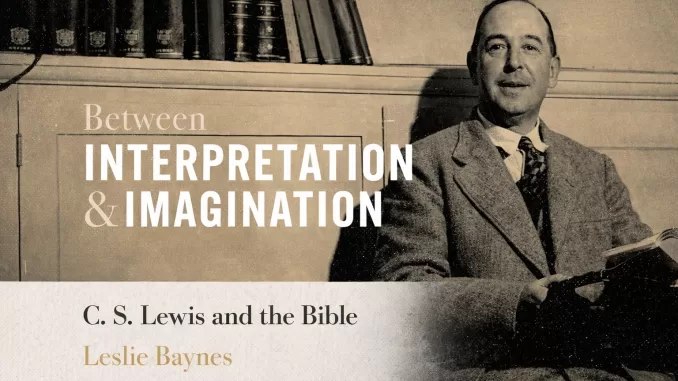
Hey, everybody! Welcome back to Tumnus’ Bookshelf, where we review any and all books written by, about, and inspired by CS Lewis, The Land of Narnia, and The Inklings. For this special edition review we will be looking at Between Interpretation and Imagination: CS Lewis and the Bible by Leslie Baynes.
TITLE: Between Interpretation and Imagination: CS Lewis and the Bible
AUTHOR: Leslie Baynes
PUBLISHER: Eerdmans
ISBN-10 : 0802874002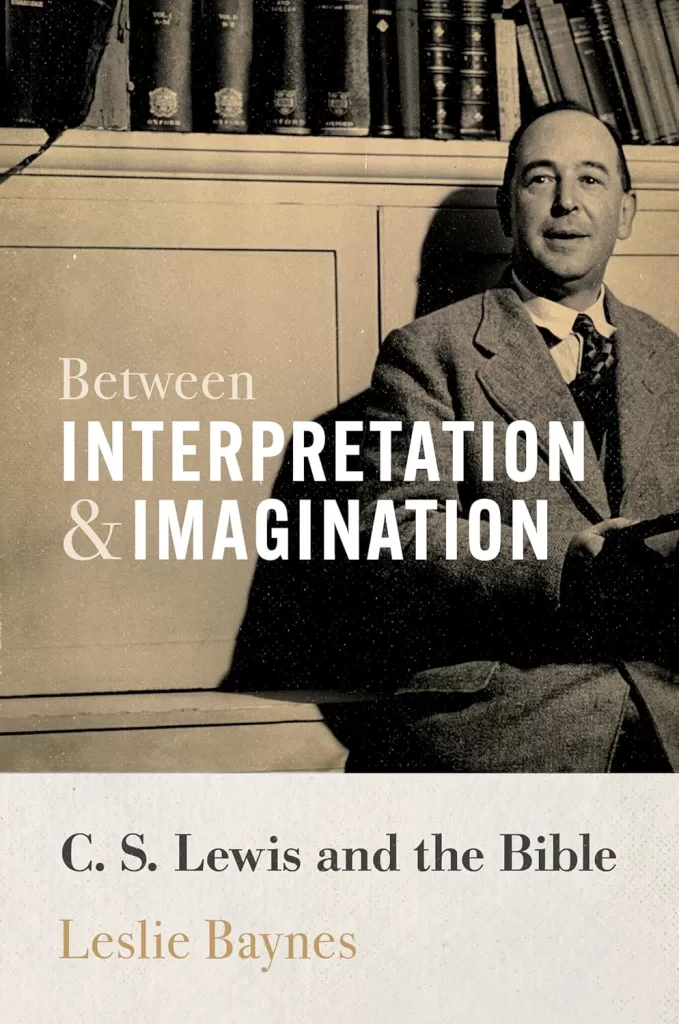
ISBN-13 : 978-0802874009
Summary:
New Testament Scholar Leslie Baynes guides readers though an all-new examination of the faith and writing of CS Lewis. Through unprecedented access to Lewis’ personal library, she looks at how Lewis wrestled with questions of faith and reason, and what works influenced his world view. Sparing no punches, she also grapples with the debate behind some of his key arguments. However, more than just a scholar, and an apologist, Lewis was also a mythmaker extraordinaire, and Baynes looks at how his faith and his love of scripture were seamlessly and subtly woven into his Narnian chronicles.
Review:
May have attempted to tell the story of CS Lewis and his journey to faith and for good reason. For almost a century he has remained a pillar of Christian thought and imagination, and with perhaps a few very vocal exceptions, has largely been respected by Christians and none believers a like for his clear, concise logical arguments. When most now a days are content to generate though more suitable for a post on social media, Lewis does not set out to give easy answer, but ideas with which to wrestle.
At the same time, his Narnia books remain a standard of fantasy literature, alongside his contemporary JRR Tolkien and other luminaries who came before. There has been discussion regarding just how “good” his mythmaking was compared to Tolkien in terms of careful attention to detail but it can’t be denied that the way he blinds faith and fantasy into seamless narrative in a way that feels familiar and yet also different is worthy of study. It’s easy for poor imitators to generate Narnia inspired stories, and even an examination of the number of fan fictions that exist, and even AI generated Narnia inspired stories, reveal a key missing trait that only Lewis had. That obvious X factor to Lewis work was his sincere faith, his mind that was nourished on a buffet of books, and a vivid imagination.
It is that very pillar that New Testament scholar, Leslie Baynes seeks to examine in her book Between Interpretation and Imagination: CS Lewis and the Bible. This is perhaps one of the first books about Lewis that examines his life and faith above and beyond the simple narrative we all know of his faith journey. It’s old news to many of us that upon losing his mother to cancer he became an atheist (if not technically an agnostic), and then later, thanks to the influences of Owen Barfield and JRR Tolkien became a deist and finally a Christian on motorcycle ride to the zoo. I’s easy to assume from what we know that between his boyhood and meeting Tolkien that as it for Jack for his faith.
However, he was an notoriously vociferous reader. Baynes reveals he didn’t just read books, Jack loved the, not only “devouring them” but studying them closely making notes in the margin line and fly leaves to better understand them. In being given access to his private library, Baynes reveals that Lewis grappled with the Scriptures long after hit appeared to have abandoned his faith. He may not have claimed to believe in God, but he wouldn’t be able to argue for or against him either way if he didn’t know about him through His Word. In fact, Lewis own commentary in letters and journals indicates that compared to the Myths and Legends of The Norse, The Greeks, The Romans and the Egyptians, he found the Bible to be “dull” in comparison, indicating he knew the book as well as he knew his favorite myths and legends and could “See” a difference. Baynes paints a picture of a man who didn’t close the door entirely to matters of faith, but perhaps like the Pevensies in Narnia, left it slightly a jar as it would be a very silly thing to shut oneself in.
Through equally careful and thoughtful examination, Baynes, also demonstrates how through his own writings both professional and private, Lewis was far from the “bigot” he’s portrayed by modern day critics. Lewis was certainly a man of his time, but in many ways, he was well ahead of them deploring racism, and antisemitism at a time when it wasn’t vogue. The mere fact he was willing to study the Psalms and look at them not just as poetry, but look at attempt to study them from the world view of the Jewish people was cutting edge scholarship for a Christian and a literary scholar at that time. Further, his condemnation or bigotry and racism was fueled by his faith in God, something far deeper then any bumper sticker slogan touted by politicians. He had blind spots due to his time, and she even examines what external factors lead to them, including Joy Davidman’s own opinions, a point that Baynes even humorously points out that if Lewis were really the misogynist he’s portrayed to be, Joy wouldn’t have been able to hold as much sway as she did in his life and work, especially in the completion of his magnum opus.
We also learn as a result which books of the Bible were the most critical to Lewis’ life of faith. Baynes reveals it was the Gospel of John, followed by Romans, and looks at what translations and commentaries illuminated his understanding the most. She concludes that it was through these two books that all of Lewis spiritual wring hinged, as well as his understanding and belief in God. The Gospel of John is perhaps the most “epic” of the gospels featuring Jesus at His most divine, to the point it’s the one Gospel with the most omissions in the notorious Jefferson Bible for that very reason. John even opens with a prologue that feels on par with those of Homer, Virgil, Dante, Milton, the Arthur legends or Beowulf, while, the Gospel of Matthew begins with the genealogy and Mark begins when He starts His Earthly ministry. Similarly it could even be argued that of Paul’s epistles Romans is the most foundational of the Church letter, and is often described as the Gospel in a nutshell due to how it describes in clear, concise points, who Jesus us, what He came to do and the gift He offers us through His Sacrifice.
From here, Baynes looks at how key translators like Moffat, and scholars influenced his understanding of scripture. She admits however this occasionally created a blind spot, and often times he was at odds with other leading scholars and critics of his day, especially when it came to matters of using terms like “myth” , “Story, and “Legends.” However, this later plays into one of her largest critiques of his work. in using only the Gospel of John, and in transposing it upon the other three synoptic gospels, Baynes contends that Lewis argues points in those three scriptures that aren’t actually said and as a result critics and other scholars may find fault with Lewis’ classic trilemma of “Lord, Liar, Lunatic.”
However, she makes it clear that is not her intent to dispute that Jesus performed miracles, in the synoptic gospels nor that he rose from the Dead. It also is not her desire to dispute the divinity of Jesus. Baynes points out that the divinity of Jesus is firmly established as Church doctrine and part of scripture, but rather that her intent is to draw attention to where Lewis could have strengthened his argument. She even acknowledges that in his humility, Lewis admitted apologetics could not supply all the answers and if it did there would be no need of faith.
Where the book really soars, is in Baynes careful analysis in the third half of the book where she looks at the biblical parallels in the books. This isn’t just through direct quotes but imagery and language characters use that reflect everything from Genesis to Revelation. Narnia isn’t just fantasy but Scripture in action. Of the books in the series, it is perhaps the easiest to see the parallels in The Magicians Nephew, The Lion, the Witch, and the Wardrobe and The Last Battle then the other books in the series. For example, we see how Shasta’s story parallels that of Moses and Joseph.
Equally refreshing is to see a woman take on “the problem of Susan.” She looks carefully at Susan’s journey of faith and examines how the ground work had already been laid, and reminds readers Susan, unlike the others isn’t dead and still can return to Aslan. However, Baynes goes one step further and notes how the seven Friends of Narnia ends up corresponding with the biblical number of completion, thus of the candidates Susan’s exclusion from The Last Battle made the most logical sense.
Baynes doesn’t just look at characters and dialogue, but the usage of biblical numbers or the incorporation of metaphors, used by church fathers. Some readers may think, for example, that the choice of an ape in The Last Battle as an antagonist is a simple arbitrary choice or a dig at evolution, but Baynes points to Martin Luther’s assertion that the devil is the Ape of God. Most intriguing was how she drew attention to Talmudic legend that spoke of the animals in Eden being capable of speech and losing it upon the fall of man. This is something I was unfamiliar with and admittedly I had merely figured it was a mere aesthetic choice as animals often talked in old fables and fairy tales. This analysis reveals a much deeper connection to it adds a layer of meaning to the text I hadn’t considered before. We see through this examination that maybe Lewis use of Scripture wasn’t as slapdash as critics may be but something deep and ingrained into his imagination that he couldn’t ignore, and it truly wasn’t forced as some may think.
This book is not exactly for the faint of heart. Some parts may be hard for readers, especially her arguments with Lewis. It certainly wouldn’t be one for new readers of Lewis, but for long time fans and scholars and those looking for a good literary debate this may be one to check out. It’s good to raise questions and investigate. In Between Interpretation and Imagination: CS Lewis and the Bible Baynes reveals how Lewis did that in his own work and invites readers to grapple with their own questions of faith and imagination.
4 ½ out of 5 shields.
Order the book from Amazon.com
Be the first to comment