

Some might blame Twilight. I know I do, and frankly, I love blaming Twilight for almost every annoying trope, cliché, and trend to come about in YA fiction and pop culture. Ever since that sparkly vampire first pouted his way into the hearts of teen girl squad members everywhere, it appears as if previously great literary villains are just “misunderstood” bad boys and girls in need of a little love and understanding, and had they been granted it, they could have become heroes. After all if a vampire, a character who previously went by the moniker “the Prince of Darkness” can be reduced to merely being a lovelorn teen who just wanted a date for the prom, then so to can it apply to any and all great villains in literature and film.
However, while Twilight may certainly take the proverbial lions share in YA fiction, the fact remains literature and pop culture seems to be in a gilded age of gritty deconstructionism. No longer is it about the battle of good and evil as was seen in Tolkien but power-hungry jerks fighting other power-hungry jerks for the world’s most uncomfortable chair in Game of Thrones. Even the Joker, a character who has canonically in the original Batman comic books abused his girlfriend/henchwoman Harley Quinn, killed Robin, paralyzed Batgirl, and tortured Commissioner Gordon, has been recontextualized reexamined as just as misunderstood man in need of love and acceptance in the movie The Joker.
But if there is one work of fiction that could truly be credited as launching an entire genre dedicated to reexamine if previously held heroes were really corrupt, and if villains were misunderstood it was Gregory Maguire’s novel Wicked. A retelling of The Wizard of Oz, it flips the script of the story and suggests that maybe the Wicked Witch of the West really wasn’t evil per say, just misunderstood and a victim of circumstance, while the institution, Oz itself made her that way and the heroes were either complicit in her downfall or inept.
To that end many Friends of Narnia wonder if it were at all possible that our beloved land of Narnia, and two characters in particular, Aslan and Jadis could ever be subjected to such a reexamining. After all, in an age of fan fiction, self-published novels, and niche markets with in niche markets, it’s certainly possible one could be told. Further the old adage in Hollywood and publishing is true, money talks, and if Wicked makes money as everything from a series of books, to a smash hit Broadway musical, to a blockbuster film, then why not inject a little Wicked DNA into Narnia?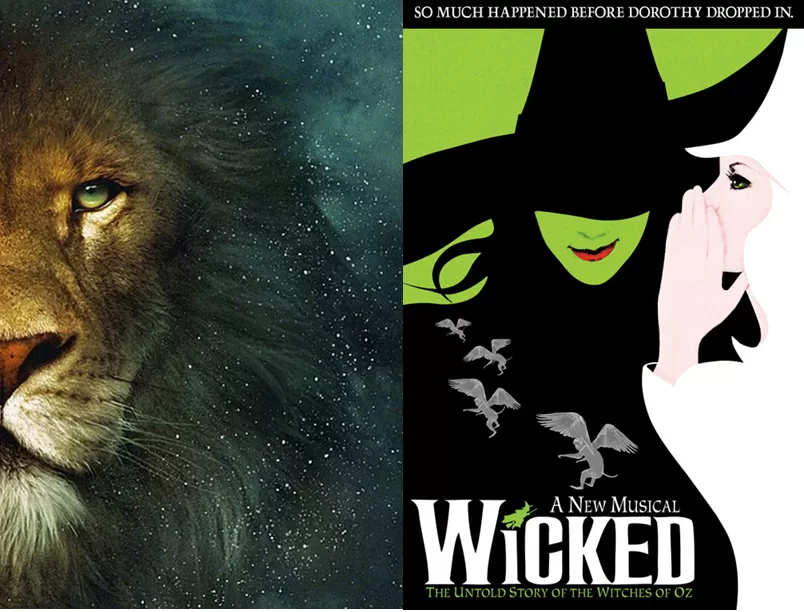
It’s a very fascinating question, but one that fundamentally fails to understand what is at the core of both The Chronicles of Narnia and The Wizard of Oz. While both books are beloved classics of the fantasy genre, and loved by children and adults alike they sprang from the mindsets of two radically different authors from different countries with divergent beliefs and values. Narnia was steeped in classical and medieval mythical traditions of Europe and tempered by Christian theology, while Oz was steeped in American Enlightenment-era thinking. Thus, while it certainly could be done, it couldn’t happen without “stretching” the text to its breaking point and incorporating views incompatible with those of Lewis that can easily be transposed onto the world of Baum.
Most know the story of The Wizard of OZ from the classic film from MGM studios starring Judy Garland. While the book and film differ in many ways, they do follow the same general plot line. A young girl named Dorothy Gale is picked up by a tornado in her small Kansas farm house and dropped on top of the Wicked Witch of the East in the land of Oz. Once there she embarks on a journey down the yellow brick road to find her way back home.
Along the way she makes new found friends with a scarecrow, a cowardly Lion, and a Tin woodsman. Each one wants something very different. The Scarecrow wants a brain, the Tin Man wants a heart, the Cowardly Lion wants courage and Dorothy wants a way to go home. They travel to Oz and meet with the Wizard who gives them a task. Kill the Wicked Witch of the West and he *might* consider granting their request.
All he asks is that they bring him her broom as proof of kill. They succeed thanks to a random chance occurrence of the Witch starting the Scarecrow on fire and Dorothy quickly reaching or a bucket of water to save her friend. In the process the water hits the witch, causing her to melt. Dorothy and her friends are accidental heroes and return to Oz, hoping the wizard will answer their pleas.
However, thanks to Toto pulling back the curtain when he reneges on his promise, and they see him for what he really is, a feeble old man, pulling and chords and levers with smoke and mirrors. In fact, when they see him, the tables are turned and they no longer tremble in fear of him, but he trembles at the little girl from Kansas, and her friends. The Scarecrow appropriately calls him a “humbug” an assertion the Wiard admits that he is.
They all want to know if he will keep their promises, but the Wizard begs,
“My dear friends…I pray you not to speak of these little things. Think of me, and the terrible trouble I’m in at being found out….No one knows it but you four–and myself…I have fooled everyone so long that I thought I should never be found out. It was a great mistake my ever letting you into the Throne Room. Usually I will not see even my subjects, and so they believe I am something terrible.”
He then shows them his bag of tricks, the costumes, props, and illusions he used to make everyone see something different in the room. Thanks to the emerald-colored lenses all had to wear when they entered the room, it made the illusion all the more convincing. He tells them his story, how he was born in Omaha, Nebraska, and was essential a traveling carnival huckster.
“The Wizard” had taken up ballooning and it was through that accident, when he got caught on a strong wind, he ended up in Oz. As he tells them,
“It came down gradually, and I was not hurt a bit. But I found myself in the midst of a strange people, who, seeing me come from the clouds, thought I was a great Wizard. Of course I let them think so, because they were afraid of me, and promised to do anything I wished them to..Just to amuse myself, and keep the good people busy, I ordered them to build this City, and my Palace; and they did it all willingly and well. Then I thought, as the country was so green and beautiful, I would call it the Emerald City; and to make the name fit better I put green spectacles on all the people, so that everything they saw was green….No more than in any other city…but when you wear green spectacles, why of course everything you see looks green to you. The Emerald City was built a great many years ago, for I was a young man when the balloon brought me here, and I am a very old man now. But my people have worn green glasses on their eyes so long that most of them think it really is an Emerald City, and it certainly is a beautiful place, abounding in jewels and precious metals, and every good thing that is needed to make one happy. I have been good to the people, and they like me; but ever since this Palace was built, I have shut myself up and would not see any of them…
I confess that while watching Wizard of Oz was certainly a staple of my childhood and I’ve read the book multiple times, I can’t say for certain that the book had impacted me or my imagination in the same way that CS Lewis’ Narnia books did. While I can admit to checking the back of closests for magical lands, growing up in the upper Midwest like I did, I avoided being outside in tornadoes on a matter of principle. I never wanted to go to Oz with Dorothy, Scarecrow, the Tin Man and Cowardly Lion the same way I wanted to journey to Narnia with the Pevensies. Nor did I want the counsel of Oz, the Great and Powerful or the advice of Glinda the Good the same way I long to rest between the paws of Aslan.
Wicked, much like the film Oz the Great and Powerful draws attention to the fact we knew all along. Oz is not really great and powerful. He’s an early 20th century carnival snake-oil salesmen looking to make a fast buck and split as soon as he can before he gets caught by the cops. At his core, he could be called anything: con artist, flim-flam, huckster, grifter, fraud, charlatan, anything but “wonderful” or “powerful”, “great” or even “Wizard”. Oscar Diggs, Oz, Professor Marvel, whatever you want to call him, can be depicted in such a fashion because that’s who he is.
As he admits,
“One of my greatest fears was the Witches, for while I had no magical powers at all I soon found out that the Witches were really able to do wonderful things. There were four of them in this country, and they ruled the people who live in the North and South and East and West. Fortunately, the Witches of the North and South were good, and I knew they would do me no harm; but the Witches of the East and West were terribly wicked, and had they not thought I was more powerful than they themselves, they would surely have destroyed me. As it was, I lived in deadly fear of them for many years; so you can imagine how pleased I was when I heard your house had fallen on the Wicked Witch of the East. When you came to me, I was willing to promise anything if you would only do away with the other Witch; but, now that you have melted her, I am ashamed to say that I cannot keep my promises.”
He is not a good, wise, and powerful god. He is not the creator of that land, nor is he the standard of absolute good. The fact he’d send a girl, a leaf golem, a primitive cyborg and a tame lion to kill a Witch is evidence of that fact. On top of that, long after he’s gone, the world of Oz continued without him through dozens of sequels with others assuming the role of authority with the Scarecrow not only being placed as interim ruler in the Wizard’s stead, but it’s later revealed in the sequel The Marvelous Land of Oz, that the rightful ruler of the land of Oz is a beautiful princess named Ozma.
Thus, as Max Lucado surmised in “ Of Oz and God” from When God Whispers Your Name,
“The moral of the Wizard of Oz? Everything you may need, you’ve already got. The power you need is really power you already have. Just look deep enough, long enough, and there’s nothing you can’t do…Sound familiar? Sound patriotic? Sound…Christian? For years it did to me. I’m an offspring of sturdy sock. A product of a rugged, blue-collar culture that honored decency, loyalty, hard work, and loved bible verse like, ‘God helps those who help themselves.” (No, it’s not in there.)…No need for the supernatural. No place for the extraordinary. No room for the transcendent. Prayer becomes a token…Communion becomes a ritual…And the Holy Spirit? Well, the Holy Spirit becomes anything from a sweet disposition to a positive mental attitude…It’s a wind-the-world-up and-walk-away view of God. And the philosophy works…as long as you work. Your faith is strong, as long as you are strong. Your position is secure as long as you are secure. Your life is good, as long as you are good…But, alas, therein lies the problem.”
The same is true for the Wicked Witch. She is a blank slate, a standard generic wicked fairy tale witch. As Gregory Maguire, the author of Wicked noted in a 2021 interview with Jacque Wilson of CNN,
“I have always found it fascinating, and written about this, that in trying to create a new sort of wonder tale for American children, Baum so successfully created new heroes, new models of virtue–not just the simple Dorothy, so clearly modeled after Wonderland’s Alice, but the Cowardly Lion, the Tin Woodman, the living Scarecrow. However, in dealing with plain and terrifying evil, he resorted to old-fashioned, even old-world ideas of wickedness–the Wicked Witch in her Castle. Thus, one might deduce, morally, we can applaud the arrival of a hero from any humble beginning, but of evil–because the story required evil–we must rely, even now, even in Baum, on stereotypes. That whole notion that the stereotype of evil is a shortcut to moral assessment–and thus a delimiting of the character of the adversary into only one attribute, wickedness–was where the novel WICKED began.”
He later related in September of 2021 to Chris Wiegland of the UK’s The Guardian in “The Changed the Ending, I was Aghast’: how we Made Wicked” that looked at the global smash hit that was the Broadway Musical Wicked, as far as what inspired him to write the story,
“If everyone was always calling you a bad name, how much of that would you internalize? How much of that would you say, all right, go ahead, I’ll be everything that you call me because I have no capacity to change your minds anyway so why bother. By whose standards should I live?”
With the Wicked Witch of the West we know nothing about her or who she is, aside from having a sister. Her sister, the Wicked Witch of the East is perhaps even worse, as in a fit of jealousy she curses a woodsman named Nick Chopper for refusing her advances causing him to lose his limps with very stroke of the axe, and given a replacement made of tin, effectively making him one of the earliest cyborgs in literature.
If anything, we remember her most from Margaret Hamilton’s iconic performance as she flew about on the brooms tick cackling “I’ll get you my pretty and your little dog too”, setting fire to the scarecrow, and threatening to kill a kid just because she felt she deserved the literary world’s most uncomfortable pair of shoes, second only to Cinderella’s glass slipper. A “misunderstood” Elphaba works because Oz is all about perception. Pull back the curtain and the godlike being is just a funny man in bad suit pulling levers. Thus, perhaps the Witch could secretly have been manipulated into being the villain for the sake of Oz so he’d look like the hero.
On the converse, thanks to CS Lewis we know a lot about Jadis in the Narnia books including who she is and where she comes from. She even has a story she’s claimed in order to argue she deserves the throne of Narnia.
As Mr. Beaver explains, when asked if the White Witch is human,
“”She’d like us to believe it…and it’s on that that she bases her claim to be Queen. But she’s no Daughter of Eve. She comes of your father Adam’s—” (here Mr. Beaver bowed) “your father Adam’s first wife, her they called Lilith. And she was one of the Jinn. That’s what she comes from on one side. And on the other she comes of the giants. No, no, there isn’t a drop of real Human blood in the Witch.”
However, for Jadis, and her world of Charn, her true origins and kingdom are sinister. Charn wasn’t a utopia, but rather, Lewis as a scholar of literature and myth understood just how a society can arise and fall. It never ends quickly. Rather, they may begin with the best intentions, like heroism, freedom, or chivalry, but eventually corruption, cruelty and decay seep into every facet of society. At that point great kings and leaders give way to tyrants and dictators and there is nothing left but a despot clinging to their last thread of power at the end when it finally collapses into ruin.
As Digory and Polly observe in the hall of statues.
“All the faces they could see were certainly nice. Both the men and women looked kind and wise, and they seemed to come of a handsome race. But after the children had gone a few steps down the room they came to faces that looked a little different. These were very solemn faces. You felt you would have to mind your P’s and Q’s, if you ever met living people who looked like that. When they had gone a little further, they found themselves among faces they didn’t like: this was about the middle of the room. The faces here looked very strong and proud and happy, but they looked cruel. A little further on they looked crueller. Further on again, they were still cruel but they no longer looked happy. They were even despairing faces: as if the people they belonged to had done dreadful things and also suffered dreadful things. The last figure of all was the most interesting—a woman even more richly dressed than the others, very tall (but every figure in that room was taller than the people of our world), with a look of such fierceness and pride that it took your breath away. Yet she was beautiful too. Years afterwards when he was an old man, Digory said he had never in all his life known a woman so beautiful. It is only fair to add that Polly always said she couldn’t see anything specially beautiful about her.”
This hall isn’t a wax museum. It is a reminder of the likes of what happened to Egypt, Babylon, Greece, Rome, and all the other nations that came before and will ever walk the face of this Earth from now until the End of Time. Eventually it all comes to ruin.
Aslan even tells Digory and Polly as much at the end of their adventure in Narnia,
“”When you were last here…that hollow was a pool, and when you jumped into it you came to the world where a dying sun shone over the ruins of Charn. There is no pool now. That world is ended, as if it had never been. Let the race of Adam and Eve take warning….Not yet, Daughter of Eve…Not yet. But you are growing more like it. It is not certain that some wicked one of your race will not find out a secret as evil as the Deplorable Word and use it to destroy all living things. And soon, very soon, before you are an old man and an old woman, great nations in your world will be ruled by tyrants who care no more for joy and justice and mercy than the Empress Jadis. Let your world beware. That is the warning.”
Aslan’s warning is prophetic, like visions of King Nebuchadnezzar and Daniel in the book of Daniel. While the King of Babylon has a dream of a great graven image with each section sprinting a different empire, each one made of a precious form of metal descending from gold all the way down to iron, and ending in Iron mixed with feet of clay. Daniel on the other hand sees these kingdoms as what they truly are in the form of great terrifying beasts. God shows him what is at the core of those kingdoms. It isn’t joy, justice or mercy, but sin, and they will all come to destruction.
In fact, it is the end of King Nebuchadnezzar’s dream that serve as the point of hope,
“In the time of those kings, the God of heaven will set up a kingdom that will never be destroyed, nor will it be left to another people. It will crush all those kingdoms and bring them to an end, but it will itself endure forever.”
With this level of cruelty and despotism at the core of Jadis, attempting to make her like Elphaba wouldn’t work. A Jadis motivated by Charnian Kitten loss because her dad made her get rid of her kitten when they learned her sister was allergic, and that kitten went onto be Aslan, isn’t Jadis. She isn’t evil because she misses her kitty. You can’t just paint a kitten in the corner of her portrait to cheer her up. She is a selfish, narcissistic megalomaniac who chose to commit omnicide rather than lose a war and for that, there can be no justification.
In fact, by her own words, Jadis stands condemned.
“It was my sister’s fault…She drove me to it. May the curse of all the Powers rest upon her forever! At any moment I was ready to make peace—yes, and to spare her life too, if only she would yield me the throne. But she would not. Her pride has destroyed the whole world. Even after the war had begun, there was a solemn promise that neither side would use Magic. But when she broke her promise, what could I do? Fool! As if she did not know that I had more Magic than she. She even knew that I had the secret of the Deplorable Word. Did she think—she was always weakling—that I would not use it?…That was the secret of secrets…It had long been known to the great kings of our race that there was a word which, if spoken with the proper ceremonies, would destroy all living things except the one who spoke it. But the ancient kings were weak and soft-hearted and bound themselves and all who should come after them with great oaths never even to seek after the knowledge of that word. But I learned it in a secret place and paid a terrible price to learn it. I did not use it until she forced me to it. I fought and fought to over-come her by every other means. I poured out the blood of my armies like water——The last great battle…raged for three days here in Charn itself. For three days I looked down upon it from this very spot. I did not use my power till the last of my soldiers had fallen, and the accursed woman, my sister, at the head of her rebels was half way up those great stairs that lead up from the city to the terrace. Then I waited till we were so close that we could see one another’s faces. She flashed her horrible, wicked eyes upon me and said, ‘Victory.’ ‘Yes,’ said I, ‘Victory, but not yours.’ Then I spoke the Deplorable Word. A moment later I was the only living thing beneath the sun.”
It should be kept in mind that they only person whose account we receive is that of Jadis. Unlike the Wicked Witch of the West, Jadis controls the narrative and thanks to her, there’s no one alive who can counter her story. As she boasts, her sister, dead for many millennia at that point, isn’t there to provide a rebuttal. Nor are there any witnesses to the battle.
As Lewis himself noted in the Preface to The Screwtape Letters with his titular demon,
“Readers are advised to remember that the devil is a liar. Not everything that Screwtape says should be assumed to be true even from his own angle… There is wishful thinking in Hell as well as on Earth.”
Like Screwtape, and like Lucifer in Milton’s Paradise Lost, she paints herself as the aggrieved party with her sister trying to usurp her throne. Further when Digory an Polly call her out for her cruelty and believe her actions ghastly she dismisses the concern. Everyone and everything on Charn were hers to do with as she saw fit. If she were truly trying to be sympathetic, she perhaps would have mentioned a lost lover who died in the battle, or a son murdered by her sister but that is not the case here.
However, while Jadis is unadulterated corrupt and unrepentant evil, she is nothing compared absolute good of Aslan. Unlike The Wizard, He is not all smoke and mirrors, and in fact from the way the characters speak of him he casts a greater presence on the story then the wizard does in Oz.
As he describes,
“And now, a curious thing happened. None of the children knew who Aslan was any more then you do, but the moment the Beaver had spoken these words, everyone felt quite different. Perhaps it has sometimes happened to you in a dream that someone says something which you don’t understand but in that dream it feels as if it had some enormous meaning-either a terrifying one which turns the whole dream into a nightmare, or else a meaning to lovely to put into words, which makes the dream so beautiful that you remember it all your life, and are always wishing you could go into that dream again. It was like that now. At the name of Aslan each one of the children felt something jump in his inside .Edmund felt a sensation of mysterious horror. Peter felt suddenly brave and adventurous. Susan felt as if some delicious smell or some delightful strain of music had just floated by her. And lucy got the feeling you have when you wake up on the morning and realize that it is the beginning of the holidays or the beginning of summer.”
We see this effect clearly in the prequel toThe Lion, the Witch and The Wardrobe,The Magician’s Nephew. Upon arriving in total darkness, Digory, Polly, Jadis, Uncle Andrew, and a seemingly unfortunate cabby named Frank and his horse Strawberry arrive in an empty world, devoid of all life, until at least they hear a song on the horizon. As the song continues light seems to grow on the horizon and they witness a new world takes shape.
Upon seeing that the singer is a Lion, creating an entire world out of nothing, each character has a different response as the four Pevensies do upon the mere mention of His Name. Digory, Polly, and Frank are filled with wonder. Uncle Andrew ignores what is in front of him and as he witnesses the creation of the world can only think of the dollar signs and plots to have Aslan killed by a game hunter so he can bring the wealthy to Narnia, treating it like a resort or health spa. Last of all is Jadis who hurls the bar from a lamppost at the Llion in abject terror and flees when she sees it has no effect.
However, while we get through the creation of Narnia a show of Aslan’s power, it’s through his interaction with Digory in which the boy confesses his part in bringing Jadis to Narnia that we fully see Aslan’s not absolute sovereignty over Narnia, but a further point of deviation from the Wizard as Dorothy even hopes , at least in the MGM movie as she and her friends journey to Oz that they will get their hearts desire if the Wizard is one who will be willing to serve, something that is abundantly clear he has no intention of doing unless coerced into doing so.
Not so with Aslan, not only does he put his plan into place immediately put into motion to protect Narnia, but to save it once and for all taking on the full role of the Suffering Servant. He is wonderful, great, powerful and compassionate. He can be called Creator, King, Savior, Redeemer, Sustainer, Hero, and Friend, because that’s who He is.
As Aslan tells the Animals,
“You see, friends…that before the new, clean world I gave you is seven hours old, a force of evil has already entered it; waked and brought hither by this son of Adam… But do not be cast down…Evil will come of that evil, but it is still a long way off, and I will see to it that the worst falls upon myself. In the meantime, let us take such order that for many hundred years yet this shall be a merry land in a merry world.”
It is here that Lewis flips the Oz narrative on its ear and reminds us where we can truly find help. Based on his reaction in letters asking about if Narnia could be made into a film he hoped among other things Aslan would not be rendered like the Cowardly Lion in the film version of The Wizard of Oz it is self-evident that he had knew both L. Frank Baum’s book and the film from MGM. His letters and journals even indicate he and Tolkien had gone to see such films as Disney’s Snow White and the Seven Dwarves, The Wizard of Oz and King Kong. Thus, the idea of characters making a request to a great and powerful being and getting something in exchange for services rendered was already part of the cultural lexicon.
However, when Aslan calls upon Digory to help protect Narnia from Jadis, for a brief moment Digory considers telling the Lion that he would help Him, if the Lion would save his mother. But because he witnessed Aslan’s divine power at the creation of Narnia, saw His might at how the Witch’s attack did nothing, and witnessed His majesty and sovereignty in calling the animals and selecting from among each of a male and female of each to give the gift of speech, he realizes quickly that Aslan is not someone with whom he can bargain.
This elevates Digory’s calling to being more than just a fantastic adventure or even a quest. Aslan’s command isn’t like the Wizard asking Dorothy and her friends to bring the broom of the Wicked Witch of the West. The Lion is calling upon Digory, like God called upon individuals in the Bible like Noah, Abraham, Moses, Gideon, David, Elijah and the prophets, Mary, Joseph and the Apostles to step out in faith and obedience. When God calls upon you, He doesn’t leave a space for negotiations and in fact, any attempts to argue with God often make Him angry. Noah couldn’t open up his planner and ask God to check back a week from Tuesday about building the Ark. Abraham can’t ask about five-star travel accommodations on the way to Canaan. Moses, Gideon, and David don’t get to put the call to lead God’s people to a vote. Mary couldn’t tell Gabriel “Can I think about it? I’m not sold on this ‘sword will pierce your heart too/suffering servant’ business. I’d like it if my Son could be a doctor.” And when a young man asked to follow Jesus and said he first had to go bury his father, Jesus told him, “let the dead bury the dead, you follow me”,
All one can do, like Digory, and like the heroes of the Bible is place their trust in Him and follow Him, saying, “thy will be done.” Yet, because of Aslan, Digory has laid his sins bare, his heart is cloven in two and upon saying yes to Aslan his heart breaks open and he asks of the Lion if he can do something to help his mother. It’s not a request for himself, or even a quid pro-quo, but an honest and sincere prayer for the health of his mother.
Unlike the Wizard of Oz who showed no concern for Dorothy and her friends, Aslan showed genuine compassion telling him,
“My son, my son…I know. Grief is great. Only you and I in this land know that yet. Let us be good to one another. But I have to think of hundreds of years in the life of Narnia. The Witch whom you have brought into this world will come back to Narnia again. But it need not be yet. It is my wish to plant in Narnia a tree that she will not dare to approach, and that tree will protect Narnia from her for many years. So this land shall have a long, bright morning before any clouds come over the sun. You must get me the seed from which that tree is to grow.”
It is at that moment Digory receives something from Alsan he hadn’t expected as the Lion cries great tears for him. His aunt is too busy caring for her ailing sister, and Uncle Andrew is locked up in his room. Save for Polly no one seems to show much compassion on this young boy hurting for his mother, and fearing she may die. That, coupled with Aslan breathing upon him gives him the strength to go forward as the Lion deeply loves and cares for him and for the land of Narnia.
Digory aided by Polly and the flying horse Fledge, formally Strawberry, travels to the mountain to retrieve the apple. It is upon that mountain where Digory is tempted again by the witch but this time resist her offer and refuses to steal the apple, all because she underestimated the friendship and loyalty between Digory and Polly. He returns, with the apple and plants it at Aslan’s request. Initially as the witch stole and ate one of the apples granting her immortality, Digory feels his quest was in vain. However, this is where Aslan reveals he is in full control as he tells him that since the witch stole an apple for herself, the smell is what will drive here off. He also tells him that if he had done as the witch said, and stollen an apple to take back for his mother it would have healed her, but it ultimately would have been better for her to die as it would have only prolonged her suffering not granted her healing.
But because Digory placed his faith and trust in Aslan, and obeyed his command, he allowed him to take an apple back to his mother with the promise it would heal her. The wizard goes back on his promise to Dorothy and her friends, only because he has no real power to grant wishes, aside from handing out a few trinkets from a bag, whereas Aslan, can do something much greater. The Great Lion hears the earnest prayers of a little boy and answers them, telling him, “Well done, good and faithful servant. You have been faithful in many things and great is your reward.”
The Wizard doesn’t kill the Wicked Witch himself because he’s a coward with no real power and only gives what he promised as he’s pushed into it. Aslan, could easily do everything himself, just as God could, but He chooses Digory to help make him not only a better person, but to make him His and help refine His faith.
As Devin Brown notes of this moment in A Life Observed: A Spiritual Biography of C.S. Lewis,
“Lewis the middle-aged, Christian author had a very different perspective on death from young Jack, the grief-stricken nine-year-old…In the end, Lewis gives the fictional mother and son the happy ending his own childhood lacked…Through the adventure, Lewis has Digory learn several important lessons which he himself learned only as an adult after his conversion.”
Further while the Wizard only assumes temporary authority, Aslan not only has absolute dominion over Narnia, he is the author and source of all absolute good in Narnia, including the Law of the Deep Magic, and the immortality granted by the apples. The fact he even says that in the arrival of evil in Narnia that the worst of the curse has will fall upon Him, means the Deeper Magic is already in play and this it is for this reason why he is able to offer Himself in sacrifice for Edmund. For Dorothy she can return to Kansas only upon completion of her journey, clicking her heels together and saying a phrase.
Salvation can only come to Edmund through a sacrifice, as He tells them,
“It means…that though the witch knew the deep magic, there is a magic deeper still which she did not know. Her knowledge goes back only to the Dawn of Time. But if she could have looked a little further back, into the stillness and darkness before Time dawned, she would have seen a different incantation. Then she would have known that when a willing Victim who had committed no treachery was killed in a traitor’s stead the table would crack and Death itself would stare working backwards.”
Further, He is the beginning and ending of all Narnia. With His song, Narnia has it’s being, and with His word, He calls the stars home, and bids father time to rise and wind his horn. When that world is gone, He bids the High King Peter to shut the door to the stable, and to the world known as Narnia once and for all. In contrast, the Wizard of Oz can’t even seem to operate a hot air balloon correctly.
Probing deep into character motivations is a relevant avenue of literary discourse and it’s fun for an evening of interactive fantasy RPG’s with your friends. However, what may work for a flat, static character like the Wizard of Oz or The Wicked Witch of the West might not work for Aslan and Jadis. To attempt to do so, would cause the narrative to break underneath the weight of a theology and a world view not supported by the text or by the Lewis’ theology.
In the end it’s not unlike what befell Tolkien when he attempted to write a sequel to The Lord of the Rings. In his unfinished novel, The New Shadow, hundreds of years after the death of Aragorn or the youth of Gondor had grown bored and decided to play at being Orcs and worshiping Sauron. He found it bleak, dreary, and utterly depressing and undercutting the theology of his work. Aslan can never truly be wicked, nor can Jadis be misunderstood. It can be done, but it won’t be Narnia. It would have to be like Phillip Pullman’s The Golden Compass, where it’s written as a criticism of Lewis and religion, in the same way that Game of Thrones was based on George RR Martin’s critique of Tolkien’s The Lord the Rings and his belief in absolute goodness, virtue, nobility, honor and authority.
But at the same time, in doing so, it is a very dangerous precipice upon which an author can walk, as to stray to far is to side of evil. One thing is for sure; it is not a spirit that could successfully take hold of Aslan or Jadis, without destroying the story or robbing it of its Deeper Magic. The nature of Aslan and Jadis isn’t just about fantasy narratives, or character alignment charts for an all-night RPG with your buddies in the basement. It’s about the struggle between Heaven and Hell.
He who is The High King of Heaven cannot be “Wicked”. And she who is aligned with the self-professed Prince of Darkness, can never be “misunderstood” and to conflate the two is a dangerous business. As the Teacher advises in The Great Divorce,
“The demand of the loveless and the self-imprisoned that they should be allowed to blackmail the universe: that till they consent to be happy (on their own terms) no one else shall taste joy: that theirs should be the final power; that Hell should be able to veto Heaven…Son, son, it must be one way or the other. Either the day must come when joy prevails and all the makers of misery are no longer able to infect it: or else for ever and ever the makers of misery can destroy in others the happiness they reject for themselves. I know it has a grand sound to say ye’ll accept no salvation which leaves even one creature in the dark outside. But watch that sophistry or ye’ll make a Dog in a Manger the tyrant of the universe.”
BIBLIOGRAPHY:
1st Kings. NIV Study Bible. Zondervan, Grand Rapids, MI. 1985.
1st Samuel. NIV Study Bible. Zondervan, Grand Rapids, MI. 1985.
Baum, L. Frank. The Marvelous Land of Oz.Barnes & Noble Press: New York, NY. 2019.
Baum, L. Frank. The Wonderful Wizard of Oz. Barnes & Noble Classics: New York, NY. 2005.
Brown, Devin A Life Observed: A Spiritual Biography of CS Lewis. Brazos Press: Ada, MI. 2013. pg. 40.
Daniel. NIV Study Bible. Zondervan, Grand Rapids, MI. 1985.
Dini, Paul and Bruce Timm. Batman: Mad Love and Other Stories.DC Comics: New York, NY. 2011
Exodus. NIV Study Bible. Zondervan, Grand Rapids, MI. 1985.
Genesis. NIV Study Bible. Zondervan, Grand Rapids, MI. 1985.
Gibson, Owen, and media correspondent. “CS Lewis Feared Film Would Ruin Narnia.” The Guardian, 29 Nov. 2005, www.theguardian.com/media/2005/nov/29/broadcasting.film. Accessed 15 May 2026.
Grenier, Cynthia. “Library : Philip Pullman’s Dark Materials.” Www.catholicculture.org, www.catholicculture.org/culture/library/view.cfm?recnum=4004. Accessed 15 May 2026.
Gunner, Shaun. “George R.R. Martin: “I Keep Wanting to Argue with Professor Tolkien.”” The Tolkien Society, 29 Sept. 2019, www.tolkiensociety.org/2019/09/george-r-r-martin-i-keep-wanting-to-argue-with-professor-tolkien/.
Harrisson, Juliette. “The New Shadow: The Dark Lord of the Rings Sequel That Almost Happened.” Den of Geek, May 2023, www.denofgeek.com/movies/lord-of-the-rings-the-new-shadow-dark-sequel/. Accessed 16 May 2026.
Isaiah. NIV Study Bible. Zondervan, Grand Rapids, MI. 1985.
The Joker. Dir.Todd Phillips. Perf: Joaquin Phenonix, Roberg Di Niro, Zazie Beetz, Frances Conroy, Brett Cullen, Carrie Louise Puttrello, Douglas Hodge and Dante Periera-Olson. By Todd Phillips and Scott Silver. Warner Bros./DC Entertainment. 2019. DVD.
Judges. NIV Study Bible. Zondervan, Grand Rapids, MI. 1985.
Lewis, CS. The Great Divorce.Harper Collins: New York, NY. 2001. Pg.136
Lewis, CS. The Last Battle.Harper Collins: New York, NY. 1994. Pg. 186-197.
Lewis, CS. The Lion, The Witch and the Wardrobe Harper Collins: New York, NY. 1994. Pg. 74-75,87-88,161-62, 168-69,178-79
Lewis, CS. The Magician’s Nephew. Harper Collins: New York, NY.1994. Pg.54-55, 69-71,212.
Lewis, CS. “Preface” The Screwtape Letters. Broadman & Homan Publishers: Nashville, TN.1996. Pg. 15.
Lucado, Max. “ Of Oz and God” When God Whispers Your Name. Word Publishing: Dallas, TX. 1994. Pgs. 124-127
Luke. NIV Study Bible. Zondervan, Grand Rapids, MI. 1985.
Matthew. NIV Study Bible. Zondervan, Grand Rapids, MI. 1985.
Milton, John. Paradise Lost & Paradise Regained. Signet Classics: New York, NY. 2001.
Moore, Alan, and Brian Bolland. Batman: The Killing Joke.DC Comics: New York, NY. 1986.
Oz The Great and Powerful. Dir. Sam Raimi. Perf. James Franco, Mila Kunis, Rachel Weisz, Michelle Williams, Zach Braff, Bill Cobbs, Joey King and Tony Cox. By Mitchell Kapner and David Lindsey Abaire. Walt Disney Studios. DVD.2013.
Starlin, Jim, Jim Aparo, and Mike DeCarlo. Batman: A Death in the Family. DC Comics: New York, NY. 1988.
Wilson, Jacque . ““Wicked” Author Gregory Maguire Returns to Oz – CNN.com.” CNN.com,2026, www.cnn.com/2008/SHOWBIZ/books/11/04/gregory.maguire/index.html.Accessed 15 May 2026.
Wiegland, Chris. ““They Changed My Ending, I Felt Aghast”: How We Made Wicked.”The Guardian, 27 Sept. 2021, www.theguardian.com/stage/2021/sep/27/changed-ending-how-we-made-wicked-defying-gravity-white-house-obamas-idina-menzel. Accessed 15 May 2026.
The Wizard of Oz. Dir. Victor Flemming. Perf: Judy Garland, Frank Morgan, Ray Bolger, Bert Lahr, Jack Haley, Billie Burke, Margaret Hamilton, and Charley Grapewin. By L. Frank Baum, Noel Langley, Florence Riverson, and Edgar Allan Woolf. WB/MGM. 1939. DVD.
Very thoughtful and in-depth. When I read the entirety of your remarks, the vast majority of things I would have commented on were dealt with. While “deconstructionism” is a good word for what’s going on in popular culture today, I think the elephant in the room is the idea of good and evil being returned to “balance” that we see in Star Wars, and that it is naivete to believe in “Happy Ever After”. Cultural Christianity even gave most non-believers a feeling that good would overcome evil someday, even if it was a Star Trek variety of secular humanistic paradise. People today are suspicious of “happily ever after” which is just plain sad.
Thanks, John!
I plan to look at both of those concepts in future essays.