
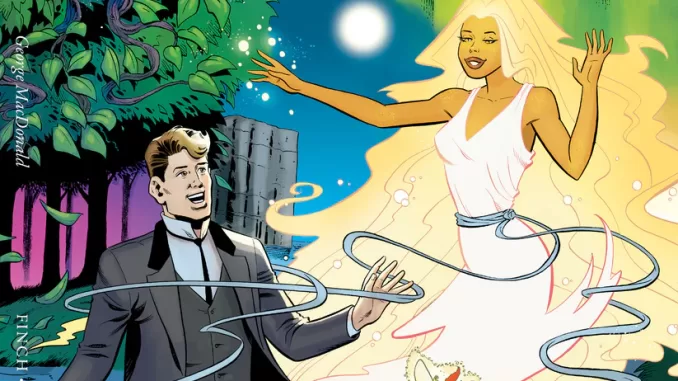
Hey, everybody! Welcome back to Tumnus’ Bookshelf, where we review any and all books written by, about, and inspired by CS Lewis, The Land of Narnia, and The Inklings. For this special edition review we will be looking at Cave Pictures Publishing’s graphic novel of George MacDonald’s Phantastes, adapted by Meredith Finch, Christine Norrie, and Andrew Pepoy!
TITLE:Phantastes
AUTHORS: George MacDonald, Meredith Finch ( adapted by)
ILLUSTRATED BY: Christine Norrie and Andrew Pepoy
COLORS BY: Triona Farrell, Pippa Bowland, and Jason Millet.
PUBLISHER: Cave Pictures Publishing, LLC.
ISBN: 978-1-949660-00-5.
Summary:
George MacDonald’s beloved fantasy classic Phantastes comes to life for a whole new generation to discover in a brand-new graphic novel. Before his 21st birthday, young Anodos lost his father, and at once is seized by the pangs of the loss of childhood and the call towards maturity. While going through his fathers things, he opened and old desk with a skeleton key. While reading alter form his father, a mysterious fairy appeared to him, and ushers him into the first steps of his journey. Now, follow Anodos as he embarks on a journey to find the land of Fairy and answer the secret yearning deep within his heart for love and adventure. Adapted by Meredith Finch and illustrated by Christine Norrie and Andrew Pepoy, the realm of Fairie comes to life as never before with vivid images that plunge from the depths of the darkest nightmares to the heights of the sublime at the resolution.
Review:
The graphic novel adaptions of The Hobbit, A Wrinkle in Time, and Coraline by Chuck Dixon and David Wenzel, Hope Larson and P, Craig Russell have been wildly praised by critics, and fans of the original source material and held up as seminal graphic novels that capture the magic and wonder of the books by which they were inspired while Friends of Narnia have a soft spot for Robin Lawire’s adaptions of The Magician’s Nephew and The Lion, The Witch and The Wardrobe. But while these graphic novels certainly have their place in the libraries of fantasy fans, the fact remains that for a long time, the masterwork of the author who inspired the likes of Tolkien, L’Engle, Lewis has remained elusive, as if it were unadaptable in any medium. Until now.
Cave Pictures Publications, an independent, creator owned and crowd funded publishing company has produced a breathtaking adaption of MacDonald’s Phantastes, the book that CS Lewis credited as the “baptism of his imagination”. Lovingly adapted and beautiful illustrated this timeless tale comes to life as never before, and captures the wonder, mystery and deep spirituality of MacDonald’s masterpiece, and it’s a welcome addition to the world of fantasy graphic novels.
Having read MacDonald’s work, I can admit for younger reader the original novel may be a difficult journey upon which to embark, and thus it’s easy to get lost in the trees as you gaze at his beautiful forest. It is perhaps one of the benefits of a graphic novel. MacDonald wasn’t just a fantasy writer or a mythmaker, he was conveying deeper truths to his readers and this graphic novel adapted by Meredith Finch conveys those truths perfectly.
It’s a well-established fact that much like Bunyan’s Pilgrim’s Progress or Caroll’s Alice in Wonderland, that MacDonald wrote Phantastes to feel as though it were in the similitude of a dream. This means the book takes on a stream of conscious narrative as we follow Anodos, and in fact he’s the only character with a given name. Finch trims the fat off the narrative, cutting out the non-sequiturs that add little to the plot, such as removing the long passages dedicated to Anodos reading a book that he finds moving. This allows for the graphic novel to focus on the key narrative moments in the story, capturing the most iconic moments in the story. It’s like with a graphic novel adaptation of Pilgrim’s Progress: there’s little need to include the moments from Bunyan’s novel that are more about the tensions with the Church of England and Protestant Reformers like Bunyan of the time, and more about getting to the spiritual heart of Christian’s journey to the Celestial City.
The same is true here. It’s not about going over every facet of Anodos’ journey, it’s about following him along on his adventure and watching how he changes and grows as a person. Due to the fact MacDonald already employed a first-person narrative, it’s already tailor made for narrating a graphic novel as modern day graphic novels favor the first-person narrator to the omniscient William Dozier style narrations from the Adam West Batman series. As a result we feel the heart break more when Anodos breaks the maidens glass ball and brings her to tears, and sense his anguish with out the brief aside that has nothing to do with the story, and then rejoice more when they reunite during the story’s final chapter. We thrill at our hero’s battle against the giants and mourn for his fallen brothers as the vignettes with them are brought into focus. We feel his anguish when he learns his stone maiden’s love belongs to another, and mourn with her and her knight when it appears he makes the ultimate sacrifice to defeat his shadow self.
While Finch does an amazing job adapting McDonald’s prose to the formulate the story would be nothing with out it’s stellar art work. In fact, as soon as I received my PDF copy for review, I found myself not unlike Anodos. The minute I met the fairy who initiates Anodos into the fairy land, I was hooked. She was rendered so beautiful, alluring, ethereal, and fantastic that like him, I felt her calling to me to come along on a journey. Unlike him, I didn’t actually enter fairy land, but I did the next best thing: I ordered a physical copy of Phantastes, not only to support the project, but because one can’t fully appreciate a graphic novel on a screen like they can in physical format. There is something about slowly turning each page and carefully looking at each line and shading and appreciating it as if one were walking through an art gallery and allowing those pictures to tell you the story before reading the narrative itself. And what I saw as I went on this journey through MacDonald’s beloved classic is on the same level with what I expect from mainstream publishers like DC, Marvel, Image, IDW, and Dark Horse.
Appropriately the book alternates artists at key points in the story. Chapters 1-3, done by Christine Norrie have a gritty 19th century Gothic aesthetic that not only grounds Anodos real world in a sense of mystery but places the realm of Fairy in the clearly fantastic. Her Anodos is trim, charming, handsome, and almost reminiscent of Mike Mignola’s Bruce Wayne in such Elseworlds’ tales as Batman: Gotham by Gaslight and Batman: The Doom that Came to Gotham, while her use of shadows and shading vividly capture his battle with his shadow self. Even the maiden with flowers who tells him which tress to avoid in the forest is a thing of beauty, and for a moment when Anodos is with her and her mother, you almost wish he could rest and linger a little longer.
One intriguing detail in this adaption is as Anodos takes his first steps into Fairy Land, Norrie abandons the use of the standard grid panels common in comic books, graphic novels, and manga. It only occurs again at three other moments, once when he finds lodging after his passage through a deep dark forest, the second during his battle with his shadow self in which the grid takes on a sharp jagged appearance, and the third during his time at the fairy castle and his departure. This absence of the grid panels allows the images to blend and blur into each other, retaining the stories dream like stream of consciousness.
But the story isn’t just a fantasy adventure, it’s a spiritual journey and as Anodos continues on his journey in chapters four through six, Andrew Pepoy steps in to tell the rest of the story. His Anodos cuts a more striking heroic figure akin to Steve Rogers or Clark Kent. Noble, selfless, we see him becoming a better and more virtuous person. Graphic novels featuring different artists on a different chapter is nothing new, and so long as it’s anchored by a solid story as the throughline it doesn’t distract from the story at all, but only enhances it. In the case of this graphic novel, timeless classic by George MacDonald makes for the best throughline it could ask for.
Filling this story with life are the colors done by Triona Farrel, Pippa Bowland and Jason Millet. Much like the pencil and ink work, the colorists on this project take turns to excellent effect. Farrell captures the darkness and shadows of the books first two chapters, making the reader feel as if the shadow is lurking every where. In contrast Bowland on chapter three, imbues at stage of the journey of Anodos with a certain surreal quality that makes it appear more mind bending. Then at last Millet concludes on chapters four through six, in which the colors are more warm, vibrant and inspiring pointing us to the stories grand conclusion. Like a beautiful tapestry, these subtle differences perfectly weave into each other.
If MacDonald’s novel baptized Lewis’ imagination, then this graphic novel is sure to give your imagination the spiritual enrichment it needs. This is a fantasy graphic novel as it should be. Equal parts gothic and fantastic, dark and yet beautiful, if you haven’t experienced the novel that inspired CS Lewis or were intimidated by the text, then this beautiful graphic novel is the perfect door way to one of the grand masters of the fantasy genre. If you have read it, then it is sure to only enhance your journey with Anodos, and make it appear more wondrous than you can ever imagine
Five out of five shields.
Order the book from Cave Pictures Publishing.
i read this book as a kid and didn’t really understand it. it’s freely available on Gutenberg so i should re-read it now if only i can get over my reading slump
I’d recommend the graphic novel for that very reason! I loved the novel, but even I can admit for many readers, the stream of consciousness narrative style can be hard to follow. This can give you the meat of the story with out the fat.
I have been looking for Phantasies at every bookstore I’ve gone to ever since I saw The Most Reluctant Convert but I can’t seem to find it!