
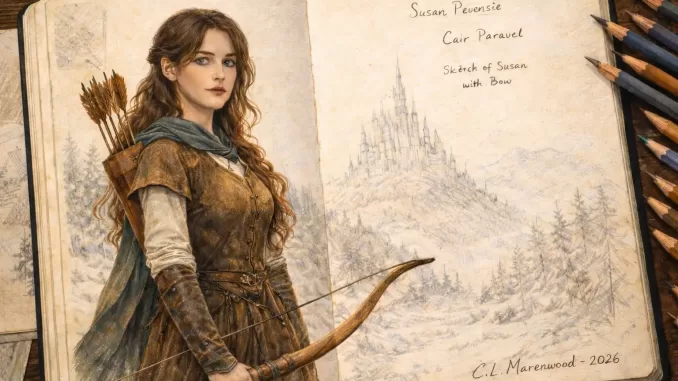
One question keeps coming back whenever Susan Pevensie comes up: was she supposed to seem younger than she does in the films?
It is an understandable question. Susan sits in an in-between place in the books. She is clearly still one of the Pevensie children, but she also comes across as older, steadier, and more cautious than Lucy and Edmund.
What matters, though, is that Lewis never frames Susan’s story around puberty. That part gets brought into the conversation from somewhere else.
What Lewis actually gives us
In The Lion, the Witch and the Wardrobe, Susan is the second oldest of the four children. Lewis does not give us exact ages, but he does give her a certain kind of presence. She is cautious. She thinks about safety. She often watches over Lucy.
None of that reads like a very small child. Susan feels more like an early teenager than a little girl. But Lewis never ties her place in Narnia to physical development.
Where the debate really comes from
Most of the confusion comes from The Last Battle. By then, Peter, Edmund, and Lucy return to Narnia one last time, but Susan does not.
The others say she is interested in “nylons and lipstick and invitations.” Readers have argued over that line for years. Some take it as Lewis criticizing her for growing up. Others read it as a shallow phase, not a final sentence on her soul.
What the passage does not say is that Susan is shut out because her body changed. The break is spiritual and emotional, not biological.
The films make the question louder
Anna Popplewell was older than book Susan probably reads on the page, but that is normal in film. Studios cast older teenagers and young adults as younger characters all the time, especially when production runs for years.
More importantly, what Popplewell brought to Susan still fits the books pretty well. Her Susan is thoughtful, protective, and slightly cautious. That is very much part of who Susan is on the page.
There is a real-life layer here too
I do think this conversation brushes against something real. Girls do not all develop at the same pace, and when someone looks older before she feels older, other people start projecting things onto her. That can be uncomfortable, unfair, and confusing.
That is part of why I am wary of reading Susan’s story through physical appearance alone. It is too easy to confuse what other people see with what a girl is actually going through.
Susan’s story is not over
Susan is practical, sometimes hesitant, and sometimes slow to trust what she cannot explain. But she is also brave, loyal, and present in some of the hardest moments her family faces.
Lewis never wrote the end of her story. That matters. Susan is not a warning about becoming a woman. If anything, she is one of the places where Narnia leaves a door open.

Incredible artwork with the story. I have also experienced something similar, regarding when someone is no longer allowed in Narnia. Frankly, it surprised me that the person was even bringing this up. Thank you for writing about this topic in a way that I never could.