
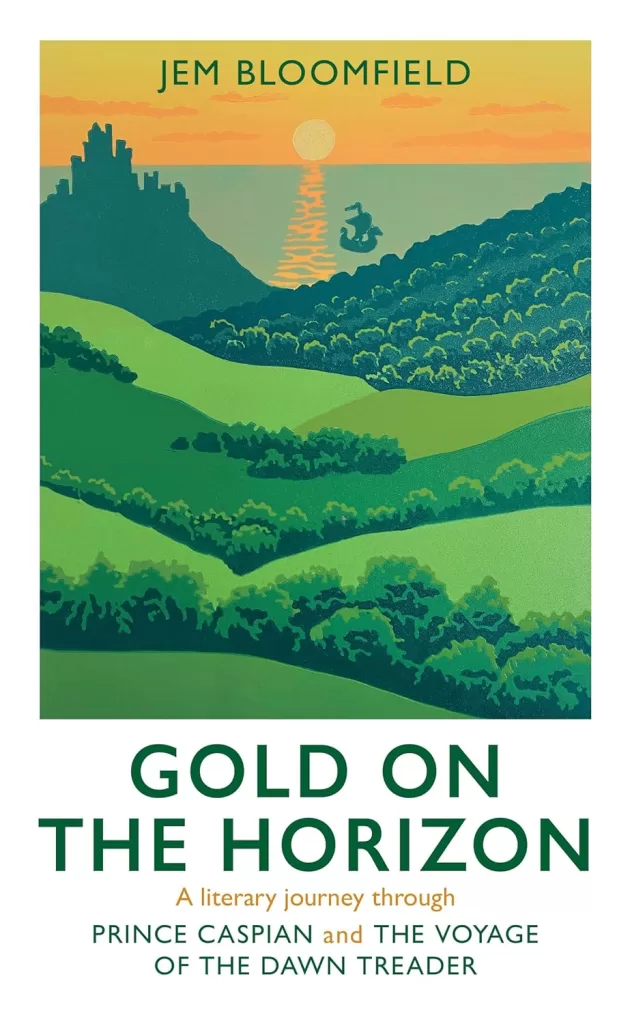
Hey, everybody! Welcome back to Tumnus’ Bookshelf, where we review any and all books written by, about, and inspired by CS Lewis, The Land of Narnia, and The Inklings. For today’s review, we will be looking at Jem Bloomfield’s book Gold on the Horizon: A Literary Journey Through Prince Caspian and The Voyage of the “Dawn Treader”.
TITLE:Gold on the Horizon: A Literary Journey Through Prince Caspian and The Voyage of the “Dawn Treader”.
AUTHOR: Jem Bloomfield
PUBLISHER:Darton, Longman, and Todd, LTD.
ISBN-10: 1915412811
ISBN- 13: 978-1915412812
Summary:
Embark on another literary journey through the land of Narnia with Jem Bloomfield in the follow up to Paths in the Snow. Examining the Narnia novels Prince Caspian and Voyage of the “Dawn Treader”, Gold on the Horizon: A Literary Journey Through Prince Caspian and The Voyage of the “Dawn Treader”, unpacks the first two books in the unofficial Caspian trilogy and examines them as both heroic epics and spiritual journeys in which our heroes and heroines are tried tested and made better not only for Aslan’s service in the world of Narnia, but pointed in the direction to find Him in ours.
Review:
In his introduction to Paths in the Snow, Jem Bloomfield spoke about how his CS Lewis club discussed not only The Lion, The Witch and The Wardrobe at length, but all seven books in the Narnia series. Thus, it stands to reason that Paths in the Snow, like the story it was analyzing would only be the beginning of the adventure. There are six more books after all, and each one feels ripe for examination. However, some books, like the direct sequels to The Lion, The Witch, and The Wardrobe are episodic in nature, and at times tend to move at a slower pace as the heroes navigate their quest. However, what if this pace wasn’t a flaw, but a feature for a greater story? What if by the very nature of both the heroic epic and the spiritual quest the two stories complement each other and set the stage for something greater?
Following suit with the BBC productions of Narnia, Bloomfield bundles Prince Caspian and Voyage of the “Dawn Treader” together into one book. In many ways it makes sense as the two books do follow each other very closely and in in many ways end up forming two thirds of a trilogy with The Silver Chair in what is known as “the Caspian Trilogy”. Unique this time around is that he doesn’t do a systematic chapter by chapter analysis of the novels Prince Caspian and Voyage of the Dawn Treader but rather appears to “group” key scenes and moments together in the novel. A vast majority of Prince Caspian is told in flash backs, while there are portions of Voyage of “Dawn Treader” that are largely told through Eustace’s diary and aren’t necessarily as deep in symbolism or literary connections. Voyage even has an entire passage where it describes them stopping at an island and nothing happening save for the fact that they are sick. A nice anecdote that adds some realism, but not one containing much in terms of literary or spiritual depth.
Thus, in analyzing the literary, mythical, and biblical allusions that exist in these books, grouping the two books together allows for a much more coherent analysis. Notably, Bloomfield dispels the notion that the Narnia books are allegories and uses the two texts to back it up. He points out that unlike The Lion, The Witch, and The Wardrobe that directly parallels the Death and Resurrection of Jesus Christ in the character of Aslan there isn’t a strict 1 to 1 correlation in Prince Caspian or Voyage of the “Dawn Treader” with a particular Bible story. The Narnia books are fantasy novels first and foremost not just repackaged Sunday school lessons and thus should be appreciated as such.
Bloomfield reintroduces readers to the Pevensies and presents them as archeologists and shows how their search through Cair Paravel and later Aslan’s Howe feel not unlike either the real-life expedition of Howard Carter into the tomb of King Tutankhamun, or H. Rider Hagrid’s novel King Solomon’s Mines. There is a sense of wonder to their discovery, but also a sense of time and place. As he draws attention to this notion Bloomfield illuminates how this is something that made Narnia unique to children’s fantasy novels at the time. Oz, Wonderland, and Neverland seemed to exist in a state of perpetual bliss, whereas Narnia, like Tolkien’s Middle-earth and even our world was subject to the ravages of time. Castles fall into disrepair and crumble into ruins. Erosion chips a way at a peninsula and transforms it into an island. In doing so we see how Lewis further played with the ideas of the passage of time present in The Lion, The Witch and The Wardrobe.
Like most fans, I know that when I first encountered Prince Caspian, I didn’t think much of Susan’s response to return. After all, she seemed sad about a horse she used to have in Narnia. However, Bloomfield looks at her not only as a horse crazy girl akin to the ones in Black Beauty and National Velvet but compares her lament not only for her house but for the decline of Narnia to an Anglo-Saxon lament, akin to Eowyn at the grave of her brother in the film version of The Two Towers. Through Bloomfield’s examination of her as an Anglo-Saxon horse rider lamenting this great loss, it adds layers to her character and makes her eventual loss of faith in Narnia all the more poignant: not only was it a matter of trying to grow up or pursue worldly desires, but this was a tender hearted person who loved Narnia, saw it fall into decay, mourned beloved friends as a result, but perhaps when she was told she could never return to Narnia chose to close herself of in an act of emotional self-preservation.
Lucy’s dance in the woods, and subsequently the romp with Aslan through Narnia to free the captives are examined through the lens not of a pagan bacchanale as some are quick to do, but rather a courtly English country dance wherein there are rules, structure, form, and more importantly a sense of celebration and community, while also being seen as a prophet bringing the news that Aslan is near, while later in Dawn Treader Bloomfield even compares her to the late Queen Elizabeth II of England. Her brother Peter is even seen through the lens of dichotomies of the chivalric Arthurian hero and the school boy story Tom Brown’s School Days in how he conducts himself in single combat against Miraz.
Most intriguing is his examination of the undragoning of Eustace. Many scholars and critics are quick to note the most obvious parallel, with the transformation of Fafnir in the Icelandic Volsungs Saga into a Dragon, a story that also greatly inspired Tolkien, in particular with Thorin Oakensheild’s dragon sickness. Here Bloomfield takes a different approach to Eustace comparing it to the Spenser’s The Fairie Queen and the physical struggle of the Knight Redcross with the metaphorical struggle inwardly of Eustace to slay his dragon-like thoughts. Considering Lewis was as equally influenced by Spenser as he was the Icelandic Sagas, it isn’t surprising that the tale would have some influence on his works.
Reepicheep is even elevated from being a mere swashbuckling mouse to being a chivalric hero, complete with his fealty to Queen Lucy, akin to the Knights of the Sangreal. Bloomfield does draw somewhat from Michael Ward’s controversial Planet Narnia in his look at Voyage, namely looking at it as a Solar novel. While I am a bit of a Planet Narnia skeptic, I can certainly see the points Bloomfield alludes to and Lewis does refer to the Dawn, and the Sun considerably in the Voyage of the “Dawn Treader”. As a result, Bloomfield postulates that Dawn Treader is not just a maritime adventure but a celestial journey akin to Lewis’s space trilogy, just told in a more medieval world.
It is a very fair point, and one I never considered before. Like in Out of the Silent Planet, and its sequels the travelers in Voyage encounter strange worlds, incredible creatures and more important they meet the physical embodiment of celestial beings. These journeys aren’t just physical in nature but spiritual and the experience broadens the heroes understanding of their place in the cosmos. Further there is even something nearly angelic about the likes of Ramandu in Voyage akin to the Oyarsa in Out of the Silent Planet that hints at their divine nature.
Even the episodic nature of Caspian and Voyage becomes much more appropriate when Bloomfield examines them through the lens of the idea of the heroic quest. Not only is Caspian, like Telemachus on a personal quest to find the Lost Lords, but Reepicheep is on a spiritual quest to Aslan’s country. Quests were episodic in nature as the heroes encountered different obstacles to not only prove their strength but to challenge and sharpen their character. Bloomfield then compares these locations not only to the sorts of locations seen in a quest but to Bunyan’s Pilgrims Progress where in Christian’s spiritual quest each stop helps strengthen Christian’s faith and prepares him for Heaven.
He reaches the conclusion of his literary journey by appropriately drawing a parallel between the Dark Island and Coleridge’s Rime of the Ancient Mariner, in particular with the appearance of Aslan as the albatross. He only spends a brief moment on the passage, and justifiably so. Other authors and scholars have picked up on that connection and expounded upon it thusly. Bloomfield’s goals are to draw attention to literary connections that others might not have considered before.
In this case, he looks at the concept of the sea voyage, in particular those from classical mythology. He traces the names of the lost lords to their root words in various languages including French, Greek and Latin before arriving at the meeting with Ramandu’s daughter who is an inversion of the enchantress of the sea voyages of Greek myths who instead of brining harm to the heroes helps them find rest and nourishment before continuing as well as winning the heart of Caspian, drawing attention to how Lewis gives a happy ending to the classical mariner by drawing on the medieval idea of keeping a vow to return to her, unlike Jason who left Medea at his earliest convenience.
It all ties together in the meeting with Aslan at the end. Much like how The Lion, The Witch, and The Wardrobe set up the idea of two worlds meeting, both Prince Caspian and Voyage of the “Dawn Treader” brought two different worlds together as well, the heroic epic journeys of classical myth with the religious quest of the Arthurian legend. It was Aslan who provided the healing to Eustace, like the Grail to the Fisher King. It was Aslan, like the Golden fleece of Jason that was waiting for them at the end of the journey. It becomes a fitting conclusion to the analysis as when being sent back to their world, Edmund, Lucy and Eustace learn that Aslan is known by Another Name in our world and that while the time for the older children to journey to Narnia has ended, the time has come for them to begin a quest of a different kind.
I’ll admit that while I may have initially wanted a chapter-by-chapter analysis of the books Prince Caspian and Voyage of the “Dawn Treader”, Jem Bloomfield did an amazing job uniting both books under one common theme of the epic quest and drawing attention to the overarching themes and motifs that I didn’t feel there was a single “episode” from either novel missing. Further, as some moments of the books have been discussed at length by other authors, by examining both books together Bloomfield gets the chance for the rest of the story to shine.
If Paths in the Snow was a careful trek through the snow-covered land of Narnia, then Paths of Gold: A Literary Journey Through Prince Caspian and The Voyage of the “Dawn Treader” is more akin to a treasure map. Like any good map it isn’t going to point out every nook and cranny on an island but rather point out key features to help you on the way. Considering how Bloomfield ties it all together in the end with the meeting of Aslan and the beginning of Lucy and Edmund’s true quest in our world, it’s a worthy parallel, as Gold on the Horizon, like the books it examines isn’t a devotional, but rather a map to help us on our own journey and reach that same treasure in the end.
Five out of Five Shields
Buy the Book on Amazon.com


Be the first to comment