I’ll admit I was crestfallen when I saw the image that appeared to be updating The Magician’s Nephew form the novel’s original setting. While Lewis merely describes the setting for The Lion, The Witch, and the Wardrobe with a mere reference to the children being evacuated during the Blitz, he, rightfully assumes for that first generation of visitors to Narnia, that this is common knowledge. They need to further explanation about the horrors, no to they want it. It’s about moving them beyond that point.
In contrast however, he gives several key hints as to when The Magicians Nephew is set in the opening, as he notes,
“In those days Mr. Sherlock Holmes was still living in Baker Street and the Bastables were looking for treasure in the Lewisham Road. In those days, if you were a boy you had to wear a stiff Eton collar every day, and schools were usually nastier than now…”
This, along with the timeline Lewis created, firmly sets when the book happened. It’s a London during the height of the Industrial Revolution, one that Digory describes as a “hole” after growing up in the English country side due to the soot in the air. I’ve gone on countless trips to Narnia since I was ten, and thanks to having developed a love for classical literature, as I re-read this passage, not only can I picture Holmes and Watson racing off to solve a mystery, or the Bestable children searching for treasure, but a whole host of wonderful friends from that time. If I happen by a book shop while waking down this street, I’d fully expect Professor Arronax expounding on his adventures with Captain Nemo, or Abraham Van Helsing relating his hunt for Dracula, while in a parlor of a nearby apartment, I could picture HG Wells nameless time traveler going to a remote future to encounter the Eloi and the Morlocks. A trip to Camden town might even require a stop off at Ebenezer’ Scrooge’s old Counting House, now under new management of Tim Crachit. A shudder can run down my spine as I expect Mr. Hyde to be lurking in a corner somewhere. With Diggory’s Eaton collar and Polly’s pinafore dress, I half expect them to be schoolmates with Mary, Colin, and Dickon from The Secret Garden and swap stories with each other. Even a glance up at the soot filled sky fills me with wonder as I expect Peter Pan to lead the Darling children to Neverland, or Mary Poppins to swoop down with her umbrella at the Banks residence. I would even not be surprised to take a walk through the country side and see the fabulous Thaddeus Toad of Toadhall from Wind in the Willows race by on his new motor car.
By placing The Magicians Nephew in this time period, Lewis reminds the reader of the wondrous adventures that came before, and reminds us to believe that anything can happen. As Dickens says regarding why he reiterates that Marley was dead to begin within A Christmas Carol,
“This must be distinctly understood, or nothing wondrous can come from the tale I am about to relate.”
Like the Wood between the Worlds seemingly containing thousands of possible worlds to visit that small, subtle reference to Holmes and the Bestables places it in a version of 19th century London that features countless stories and adventures to encounter that make that London come alive and feel more fantastic. It was almost like Lewis, Berrie, Stoker, Stevenson, Travers, Burnett, Dickens, Wells and Verne captured the spirit of the era and populated the world with their dreams and visions and make that city come to life and made them landmarks of that place and time.
Fact of the matter is, while there were certainly wonderful characters in fiction and literature to come out of the 1950s and 60s, they carry a weight of a different era then the Gothic literature of the 19th century. I am less likely to think of the cavalcade of characters from the likes of Doyle, Nesbitt, Verne, Wells, Dickens, Stevenson, Stoker, Shelley, Berrie, Travers, or Burnett in the 1950s and 60s, and more likely to think of Silver Age comic book superheroes like The Flash, Green Lantern, The Fantastic Four, Spider-Man or The X-Men, or monsters like Godzilla or the Incredible Hulk who were born out of the Atomic age paranoia instead of the Bestables, while the Cold War era is more inclined to make me think of James Bond, Tony Stark, Nick Fury, or Natasha Romanova or even a time-traveling Captain James T. Kirk and Mr. Spock then Mr. Holmes.
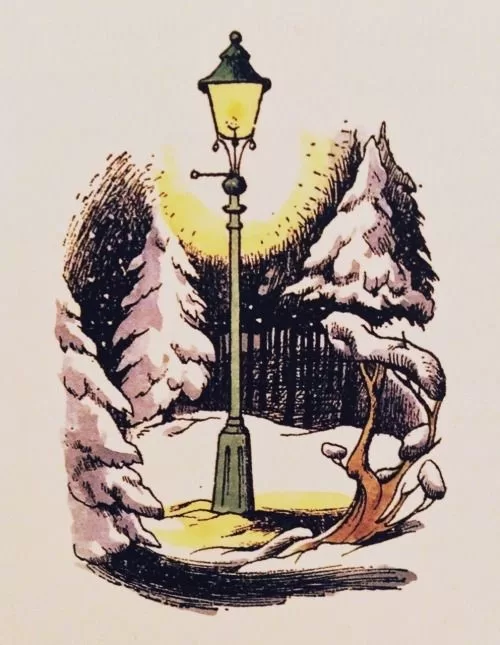
But in the comment section of the article one savvy reader pointed out that by updating The Magician’s Nephew from 1900 to 1950, there is a risk that Narnia could lose one of its second most iconic images after the resurrected Aslan. It’s surprising too, considering no other symbol in the books, better captures the idea of the ordinary becoming extraordinary, better than this simple object: the gas-lit Lamp-post, still burning brightly in a cold, in the snowy wood.
In fact, Lewis takes pains at the conclusion of The Magician’s Nephew as he wraps up the story not only of Digory, Polly and Andrew, but of the creation of Narnia, to talk about the lamp-post and its origins, saying,
“The lamp-post which the Witch had planted ( without knowing it) shone day and night in the Narnian forest, so much that the place where I grew came to be called Lantern Waste; and when, many years later, another child from our world got into Narnia, on a snowy night, she found the light still burning.”
The Lamp-Post by Pauline Baynes.
I’d like to take some time look at our friend the Lamp-post a little more carefully, first by looking at how prevailing this image is in the books, and its connection that started it all for the writing of Narnia. Then I’d like to look at how this could affect the overall design, aesthetic and look of the films, and if there is a remedy to the problem. Finally, I’ll conclude by looking at the symbolism behind the Lamp-post itself, and see if maybe the reason we treasure this lamp-post so much isn’t just the lamp itself, but what it represents.
Admittedly many of us here at NarniaFans were surprised none of us brought up that possibility in our staff-meeting, that by moving Digory and Polly’s story out of the 1900s to 1950s, we stand the risk of losing an old familiar friend who showed up in every adaptation of Narnia, from the BBC Series, to the Walden Media/Disney films, to the animated film from Bill Melendez and Lee Mendelson of The Peanuts specials, to the stage productions. I’d even contend that it is perhaps one of the symbols most associated with the books themselves. In fact, a quick glance at the covers of the number of books analyzing The Lion, The Witch, and the Wardrobe reveals that this is often the most used object form the book to appear, an appropriate choice considering that flames have been a primeval symbol long associated with knowledge, wisdom, insight, and illumination, while the lightbulb has often been used in cartoons as a symbol of saying a character had a sudden breakthrough.
In terms of the story of The Lion, the Witch, and the Wardrobe itself, the Lamp-post serves as a natural boundary line for Narnia, as explained by Tumnus upon Lucy’s first visit, saying,
“This is the Land of Narnia…where we are now; all that lies between the lamp-post and the great Castle of Cair Paravel on the eastern sea.”
More than just a line of demarcation on a map, or even a national monument or sacred site, for the Pevensies it marks the threshold of their journey. In old myths and legends, fairy tales and the plays of Shakespeare to enter into the woods was to begin a journey of transformation. The Pevensies who stumble through that doorway at the start of their adventure, are not the same who walk out.
The concluding scenes of The Lion, The Witch and the Wardrobe in which the Four Kings and Queens of Narnia are hunting for the White Stage further establishes the idea of the Lamp-post being a mythic threshold is further conveyed through the observations of Queen Lucy,
“And more…for it will not go out of my mind that if we pass this post and lantern we shall find strange adventures or else some great change of our fortunes.”
Arguably, the Lamp-post connected to the image that started it all. As he related in “It All Began with a Picture”, found in the book On Stories,
“One thing I am sure of. All my seven Narnian books, and my three science fiction books, began with seeing pictures in my head. At first they were not a story, just pictures. The lion, all began with a picture of a Faun carrying an umbrella and parcels in a snowy wood. This picture had been in my mind since I was about sixteen. Then one day, when I was about forty, I said to myself;’ Let’s try to make a story about it.”
Thus, as Sutton deftly points out, there is a certain Genesis-like purity to the creation of Narnia, as found in The Magician’s Nephew as Aslan creates Narnia out of nothing, but total darkness, calling forth the light. I would argue that in the actual fundamental moment of creation in which Narnia began in Jack’s imagination, this was God’s way of saying “Let there be light.”
To move The Magician’s Nephew into the 1950s would mean the filmmakers would have to move every aspect of the book into the 50s as well, including the Lamp-post. If the movie is moving to 1955, the year The Magician’s Nephew was published, it would be terribly anachronistic for there to still be a gas-lit lamp-post in London.
The writers for William K. Sugg & CO., a British based heritage lighting company that specializes in decorative lighting,
“After WWII the gas industry decided that it needed to consider the end for gas street lighting as the writing was on the wall. A large country-wide survey was taken. All gas boards provided the numbers of gas lamps running and the numbers replaced or out of use from war damage over a period of years. This was used to indicate the percentage reduction that could then be applied looking forward. Given a shortest and longest time, the eventual year considered was 1968. There was a final paragraph which has certainly come true some 50 years later: “For reasons such as the affection which is felt in certain parts of the country towards gas lighting and the possibility of electricity not being available in every country lane, it is possible that isolated pockets of gas street lighting will remain after the general disappearance from the streets. Like its elder sister domestic gas lighting, it may well never die but only fade away….Post 1945, because of widespread damage from the war and the development of electricity advancing, the decision was made to stop gas lighting and move forward with electric lighting instead, by 1968 this transition was complete.”
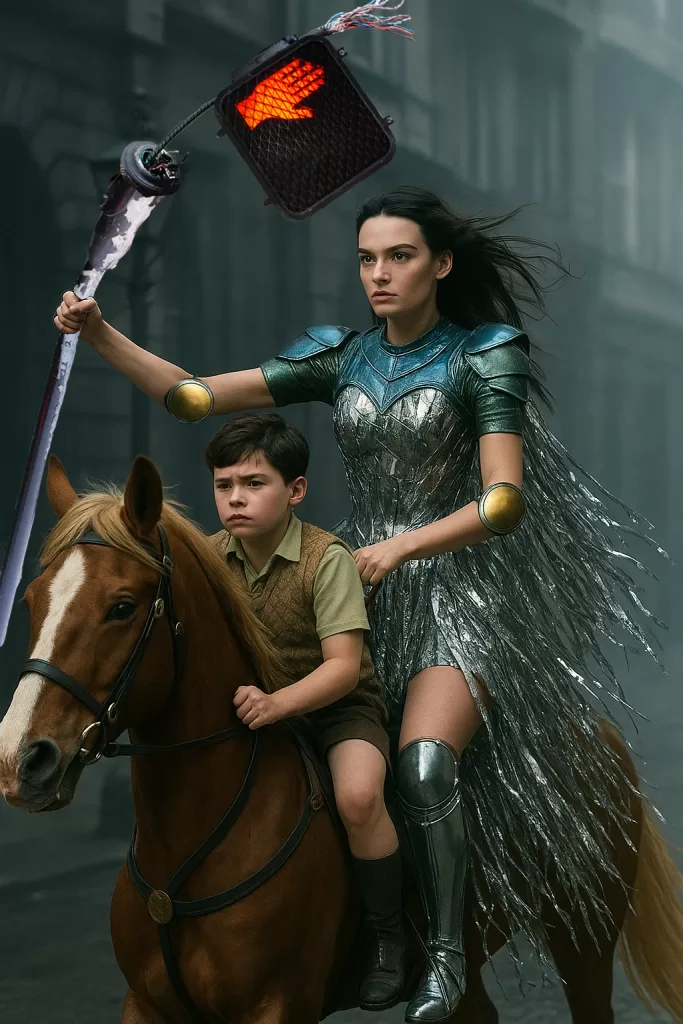
This means that in a large metropolitan area, like London all, lights would have been replaced with electric lights. While it’s certainly feasible that Jadis could steal the bar of an old gas lamp-post on the outskirts of London during her mad dash, or use a substitute, such as a more ‘modern’ electric lamppost or even swing a traffic light like a mace, the objects in question retain a very specific design aesthetic, and still lead to an alteration to the Lamp-post itself.
The gas lampposts in particular have a very distinct aesthetic look to them, and in fact it is not uncommon to find electric lights that bear a striking to these historic lamp-posts now a days. As it is noted further by William K. Sugg,
“These very beautifully designed gas lanterns needed a very large post to support them. Despite the increased power of these gas lamps, they were still nowhere near as powerful as lamps are today. In those days, gas lamps were placed only half as high as we recognize as ‘normal’ in today’s cities. These massive cast iron posts can still be seen in some places today but often can look out of proportion with a tiny modern lamp placed on the top. Modern lanterns are generally placed much higher up which is more suitable for lighting a large space. Luckily, in many locations, the original lamp has been sympathetically converted to an electric light source restricted in power to match the height of the post which retains the look of the original lantern that would have been designed with gas in mind.”
Picture by: Open AI DALL·E through the Chat GPT system and revised in Adobe Photoshop
But perhaps it could be easily remedied by simply having it be an electric decorative lighting fixture that looks like an Edwardian gas lamp, since such things exist. It could even be a gaslight that is retrofitted for electricity. The problem then becomes that the language surrounding it has to change. Now, while I am old enough to remember an incandescent light bulb getting too hot and exploding because a bulb with the wrong wattage was placed in a lighting fixture with the wrong wiring, lightbulbs do not burn, as the lamp-post is said to do. Rather, they “glow”.
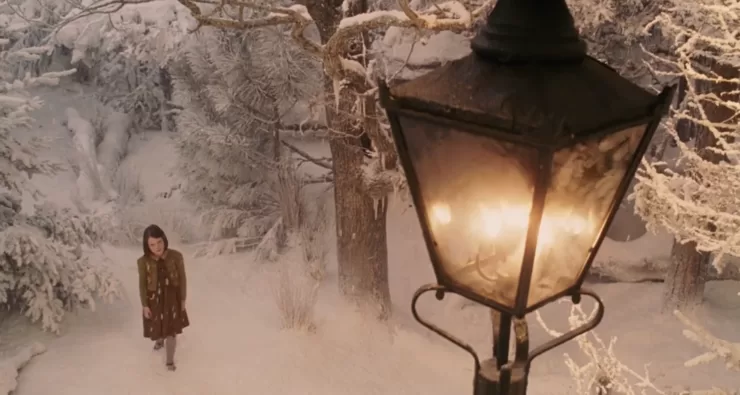
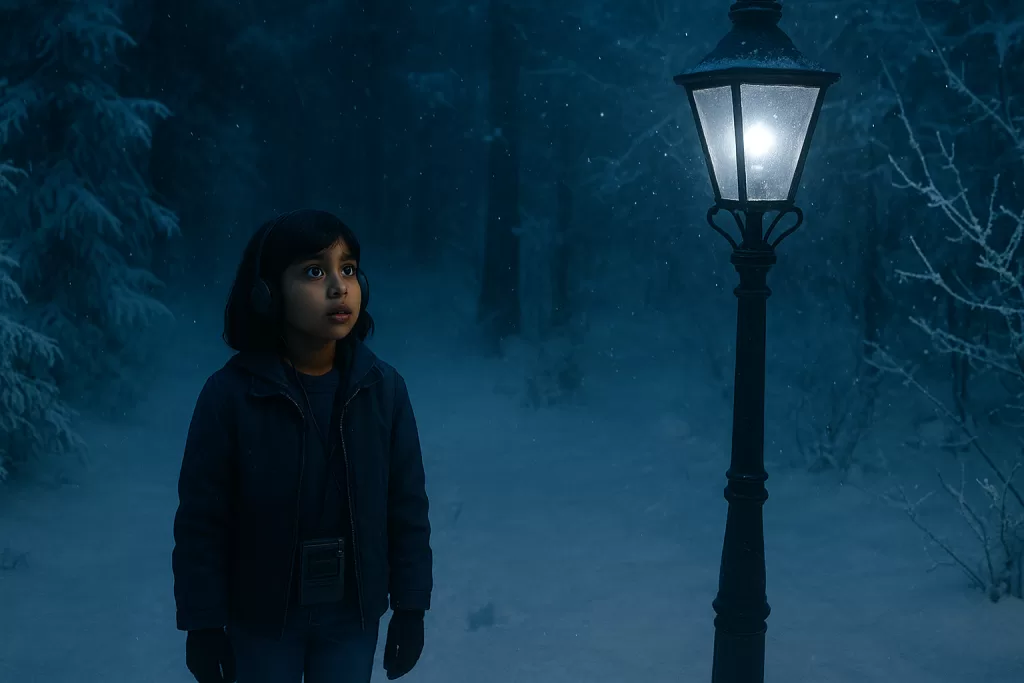
However, this would still alter the quality of the light from the object itself, especially in relation to an out door environment. Thanks to his experience as a Disney Imagineer, Sutton was able to conduct some lighting tests using the Open AI DALL·E through the GPT-4o system and create an image comparison from the 2005 adaptation of LWW from Walden Media and Disney against a lamp-post with more modern electric light, and there is a noticeable difference in the tone for the scene. The light for the “classic” lamp-post, a flame that needs no fuel to burn, looks brighter, more alive, and more inviting, like it’s actually guiding Lucy into Narnia, while the more “Modern lamppost” not “running” on electricity looks colder, sterile, and almost murkier and makes Narnia feel less inviting. From a mere technical stand point, fire-based lighting effects are often rendered in amber and gold tones, where as “industrial lighting”, like light bulbs are often in blues and purples.
PHOTO: Still frame from Walden Media/Walt Disney Studios film The Lion, The Witch and the Wardrobe.PICTURE: Lighting Test. Open AI DALL·E through the Chat GPT system.
Other filmmakers have employed the usage of similar lighting techniques often to highlight thematic and moral differences between characters. In the first film in Sam Raimi Spider-Man trilogy from the early 2000s, the Parker home was often bathed in warm amber hues, creating the feeling of a warm cozy hearth, while the Osborns were often in blue or purple light, highlighting the contrast between the two families. A similar visual trick was used in Smallville to contrast the warm Norman Rockwell-like feel of the Kent farm with the cold clinical world of the Luthors. You wanted to live with the Parkers or Kent while simultaneously wanting Harry and Lex to leave their cold, cruel fathers. The light from the Lamp-post needs to create a similar contrast against the Witch.
Now, it is certainly possible that the filmmakers could use a modern lamp-post, or even a traffic light, and once it enters Narnia and begins to grow, it has a flame instead of a light bulb. After all, Narnia, is a fantasy series and transmutation is certainly a key magical ability. However, the only thing we see Aslan “change” in The Magician’s Nephew is the horse Strawberry into the flying horse Fledge. This is not a drastic transformation, it is merely affixing wings onto a horse to make it into a Pegasus, not completely altering one thing, such as glass and filaments of a lightbulb, into another, a wick and flame.
Aslan’s work here is closer to that of the Miracles of Christ. For it to be an act of transmutation, changing the parts of the lightbulb into something they are not, it would run contrary to what Lewis personally thought regarding miracles. As he noted in the book Miracles,
“By definition, miracles must of course interrupt the usual course of Nature; but if they are real they must, in the very act of so doing, assert all the more the unity and self-consistency of total reality at some deeper level. If what we call Nature is modified by supernatural power, then we may be sure that the capability of being so modified is of the essence of Nature-that the total events, if we could grasp it, would turn out to involve, but it’s very character, the possibility of such modifications…. In calling them miracles we do not mean that they are contradictions or outrages; we mean that, left to her [Nature] own resources, she could never produce them… But to think that a disturbance of them would constitute a breach of the living rule and organic unity whereby God, from his own point of view, works, is a mistake.”
To put it another way, as Madeleine L’Engle wrote in Bright Evening Star: Meditations on the Incarnation,
“Weren’t the miracles power? Yes, but never just for power’s sake. Never to prove a point. Never for Jesus to show off and get his own way. And Jesus always attributed the power to God; it belonged to God and not to Him.”
The only times in the chronicles that we ever see Aslan completely transform something, is when he turns the bratty boys in Prince Caspian into pigs, and the arrogant Prince Rabadash into a donkey in The Horse and His Boy. However, these acts aren’t miracles or magic tricks as much as deed so of divine retribution and judgment for sins, like when God struck King Nebuchadnezzar mad and drove him out into the wilderness for his arrogance in the book of Daniel. Giving Fledge wings to take Digory and Polly on their quest is akin to parting the Red Sea for Moses in the book of Exodus, while making the lamplight burn with out fuel, is more like when the prophet Elijah in the book of 1st Kings, chapter 17, made the Widow of Zarephath’s yeast and oil last for the entire duration of the famine, or even when Jesus multiplied the loaves and fish to feed the 5000, as recorded in the gospels. These miracles are acts of true Providence.
The fact that this lamplight burns without fuel, not only makes Narnia more magical but dare I say it miraculous and supernatural. Nothing, not even the White Witch’s magic can snuff out this light. Ebenezer Scrooge may be capable of putting a cap on the light of the Spirit of Christmas Past, but Jadis can’t defeat this light. She may have cursed Narnia under a winter that lasts for 100 years, but that light still brins, not because of technology or even magic, because it is empowered, not with magic, but with the very echo of Aslan’s song of Creation.
Thus, it is a living Narnian illustration of what is said in the Gospel of John,
“ In the beginning was the Word, and the Word was with God, and the Word was God. He was with God in the beginning. Through him all things were made; without him nothing was made that has been made. In him was life, and that life was the light of all mankind. The light shines in the darkness, and the darkness has not overcome it.”
This image of a light, that keeps burning goes beyond just the traditional teachings surrounding Jesus. According to the Talmud God made the oil for the lights of the menorah in the Temple last for eight nights.
As it says in the Talmud,
“When the Hasmonean family overpowered and were victorious over the Greeks, they searched and found only a single cruse of pure oil . . . enough to light the Temple menorah for a single day. A miracle occurred, and they lit the menorah with this enough-for-one-day-oil for eight days. The following year they established the festival of Chanukah, in which we light the menorah for eight days, commemorating this miracle.”
The world of Narnia, a world in which it is always winter and never Christmas, is still illuminated by an almost eternal flame powered by only the Divine. It’s a curious dichotomy, and one I pondered on a trip to Target. As I passed by a stop light, affixed to a modern lamppost and my gears started working . Entering the seasonal aisle and saw the Halloween items starting to go on display my mind drifted to the next holiday on the retail calendar: Christmas. As I thought about that silly old Edwardian lamppost in a snowy wood, it occurred to me that within Lewis’ image of Narnia as “Always Winter and Never Christmas” he may have been subtly and subconsciously connecting this Lamp-post that burns day and night, through a supernatural means, with no one to tend it, to another supernatural light associated with the holiday.
The Star of Bethlehem that guided the Magi to finding Jesus.
As it is recorded in the Gospel of Matthew,
“ After Jesus was born in Bethlehem in Judea, during the time of King Herod, Magi from the east came to Jerusalem and asked, “Where is the one who has been born king of the Jews? We saw his star when it rose and have come to worship him.”When King Herod heard this he was disturbed, and all Jerusalem with him. When he had called together all the people’s chief priests and teachers of the law, he asked them where the Messiah was to be born. “In Bethlehem in Judea,” they replied, “for this is what the prophet has written:
“‘But you, Bethlehem, in the
land of Judah, are by no means least among the rulers of Judah; for out of you will come a ruler who will shepherd my people Israel.’”
Then Herod called the Magi secretly and found out from them the exact time the star had appeared. He sent them to Bethlehem and said, “Go and search carefully for the child. As soon as you find him, report to me, so that I too may go and worship him.”
After they had heard the king, they went on their way, and the star they had seen when it rose went ahead of them until it stopped over the place where the child was. When they saw the star, they were overjoyed. 1On coming to the house, they saw the child with his mother Mary, and they bowed down and worshiped him. Then they opened their treasures and presented him with gifts of gold, frankincense and myrrh. And having been warned in a dream not to go back to Herod, they returned to their country by another route
This Star itself is believed to be the fulfillment of a prophecy from Numbers Chapter 24,
“I see him, but not now; I behold him, but not near. A star will come out of Jacob; a scepter will rise out of Israel.
This in turn connects to a symbol closely related to both Aslan and Jesus: the lion, a symbol ascribed to associated with the tribe of Judah, while Christ Himself is called The Lion of Judah and the Lamb of God. Lewis himself noted when a young reader asked for clues, that he pointed specifically to ask who else in was known as being both a Lion and a Lamb, pointing only to Christ.
Numerous theories exist about the origins of the star, many trying to explain the phenomena, as Ray Bohlin noted for Bible.org
“The bright star usually seen hovering over Nativity scenes depicted on numerous Christmas cards actually dominates nearly every nighttime Christmas panorama… (T)he Star of Bethlehem is just about the only ubiquitous biblical symbol associated with Christmas. The reason probably has to do with the mystery surrounding what this star was. Earlier, I showed the unreasonableness of the star being a comet or supernova explosion. If you were to attend a planetarium show concerning the star of Bethlehem, they would most likely present the idea that the star was a triple conjunction of the planets Jupiter and Saturn in the year 7 B.C. followed by a massing of Jupiter, Saturn, and Mars in 6 B.C. Realizing that planetarium shows view Scripture as something less than historically accurate, it is still necessary to ask if this indeed could have been the Star of Bethlehem…In the early 17th century the great astronomer and Christian, Johannes Kepler, calculated that a triple conjunction of Jupiter and Saturn had occurred in 7 B.C. While Kepler did not believe this to be the actual Star of Bethlehem, it may have alerted the magi to the coming star. 7-4 B.C. have become the usual dates for fixing the birth of Christ since Herod the Great’s death, the Herod mentioned by both Matthew and Luke in their birth narratives, is well established in 4 B.C. Therefore, Jesus had to have been born in the few years prior to 4 B.C. since He started his three-year public ministry around the age of 30 (Luke 3:23) and His death is usually fixed between 27-30 A.D.”
However, the 16th Century theologian John Calvin argued in A Harmony of the Gospels Matthew, Mark and Luke,
“It was not a natural star, but extra-ordinary, for it was not of the order of nature…None of this accords with natural stars.”
To put it another way as Ramandu says in The Voyage of the “Dawn Treader” when Eustace points out that in our world a star is just a ball of gas burning billions of miles away,
“Even in your world, my son, that is not what a star is but only what it is made of.”
It was the popular 19th Century British preacher Charles Spurgeon, who postulated in his Christmas sermon “The Star and the Wise Men” , that this light wasn’t just a “star” but the very manifestation of the “Shekinah Glory”.
“It must have been a star occupying quite another sphere from that in which the planets revolve. We believe it to have been a luminous appearance in mid-air; probably akin to that which led the children of Israel through the wilderness, which was a cloud by day and a pillar of fire by night.”
Literally translated into English as “the Glory of God”, this Shekinah Glory is found numerous places in Scriptures, and not just in pillar of fire guiding the Hebrews through the wilderness in the story of the Exodus. It is this glory that appears to Moses on Mount Sinai at the burning bush and later gives him the Ten Commandments, and rested within the Tabernacle and later the Temple. It was what consumed the armies of Ahab and Jezebel when Elijah called down fire and what carried him up to Heaven in the form of a chariot, blinded the Armenian soldiers and allowed Elisha to lead the invading armies into Samaria, appeared before the prophet Isaiah in the Holy of Holies, and it was where the prophet Ezekial saw the vision of the angels. King Nebuchadnezzar was given a glimpse of the Shekinah Glory when he peered inside the fiery furnace where Shadrach, Meshach, and Abendego were thrown in and the Angel of the Lord appeared in the fire with them in the book of Daniel. This was the very same “glory” that shown around the angels before the shepherds in the Gospel of Luke, and it was this same presence that came to rest on God’s children at the Pentecost, signifying that God now dwelt among us, while when Christ appeared to Paul on the road to Damascus, He blinded him with the full radiance of the Shekinah Glory.
Thus, if the Star of Bethlehem wasn’t just a star, or a supernatural sign, but the very Divine Light of God Himself, that meant this was a sign that God was not only coming to dwell among humankind but that He was pointing the way to find him. So too is this the case with the Lamp-post. It doesn’t just have magical, or supernatural properties but spiritual properties and serves a beacon to guide the Pevensies into Narnia.
Like Moses, and the Magi, the Pevensies are on a quest, and not just one to free Narnia, but one of spiritual discovery. Thus, instead of a Star guiding the Magi to Christ or a Pillar of Fire writing the words of the Ten Commandments, or leading the Children of Israel to the Promised Land, Aslan chooses to guide the children with His glory manifested in the warm light of the Lamp-post, not towards a manger where they can kneel before a new born Baby, but for a Divine encounter of a different kind. As was seen at the end of Voyage of the Dawn Treader, when Lucy and Edmund are told they can never return to Narnia,
“”You are too old, children,” said Aslan, “and you must begin to come close to your own world now.”
“It isn’t Narnia, you know,” sobbed Lucy. “It’s OK. We shan’t meet you there. And how can we live, never meeting you?”
“But you shall meet me, dear one,” said Aslan.
“Are—are you there too, Sir?” said Edmund.
“I am,” said Aslan. “But there I have another name. You must learn to know me by that name. This was the very reason why you were brought to Narnia, that by knowing me here for a little, you may know me better there.”
We never learn second-hand from Eustace in The Silver Chair if his cousin’s learned that name, but given Lucy’s response when Lord Digory makes the observation that the inside of the stable is bigger than the outside, it’s clear that she and her family the truth. Considering the book was written and published before such a reference to an object being “Bigger on the inside” led to an obligatory joke about Dr. Who and the TARDIS, Lewis left only one option to us.
As Lucy says,
“”Yes… In our world too, a Stable once had something inside it that was bigger than our whole world.” It was the first time she had spoken, and from the thrill in her voice Tirian now knew why. She was drinking everything in more deeply than the others. She had been too happy to speak.”
This means that the Lamp-post is not only a magical lamp or supernatural artifact but rather the manifestation of Gods own guiding light. So yet, now we have to wonder, what will Narnia be like without that lamppost? The set pictures don’t show any “traditional” Narnian lamp-posts in the background, so will it be replaced by another object, and in fact Sutton has pointed out that Frank the Cabby already has to be replaced, so perhaps something with a duller, harsher, colder, more sterile light? Without that warm beacon, a gas-lit lamp, tended by any human hands, guiding the children across the wilderness to meet Aslan, what will this cinematic iteration of Narnia be like?
For the Lamp-post is in those woods, not only to serve as a boundary for Narnia, or a landmark, but rather to draw the characters, and the readers, to Aslan. Then in catching that glimpse of Aslan’s mane, we may grow to love Him more through the world of Narnia, and know Him better in our own.
Lewis himself wrote to a mother who was worried that her son, Laurence loved Aslan more than Jesus.
“Laurence can’t really love Aslan more than Jesus, even if he feels that’s what he is doing. For the things he loves Aslan for doing or saying are simply the things Jesus really did and said. So that when Laurence thinks he is loving Aslan, he is really loving Jesus: and perhaps loving Him more than he ever did before.”
BIBLIOGRAPHY:
1st Kings. NIV Study Bible. Zondervan, Grand Rapids, MI. 1985.
2nd Kings. NIV Study Bible. Zondervan, Grand Rapids, MI. 1985.
Acts. NIV Study Bible. Zondervan, Grand Rapids, MI. 1985.
Bohlin, Ray. “The Star of Bethlehem | Bible.org.” Bible.org, 17 May 2010, bible.org/article/star-bethlehem. Accessed 18 Aug. 2025.
Broome, John, Carmine Infantino, and Gil Kane. “S.O.S. Green Lantern.” Showcase #22. DC Comics: New York, NY. Sept-Oct . 1959.
Calvin, John. A Harmony of the Gospels Matthew, Mark and Luke. Grand Rapids: Eerdmans, 1972. Pg. 83.
Chabad.org. “The Miracle.” @Chabad, 8 Dec. 2000, www.chabad.org/holidays/chanukah/article_cdo/aid/2684/jewish/The-Miracle.htm.
Daniel. NIV Study Bible. Zondervan, Grand Rapids, MI. 1985.
Dickens, Charles. A Christmas Carol. Bantam Books: New York, NY. 2008.pg. 1
Dr. No. Dir. Terence Young. Perf: Sir Sean Connery, Ursula Andress, Joseph Wiseman, Anthony Dawson, Bernard Lee, and Jack Lord. By Richard Maibaum, Johanna Harwood, Berkely Mather and Ian Fleming. 1962. UA/EON Films/Sony Pictures. DVD.
Exodus. NIV Study Bible. Zondervan, Grand Rapids, MI. 1985.
Ezekiel. NIV Study Bible. Zondervan, Grand Rapids, MI. 1985.
Godzilla King of the Monsters! Dir. Ishiro Honda, Terry O. Morse. Perf: Raymond Burr, Takashi Shimura, Momoko Kōchi, Akira Takarada, and Akihiko Hirata, with Haruo Nakajima and Katsumi Tezuka. Shigeru Kayama, Takeo Murata, Tomoyuki Tanaka, and Al C. Ward, writers. Toho Company/Jewell Enterprises, Inc. 1956. Roku Channel
Isaiah. NIV Study Bible. Zondervan, Grand Rapids, MI. 1985.
John. NIV Study Bible. Zondervan, Grand Rapids, MI. 1985.
Kanigher, Robert and Carmine Infantino with Joe Kubert “Mystery of the Human Thunder Bolt!” Showcase #4. DC Comics: New York, NY. October, 1956.
Lee, Stan and Jack Kirby. “The Fantastic Four!”Fantastic Four #1. Marvel Comics: New York, NY. November, 1961.
Lee, Stan and Jack Kirby. “The Coming of the Hulk.” The Incredible Hulk #1. Marvel Comics: New York, NY. July, 1962.
Lee, Stan and Jack Kirby “X-Men” The X-Men. Marvel Comics: New York, NY .Sept. 1, 1963.
Lee, Stan and Jack Kirby. “The Man for the Job” Strange Tales #135. Marvel Comics; New York, NY. August 1965.
Lee, Stan, Jack Kirby, Larry Lieber, and Don Heck “ Iron Man is Born!” Tales of Suspense #39. Marvel Comics, New York, NY. December 1962.
Lee, Stan, Larry Lieber and Don Heck. “The Crimson Dynamo Strikes Again!”Tales of Suspense #52. Marvel Comics, New York, NY. April, 1964.
Lee, Stan and Steve Ditko. “ The Origin of Spider-Man.” Amazing Fantasy #15. Marvel Comics: New York, NY. August 1962.
L’Engle, Madeleine. Bright Evening Star: Mystery of the Incarnation. Convergent: New York, NY.2018. pg. 92.
Lewis, CS. The Horse and His Boy. Harper Collins: New York, NY. 1982.
Lewis, CS. “Dear Mrs. K…” Letters to Children. Lyle W. Dorsett and Marjorie Lamp Mead, Eds. Touchstone Books, New York. NY. 1995.Pg. 52.
Lewis, CS The Last Battle. Harper Collins: New York, NY. 1984. Pg. 177.
Lewis, CS. The Lion, The Witch and the Wardrobe.Harper Collins: New York, NY. 1978. Pgs: 12,203-204.
Lewis, CS. Miracles. Harper Collins: New York, NY. 1974. Pgs. 61-62, 153.
Lewis, CS “It all began with a Picture”. On Stories: And Other Essays on Literature. Owen Barfield, Walter Hooper, Eds. Harcourt Brace: Orlando, Fl. 1982. Pg. 53.
Lewis, CS. The Magician’s Nephew. Harper Collins: New York, NY. 1983. Pgs.130,219
Lewis, CS. Prince Caspian. Harper Collins: New York, NY. 1979.
Lewis, CS. The Voyage of the Dawn Treader. Harper Collins: New York, NY. 1980. Pg. 226, 269-70
Matthew. NIV Study Bible. Zondervan, Grand Rapids, MI. 1985.
Numbers. NIV Study Bible. Zondervan, Grand Rapids, MI. 1985.
“Pilot” Smallville. By Alfred Gough and Miles Millar.Dir. David Nutter. Original Airdate: October 16,2001. KMWB WB 23.
Spider-Man. Dir. Sam Raimi. Perf: Tobey Maguire, Kirsten Dunst, James Franco, Willem DaFoe, Cliff Robertson, Rosemary Harris, and JK Simmons. By David Koepp. 2002. Marvel Entertainment/Sony Pictures/Columbia Tri-Star. DVD.
Spurgeon, Charles. “The Spurgeon Library | the Star and the Wise Men.” The Spurgeon Center, 2020, www.spurgeon.org/resource-library/sermons/the-star-and-the-wise-men/#flipbook/. Accessed 19 Aug. 2025.
“Tomorrow is Yesterday”. Star Trek. By DC Fontana. Dir. Michael O’Herlihy. Original Airdate: January 26, 1967. KSTP 5- NBC Twin Cities.
ChristianityToday has posted an interview today with Walden Media’s Micheal Flaherty. He addresses a number of things, including The Magician’s Nephew, the Narnia Police, the un-dragoning and the dialogue of Aslan. Why Magician’s Nephew next? […]
Hey, Narnia Fans! Welcome to “Behind the Wardrobe” an Interview Series with Douglas Gresham. Join me as we find out about CS Lewis, Narnia and more in this interview series.
Special thanks to Paul Martin (The Webmaster for NarniaFans) and to Mr. Douglas Gresham himself for this amazing opportunity. And an even bigger thanks to Mr. Gresham for putting up with a few of my impossible questions. Thanks for being such a great sport about it!
For this week: On The Lion, The Witch, and The Wardrobe.
The idea of a “left wing” and “right wing” in politics and society is a fluid one, subject to a lot of confusion. You can’t understand liberals unless you know what they want to liberate, and you can’t understand conservatives unless you know what they want to conserve….It may help us toward clarity if I attempt, presupposing what I think to be reasonable modern definitions of the left and right, to identify some places in The Chronicles Of Narnia where C.S. Lewis expressed sometimes liberal ideas, and sometimes conservative ones.



Be the first to comment