

Sometimes the journey to Narnia doesn’t begin with a wardrobe. Sometimes it begins in a hedgerow.
Last September, a quiet team from Shepperton Studios arrived at Startop Farm near Marsworth to carefully dismantle a distinctive dead maple tree that had stood for years along the edge of an old rally field. Locals knew it well for its twisted, lightning-scarred silhouette. Contractors methodically removed it, cutting and numbering branches so the tree could be reconstructed exactly as it had stood. At the time, the production it was destined for remained under wraps.
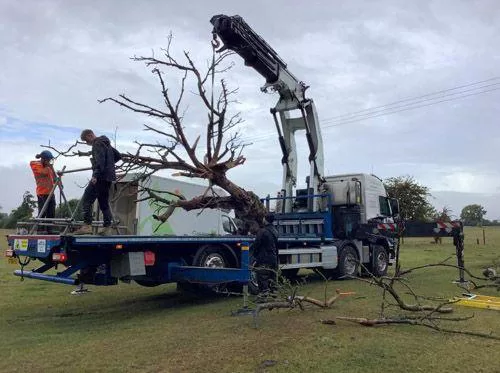
Now we know where it went.
The maple will feature in Narnia: The Magician’s Nephew, Netflix’s major adaptation of The Magician’s Nephew, directed by Greta Gerwig. The film is scheduled for a theatrical release in November 2026, followed by a Netflix premiere on Christmas Day. It stars Emma Mackey, Carey Mulligan, and Daniel Craig, and filming wrapped at the end of January.
According to farm owner Josie, the maple will appear as one of two apple trees in the wood — specifically, the one on the left side of the screen.
That detail alone will spark the imagination of anyone familiar with Lewis’s story.
The Magician’s Nephew marks the chronological beginning of the Narnia saga. Digory and Polly discover the Wood Between the Worlds — a quiet, dreamlike forest filled with pools that serve as portals to other universes. Their travels take them to the ruined world of Charn, where they awaken the future White Witch, and ultimately to the breathtaking moment when Aslan sings Narnia into existence.
Lewis describes the Wood Between the Worlds as “a place of pools and trees,” where everything felt “very quiet… almost as if it were a church.” That stillness matters. It is not an orchard. It is not a garden. It is a threshold — a place between stories.
The source article suggests the tree may appear in the Wood Between the Worlds, one of the most atmospheric settings in the novel. But readers of The Magician’s Nephew will remember that the apple tree central to Digory’s quest does not grow there. The Wood is described as still and drowsy, filled with trees and pools — not fruit-bearing orchards. It seems just as likely, perhaps even more likely, that this maple will stand in for one of the trees in Narnia itself, possibly connected to the apple garden or the Tree of Protection sequence.
Later comes one of the most pivotal moments in the entire series: Digory’s journey to retrieve a magical apple from the walled garden on the western mountain. When Digory stands there and hears the Witch’s whisper, Lewis tells us that the apple’s scent was “delicious beyond description.” The temptation is not abstract. It is vivid. It is fragrant. It is immediate. From that apple grows the Tree of Protection, a living safeguard that shields Narnia from the Witch for generations.
If this maple is part of that sequence, it represents far more than set decoration. In this story, an apple tree becomes a hinge on which the future of a world turns.
There is something fitting about the tree chosen for the role. Josie described it simply: “The tree has been here forever; it just died and continued to stand there. It was spotted by a member of the production team at our steam rally in June.” A tree that had died, yet remained standing — now given new life in a story about creation, temptation, and renewal.
In an era dominated by digital effects, the decision to transport and reconstruct a real tree is notable. Shepperton Studios could easily have fabricated one. Instead, the production team chose texture, age, and natural imperfection. A lightning-scarred trunk shaped by real storms carries a presence that no digital model quite replicates.
Trees, after all, are rarely just trees in great literature.
In The Lord of the Rings, the White Tree of Gondor stands at the symbolic heart of a kingdom. When it withers, hope fades. When a new sapling is discovered, it signals restoration and rightful return. A single tree can carry the emotional weight of an entire realm.
Lewis understood this instinctively. In Narnia, forests are not passive scenery. The Wood Between the Worlds hums with suspended stillness. The Tree of Protection guards a nation’s future. In Prince Caspian, trees themselves awaken when Aslan’s power returns to the land.
Trees, in Lewis’s imagination, are not merely symbols. They are timekeepers. They grow slowly. They endure silently. They outlast empires. The Tree of Protection does not defeat evil with spectacle. It stands. And in standing, it keeps watch.
That is what makes the Startop Farm maple such a compelling choice. Its sculptural form, weathered and dramatic, feels at home in a landscape that exists somewhere between myth and memory. It is easy to imagine it standing in a hushed wood where universes are only a pool away, or in a sacred garden where a boy must choose between selfish desire and obedience.
For the local community near Marsworth, it is exciting to know that a piece of their countryside will appear in one of the world’s most anticipated fantasy films. For Narnia fans, it is something more: a small but meaningful glimpse into how this adaptation is approaching Lewis’s world.
Lewis understood that the great moments of history are often rooted in something planted long before anyone notices. Perhaps it is fitting that the beginning of Narnia’s story – on film – rests in the branches of a tree that once stood unnoticed in a field.
A hedgerow in Buckinghamshire.
A tree marked by lightning.
Branches numbered and carried away to be rebuilt on a soundstage.
Soon, it will stand in Narnia.
And in a story where an apple tree shapes the destiny of a world, that feels exactly right.



Be the first to comment