
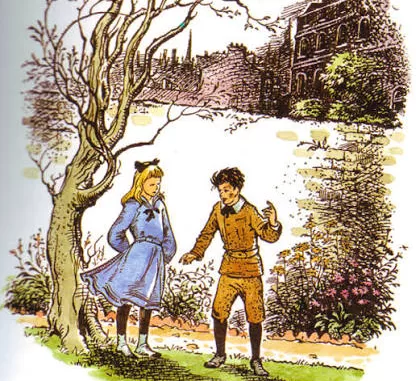
They are a popular duo as is evident by the number of “Shipping” fictions dedicated to them. In fact, a search through FanFiction.net alone reveals that of canonical duos in the series, they are the most popular, dwarfing even SuSpian form the Walden films in terms of fan good will and appeal. The original text depicts one of the richest, warmest and most dynamic friendships between a boy and a girl, and in fact as presented in Lewis’ original novel is not that dissimilar from the dynamic of the friendships between the likes of Tom Sawyer and Becky Thatcher in Mark Twain’s The Adventures of Tom Sawyer, Princess Irene and Curdie in George MacDonald’s The Princess and the Goblin and Mary Lennox and Dickon in Frances Hodson Burnett’s The Secret Garden.
These characters held such stellar chemistry with one another that readers are swept up in their stories whether it was searching for buried treasure in a cave, batting Goblins, unlocking a hidden garden and brining healing to a family or witnessing the creation of a universe. Their stories have a universal appeal that transcends time and place and not only sweeps the readers up in the adventure but grounds the readers in a very real, very compelling relationship. Digory and Polly have a chemistry that feels real, like that of Princess Irene and Curdie in MacDonald, Taran and Elionwy in The Black Cauldron or Calvin O’Keefe and Meg Murray in A Wrinkle in Time, all three of these being duos who started as friends but eventually married.
Considering that Digory ends up a professor with a fairly nice estate in the English countryside indicating he is well-off, for him to end up with only a maid service and Mrs. MacCready feels odd given the period time the books are set. 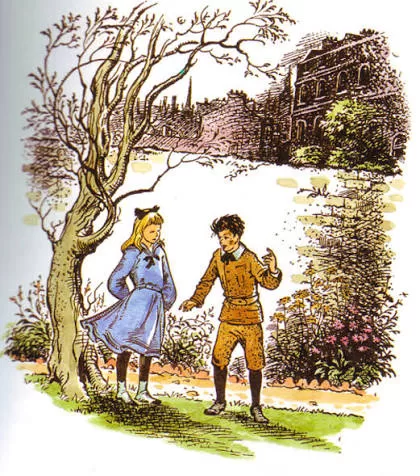
After all, as Jane Austen once observed in Pride and Prejudice,
“It is a truth universally acknowledged, that a single man in possession of a good fortune, must be in want of a wife. However little known the feelings or views of such a man may be on his first entering a neighbourhood, this truth is so well fixed in the minds of the surrounding families, that he is considered the rightful property of some one or other of their daughters.”
Because Digory and Polly are often depicted as being the same age it has led fans to engage in what’s affectionately known among the fan fiction community as “toy shipping”, much like with Tom and Becky or Mary and Dickon. wherein because of the ages of the characters their friendship develops into a crush, which leads to romance and marriage. And, as any kid who went through elementary school will attest, marriage usually leads to having to push a pram a lot.
As Efie Sapuridis notes on the phenomenon in “Are You a Destiel Stan? There’s So Much more to Shipping Than Wanting Characters to Kiss” for the Conversation,
“Shipping has become a massive part of fan culture. Even when writers and media producers don’t explicitly pair up characters, fans will fill the gaps, creating their own versions and interpretations…Fans often become deeply invested in fictional couples because they empathize with and feel connected to the characters…Well-developed characters evoke emotional responses in audiences, similar to the connections we forge with others in real life, especially when we’ve spent a lot of time engaging with the media. The characters become like friends on the screen or page – we become invested in their relationships and growth…This connection grows even more when characters are placed in relatable situations, such as navigating a breakup or unrequited love. When we can put ourselves in the shoes of the character, we become more invested in their story. Fans connect with characters, and then yearn for their happiness because it feels connected to their own happiness…..It becomes more than just a story; instead, shipping the characters becomes a way for fans to explore their own emotions.”
In fact, a search of Fanfiction.net alone reveals of romantic pairing stories that they yield over two dozen stories, third only to the canonical Caspian and the Star’s Daughter and Shasta and Aravis. ( like Bruno in Encanto, we don’t talk about SusPian). Ignoring of course the sticky theological issues of at least one of them depicting Digory and Polly pursuing a romance in Aslan’s kingdom, or Heaven, it remains relationship fans want to explore further. Many fans are even surprised that given the time the book was set that neither Professor Kirke nor Aunt Polly were married, and thus it falls on the fan fiction writers to try and figure out what came next for them. I would tell you to go check these stories out and promise to wait, but I can’t recommend it on principle. Gaze long enough into the cesspool of AO3 shipper fiction, and the cesspool gazes back into you—and then you stumble on perverse fan art that makes you pray for an EMP.
To be fair, perhaps we shouldn’t blame the writers entirely. Given the median age of the average fanfic author, our brains were conditioned by a steady diet of 80s and 90s sitcoms. We grew up watching Zack Morris and Kelly Kapowski on Saved by the Bell, Kevin Arnold and Winnie Cooper on The Wonder Years, Cory Matthews and Topanga Lawrence on Boy Meets World, Steve Urkle and Laura Winslow on Family Matters, and D.J. Tanner and Steve Hale on Full House. In fact, it’s safe to say that generation of kids were just as invested in seeing whether or not Zack and Kelly, Cory and Topanga or Kevin and Winnie get together as their parents had been invested in seeing Sam Malone and Diane Chambers on Cheers, David Addison and Maddie Hayes on Moonlighting or Richard Castle and Kate Beckett on Castle resolve their romantic tension. Decades of television taught us to anticipate one absolute truth: if two leads of an opposite gender share a screen, and have such great chemistry, they must end up together. But C.S. Lewis wasn’t in the writer’s room for Saved by the Bell, The Wonder Years, or Boy Meets World. Candace Cameron Bure of Full House might share a CS Lewis quote, but Narnia was not the source material for the two-part episode where the Tanner family goes to Disney World.
Moreover, while two of the pillars of 19th century literature Jane Austen and Louisa May Alcot wrote delightful novels focusing on the cozy domestic dynamics of the bustling family life of the Bennet sisters in Pride and Prejudice and Little Women respectively that saw the likes of Elizabeth Bennet cross verbal swords with Mr. Darcy or Jo March chose not to marry Laurie to she might pursue her career, Lewis wasn’t wring a regency era comedy of manners or a cozy domestic drama. For those TV sitcoms, and for Alcott and Austen, the act of courtship and marriage, and following your path was part of growing up, and leaving behind the cozy comfort of home. Cory Matthews had to come to see Topanga as more than just that weird girl with the even weirder name. Laura Winslow had to look past the suspenders and see that Steve Urkle is a nice guy. In order to get his happy ending with DJ Tanner, Steve Hale had to be more than the jock who liked to eat a lot of sandwiches, even if he was also the voice of Aladdin.
To put it bluntly as Captain Kathryn Janeway expresses to the entity posing as her father when she’s in the space between life and death in the Star Trek:Voyager episode “Coda” and two of her own crew members are engaged in a “will they or won’t they” relationship,
“I have to know what’s going to happen to them…To know if Tom and B’Elanna will ever stop sparring with each other and develop a real friendship.”
But the problem of shipping in the context of Digory and Polly is that the core of the DNA of their friendship isn’t romance. As I have already stressed, the Narnia books have more in common with the children’s novels of the 19th century like The Secret Garden and the Adventures of Tom Sawyer then they do with the more prestigious novels for adults like Pride and Prejudice and Little Women. The children in those stories certainly, learned, grew, changed and were challenged, but it was less about becoming adults and entering “the real world”, and more about the development of their moral character, now, while they are children so maybe, just maybe they might grow up to be half-way decent adults.
So too is it with the dynamics of how these characters meet and why. For starters Digory and Polly do not meet at an English country dance and in fact they don’t even encounter each other at school. Rather Digory and Polly’s friendship in many ways is a mirror flip of the friendship between Mary Lennox and Dickon The Secret Garden. While Digory and Polly live in a row of houses and Mary goes to live at Mistelwhite Manor where she meets Dickon and the rest of her friends, the reasons for their meeting is far more similar than they are different.
Mary is sent to the manor in England because her own life is upended as her own parents had been in India, and died from Cholera, rendering her an Orphan. She then becomes incredibly miserable to the point she’s called “Miss Mary Contrary”. For Digory his life is just as precarious, and even involves a parent conducting duties in India, as he makes it clear to Polly when she comments on the fact he’s been crying,
“”All right, I have then,’” said Digory in a much louder voice, like a boy who was so miserable that he didn’t care who knew he had been crying.’And so would you,’ he went on, ‘if you’d lived all your life in the country and had a pony, and a river at the bottom of the garden, and then been brought to live in a beastly Hole like this…And if your father was away in India—and you had to come and live with an Aunt and an Uncle who’s mad (how would you like that?)—and if the reason was that they were looking after your Mother—and if your Mother was ill and was going to—going to—die.’ Then his face went the wrong sort of shape as it does if you’re trying to keep back your tears.
These aren’t the sort of first encounters that develop into a ‘meet cute” resulting in any form of romantic attachment. Polly isn’t going to write “Mrs. Polly Kirke” on her notebook anymore then Dickon is going to ask Mary’s uncle for permission to court her. This is the sort of interaction that leads the new found friend to stop, pause a moment and ask themselves what they can do to help them. Polly, not only apologizes for what Digory’s been through, clearly being one of the few to openly display any compassion for him, she promptly changes the subject and wants to talk to him about other matters to get his mind out of his bog of despair.
Yet despite the manor being bigger than the row of houses, there is a sense of loneliness that permeates the lives of the central protagonist of The Secret Garden and The Magician’s Nephew in their new settings. Both Mary and Digory have an eccentric, reclusive uncle, with Andrew Ketterely is cut off from society by choice being caused by his alchemistic pursuits, while for Lord Archibald Craven his reclusiveness is caused by not only his physical deformity but by the grief in losing his wife and the condition of his own son, Colin.
Digory much like Mary in the grief of her parents, is going through the midst of that same fire with the death of his mother and prays every night she’ll live. Further, he willingly accepts one of the magic rings form his uncle not out of a sense of adventure or a desire for fame that might come in traveling to a strange new world, but in saving the life of his best and only friend, Polly. Yet, much like how Dickon helps Mary overcome her selfish nature which in turn leads Mary to bring healing to the relationship between Archibald and Colin, Polly helps Digory confront tendencies of his own that aren’t that far off form his uncle. He is incredibly a reckless and headstrong, striking the bell in Charn that awakens the witch, and even physically grabs her to keep her form leaving.
As we learn in the book The Magician’s Nephew,
“(F)or he saw Polly’s hand moving to her pocket to get hold of her yellow Ring. I can’t excuse what he did next except by saying that he was very sorry for it afterwards (and so were a good many other people). Before Polly’s hand reached her pocket, he grabbed her wrist, leaning across her with his back against her chest. Then, keeping her other arm out of the way with his other elbow, he leaned forward, picked up the hammer, and struck the golden bell a light, smart tap. Then he let her go and they fell apart staring at each other and breathing hard. Polly was just beginning to cry, not with fear, and not even because he had hurt her wrist quite fairly badly but with furious anger. Within two seconds, however, they had something to think about that drove their own quarrels quite out of their minds.’”
In a traditional YA novel, that would be the end of it for Polly and Digory and she’d want nothing to do with him. However, upon witnessing the cruelty of Jadis, he begins to have a change of attitude and actively works to keep away from her. Then when the witch grabs a hold of Polly to escape Charn, he helps her get free. Later when they are back in England, Digory begins to make plans to return the witch home. At first Polly thinks nothing of it, seeing it as Andrew’s problem. But her position on the matter changes when Digory brings up the subject of his mother. The witch is a terrible person who could easily frighten his dying mother into her grave, and Polly, makes a promise to help as soon as she can, having been punished by her mother for being late for dinner and getting muddy.
However, as soon as Digory makes his move to try and grab a hold of the witch, that’s when he learns he’s not alone.
As Lewis relates,
“”Now’s my chance,” thought Digory. He darted between the horse and the railings and began going forward. If only the brute would stay still for a moment he might catch the Witch’s heel. As he rushed, he heard a sickening crash and a thud. The Witch had brought the bar down on the chief policeman’s helmet: the man fell like a ninepin. …
“Quick, Digory. This must be stopped,” said a voice beside him. It was Polly, who had rushed down the moment she was allowed out of bed.
“You are a brick,” said Digory. “Hold on to me tight. You’ll have to manage the Ring. Yellow, remember. And don’t put it on till I shout.”
This is something that makes Polly far more than just a love interest, but a true companion in every sense of the word as she faces the danger right alongside him and they help each other through it all. In fact, it’s here their narrative takes a different turn as the magic of the Secret Garden in Burnett’s novel is all in the mind. Whereas for Digory and Polly they not only travel to two different worlds and a pastoral cosmic weigh station between the two of them, they confront evil itself and find themselves in grave danger.
This makes them more than just a boy and girl next door, as it takes their journey through a path not unlike Mark Twains Tom Sawyer and Becky Thatcher at the end of his classic novel The Adventures of Tom Swayer. By the time of the climax of his story, Tom has stood before a court and testified just who it was that committed murder, saving the life of the town drunk, Muff Potter. Yet in identifying the true killer, he’s put a price on his head.
At this point Becky hasn’t spoken to Tom, ever since he faked his own death, causing the poor girl to cry real tears for him at his funeral. It takes being stuck in the caves, with Joe in hot pursuit for her to trust him again as they not only are facing an unrelenting evil, but Tom knows those caves like the back of his hand. It raises the stakes of their adventure beyond just a will they or wont they child hood crush.
So too is it with Digory and Polly. They encounter an evil witch, and their escape form the collapsing castle is more like the Fellowship of the Ring racing across the bridge of Kazad dum, or Indiana Jones escaping from a giant boulder then a cozy stroll across a foot bridge hand in hand or a polite English Country dance or sharing a basket of fries at Chubbies. The stakes are of life and death and if they dawdle, they’re dead. Further, their foe is bigger, stronger, and deadlier than them and given the witch regards them as a little less then flies, she’d probably have had no problem killing them once they served their purpose.
But more than the adventure, more than the danger, more than the battle of good and evil, their journey is about their spiritual growth and development. It’s when they both meet Aslan, when they see the Creator face to face, that not only does Digory openly confess his sins in the Hall of Statues, while for Polly, it’s about learning to extend forgiveness and grace. This is a critical spiritual moment for them both as it causes Digory to confront his own pride, while for Polly she has to confront any anger she still harbors towards Digory for his actions.
While Aslan sends Digory on the quest to receive the apple that will grow into the tree that will protect Narnia, Polly goes with him. It’s imperative to note that she has her own rings with her, she can leave Digory at any time that she chooses, let him face the Witch and deal with his uncle on his own, but she selflessly chooses not to. Not because she’s madly in love with him, but he’s become her best friend, and she’ll do what she can to help him because it’s right. In turn Digory’s friendship with Polly becomes what gets him to completely resist the Witch’s temptation. She appeals first to his sense of vanity, offering him eternal life, but he rejects it, saying how miserable he would be to live forever while the people he loved died and went to Heaven. Then Jadis twists the knife, bringing up his mother. This becomes harder for Digory to resist.
Jadis never cared for any one or loved them half as much as Digory loves his mother, but she knows how to use this against him, he holds fast but his resistance is waning as he tried to refute by saying his parents wouldn’t approve of him going back on his word and stealing or lying. Then the witch tries her last trick, certain it would break him, she tells him, that his parents should never need to know, and says it could be kept a secret. As there’s only one witness she whispers, that he doesn’t have to take the girl home.
As Lewis notes,
That was where the Witch made her fatal mistake. Of course Digory knew that Polly could get away by her own Ring as easily as he could get away by his. But apparently the Witch didn’t know this. And the meanness of the suggestion that he should leave Polly behind suddenly made all the other things the Witch had been saying to him sound false and hollow. And even in the midst of all his misery, his head suddenly cleared, and he said (in a different and much louder voice): “Look here; where do you come into all this? Why are you so precious fond of my Mother all of a sudden? What’s it got to do with you? What’s your game?”
Lewis notes that Polly congratulates him and remained quiet through the whole thing as it wasn’t her temptation to face, it was Digory’s She couldn’t make it for him and she couldn’t act as an angel on his shoulder whispering to him. All she could do is be there for him, and help him up when he stumbled. He had to make the choice on his own, and while the witch might manipulate his sense of love and duty towards his parents, she could not break the bond of friendship between him and Polly.
In her own way, she understood the same fundamental truth that Samwise Gamgee understood on the Slopes of Mount Doom in The Return of the King,
“I can’t carry it for you, but I can carry you and it as well. So up you get. Come on..Just tell him where to go, and he’ll go.”
They’ve traveled to a Wood between Worlds, they survived the post-apocalyptic Hellscape of Charn, and witnessed the birth of Narnia’s cosmos together. They faced evil, pure, undiluted, unrepentant evil together, saw animals could talk, and witnessed miracles. For two people to experience such things together and not come away with a deep, lasting bond would be impossible. I would argue to that end, their friendship served as an inspiration not for any relationships we’ve seen on sitcoms, but Harry and Hermione in Harry Potter. Two fire forged companions who see each other’s strengths and weaknesses, and stay by each other’s side till the bitter end, not out of any romantic entanglement, but because of the bond of their friendship.
Each step on Digory and Polly’s journey together is one of willful choice. The relationship between them is best described by what Lewis wrote in The Four Loves about Friendship,
“In friendship…we think we have chosen our peers. In reality a few years’ difference in the dates of our births, a few more miles between certain houses, the choice of one university instead of another…the accident of a topic being raised or not raised at a first meeting–any of these chances might have kept us apart. But, for a Christian, there are, strictly speaking no chances. A secret master of ceremonies has been at work. Christ, who said to the disciples, “Ye have not chosen me, but I have chosen you,” can truly say to every group of Christian friends, “Ye have not chosen one another but I have chosen you for one another.” The friendship is not a reward for our discriminating and good taste in finding one another out. It is the instrument by which God reveals to each of us the beauties of others.”
Because of this experience Lewis assures readers that they remained best friends all their lives. Yet this of course begs the question why both were still single by the time of The Last Battle. The Doylist explanation is simply that when Lewis wrote the Lion, the Witch and the Wardrobe he had no idea at that time that Professor Kirke had travel to Narnia himself as a boy, nor that he had a friend who was a girl named Polly. But the Watsonian explanation, at least my personal theory is this: they both know full well if they tell anyone else about Narnia that’s a literal one-way ticket to Bedlam the minute that they start talking about talking Lions or Magic Rings. At the same time, because of their shared experiences their bond is like that of a brother and sister and marrying each other would feel “weird” to them.
To put it another way, if Polly dedicated a song to Digory, it wouldn’t be Taylor Swift’s “Love Story”,‘Carly Rae Jepsens “Call me Maybe”, or Celine Dion’s “My Heart Will Go On” it would be either Bill Withers “Lean on Me”, Kenny Rogers and Dolly Parton’s “You Can’t Make Old Friends” or even “I’ll Be There For You” by The Rembrandts. They don’t love each other because they shared a kiss in front of the lockers and grabbed a soda at their favorite hangout. They love each other because they know each other better hen they know themselves, would die for the other, and have made incredible sacrifices for the other.
They love each other as brother and sister because they choose the other, not because they have to due to shared DNA or even a marriage contract, and honestly for me, it’s one of the most relatable relationships in literature. Allow me to elaborate. There’s this girl I’ve been friends with for my entire adult life. We first met our freshman year of college, two days before classes started at floor ministry event. We connected instantly, and in the years since that day, our bond has become one of a brother and sister.
But there is a fundamental difference at times between my relationship with her and my own biological sisters and certainly my female cousins. In fact, there have been times I feel closer to her, and feel she understands me better than they do, because members of my family had no choice in the matter of having me in their lives. My younger sisters put up with me because they have to, my cousins because I happened to be at a family gathering with people who shared a last name, but my friend spends time with me because she chooses to do so. As a result, our friendship has shaped us changed us, and caused us to become better people.
I think back over the early years of our friendships. The times we’d misunderstand each other, make each other angry, or accidentally hurt the other. There were times I ignored her, and snubbed her, and I’d take my teasing too far. There were times her suggestions for my writing could take on a tone of negative criticism. But this is also someone who when someone openly mocked me for my study habits and work ethic, she wrote a very long e-mail standing up for me, and when she was having a bad week, I suffered through the outrageous slings and arrows of The Notebook for her. When she and her husband welcomed their first child into the world and she asked me to be praying for God to grant them wisdom and guidance as parents and I told her that I had been praying since they told me they were expecting him, she gave me the title of honorary uncle.
She had every reason to end our friendship, and frankly I wouldn’t have blamed her if she did. She deserved a heck of a lot better friend then me, but we worked past those misunderstandings, forgave each other at every turn, and granted each other grace upon grace. That’s how it is with Polly and Digory. They have plenty of opportunities to ignore each other or turn a side, or abandon each other but they don’t. They stick with each other because of the bond of friendship and the deep, sacrificial love it entails while grace covers their failings.
The great ships of TV, literature and movies have their place, and have more then made an indelible mark on pop culture, especially on kid focused sitcoms. Further, for young writers, it can be an avenue to explore emotions and romance by opening up the toy box and playing with someone else’s action figures and dolls for a while to “act it out”.
Thus, in adapting Narnia it would be incredibly easy, and not to mention expected, to take these childhood friends and explorers of a strange new world, and ask the same question that Star-Lord asked Gamora in Guardians of the Galaxy Vol.2,
“When are we going to do something about this… unspoken thing between us?..This Cheers-Sam-and-Diane-guy-and-girl-on-a-TV-show-dig-each-other-but-never-say-it-because-if-they-do-the-ratings-would-go-down sort of thing… Well, it’s a catch-22, because if you said it, then it would be spoken, and you’d be a liar. So by not saying it, you aren’t telling the truth and admitting that there is—”
But that tension was never in the book, and Polly unlike Jo March or Elizabeth Bennet wasn’t trying to move onto the next stage of her life, there it was a career or a marriage, while giving her the bustling cozy domestic life of those classic literary heroines would reduce the shared loneliness that bonds Digory and Polly out of which their friendship is born.
Romance, dating, courtship have their place. They are very important parts of life. But that’s not the be all end all for every relationship. Some person might very well be that “right person” and you go on to get married and live happily ever after. Others may come and go in your tale in the telling, wandering on down that long and winding road. But then there are those people who enter your life and stay there forever. They love you at your worst, see you at your best, and in sort become family in all but blood or marriage.
There;s a word for this type of: “Friendship.” And that love between Digory and Polly, is just as real, just as transformative, and just as important as any will they or won’t they ship. In fact, perhaps it’s more important, especially now for children to see that friendship is a type of love.
As Lewis acknowledged in The Four Loves,
“Friendship is something that raised us almost above humanity. This love, free form instinct, free form all duties but those which love has freely assumed, almost wholly free form jealousy, and free without qualification form the need to be needed, is eminently spiritual. It is the sort of love one can imagine between angels.”
What teens and tweens need, as much as to see a romance depicted on the screen is to be reminded of what Pastor Bruce Barnes told his young charges in the Left Behind: The Kids novella Death Strike, as they came to him with questions about dating in a world that was growing increasingly darker as it drew closer to the end of Days,
““Try to find friends, good friends. Don’t get entangled in a romance. Dating someone doesn’t make you happy or fulfilled…”
It’s wise words of advice, and frankly it applies to every one regardless of how old or young they are or what the geopolitical situation is. It doesn’t matter if you’re an adult, a kid just starting college, a bright -eyed child in kindergarten. It is better to end up with a good lifelong friend like what Digory and Polly found then it is to end up in a terrible, toxic marriage like something out of Married with Children. The problem is no one seems to know how to do it. Children grow up too fast, and it seems with each generation that this rate increases exponentially, many not knowing how make and keep a friend. Further, events of the past seven years have led to a great disconnect between people not only due to social distancing, but deep, tense political strife. This contributes to what social psychologists call a “loneliness epidemic”.
As Tayla Holman notes in “Why is Friendship so Important? Surprising Benefits of Having Friends” for HCA South Atlantic Division,
“Maintaining close bonds with friends is crucial to our health…A growing epidemic in the United States, loneliness affects thousands of people. But unlike with cancer or diabetes, not everyone understands its severity or its impact on our physical and mental health…Loneliness is an emotional state that stems from social isolation, or a lack of meaningful relationships, social contact or support. In 2023, the U.S. Surgeon General released a report claiming that 1 in 2 American adults is lonely. The report also found that this is partly due to a significant decline in friendships over the past several decades…People who feel lonely may desire a deeper level of connection with others than they actually have…Society tends to emphasize romantic relationships as the most important form of connection, but friendship is just as vital for maintaining a healthy and meaningful life. While a Pew Research Center survey found that 23% of U.S. adults felt being married is important for living a fulfilling life, 61% said close friendships are essential… It’s not just that it feels good to be around someone with whom we have shared values and interests. Friends can help us feel less lonely and isolated. Whether we realize it or not, these feelings can have a negative impact on our mental and physical health...Friendship is important for combating loneliness and staying healthy, in body and mind.”
Books, and for that matter film and graphic novels are the medium by which we tell stories that convey the timeless truths and beliefs we value as a society to young an old. In an age in which people are more starved for warmth, companionship, affection and friendship then ever before, depicting two young people who love each other so selflessly and so completely, but without romantic entanglements is critical developmental skill for all to learn.
As Zara Abrams surmises in “The Science of Why Friendships Keep us Healthy” for the American Psychological Association that looked at how while American culture mat place a premium on romance, the science of the brain shows that friendship is just as important, saying,
“Given the clear benefits of friendship, psychologists say we should promote platonic social connection across society—including in school, at work, in public spaces (such as on public transportation), and through entertainment.”(emphasis mine.)
The friendship of Digory and Polly has that ability to show visitors to the land of Narnia the transformative nature of friendship. The love of a good friend can be just as substantive, just as impactful, just as nurturing and just a enduring as a romance, if not more so. Long after a juvenile romance has fizzled out, a lifelong friend may often still be there for you as it was with Digory and Polly, even until the bitter end.
Such a bond might be misunderstood to those on the outside looking in, but as CS Lewis said in the Four Loves,
“Those who cannot conceive Friendship as a substantive love but only as a disguise or elaboration of Eros betray the fact that they have never had a Friend.”
BIBLIOGRAPHY:
Abrams, Zara. “The Science of Why Friendships Keep Us Healthy.”American Psychological Association, 1 June 2023, https://www.apa.org/monitor/2023/06/cover-story-science-friendship. Accessed 8 Sept. 2026.
Alcott, Louisa May. Little Women. Aladdin: New York, NY. 2019.
Alexander, Lloyd The Black Cauldron. Dell Publishing, New York, NY. 1965.
Alexander, Lloyd. The High King.Dell Publishing: New York, NY. 1968.
Austen, Jane. Pride and Prejudice. Jane Austen Four Classic Novels. Fall River Press: New York, NY. 2014.Pg. 201.
Burnett, Frances Hodgson. The Secret Garden. Aladdin: New York, NY. 2022.
“Coda” Star Trek: Voyager. By Jeri Taylor. Dir. Nancy Malone. Original Airdate: January 29, 1997. KMSP-UPN 9
“Come Fly With Me” Full House. By Dennis Rinsler & Marc Warren. Dir. Joel Zwick. Original Airdate: September 22, 1992. KSTP-ABC 5
“Cory’s Alternative Friends” Boy Meets World. By Patricia Forrester. Dir .David Trainer.Original Airdate: October 15, 1993. KSTP-ABC 5
“Flowers For your Grave” Castle By Andrew W. Marlow. Dir. Rob Bowman. Original Airdate: March 9, 2009. KSTP-ABC 5
“Give Me a Ring Sometime” Cheers. By Glen Charles & Les Charles. Dir. James Burrows. Original Airdate: September 30, 1982. NBC-KARE 11
Guardians of the Galaxy Vol.2. James Gunn (Dir.) Perf: Chris Pratt, Zoe Saldana, Dave Bautista, Vin Diesel, Bradley Cooper, Michael Rooker, Karen Gillan, Pom Klementieff, Sylvester Stallone, Kurt Russell, Elizabeth Debicki, Sean Gunn, and Laura Haddock. By James Gunn. Marvel Studios/Walt Disney Home Entertainment. DVD. 2017.
Holman, Tayla. “Why Is Friendship Important? Surprising Health Benefits of Having Friends.”HCA South Atlantic Division, 5 Aug. 2024, https://hcasouthatlantic.com/blog/entry/why-is-friendship-important-surprising-health-benefits-of-having-friends. Accessed 7 Sept. 2026.
Jenkins, Jerry B., Tim LaHaye and Chris Fabry. Left Behind: The Kids: Busted!Tyndale Kids: Wheaton, IL. 2000. Pg. 90.
“King of the Hill” Saved by the Bell By Tom Tenowich. Dir. Don Barnhart. Original Airdate: December 16, 1989. KARE-NBC 11
L’Engle, Madeleine. A Swiftly Tilting Planet. Bantam Doubleday Books: New York, NY. 1978.
L’Engle, Madeleine. A Wind in the Door. Bantam Doubleday Books: New York, NY. 1973.
L’Engle, Madeleine. A Wrinkle in Time.Dell Laurel-Leaf: New York, NY. 1962.
Lewis, CS. The Four Loves. Harper Collins: New York, NY. 1980. Pg. 77,91, 114.
Lewis, CS. The Magician’s Nephew. Harper Colins: New York, NY. 1994. Pgs.3-4,57-58,110,194-95.
MacDonald George. The Princess and Curdie. Puffin: New York, NY. 1994.
MacDonald, George. The Princess and the Goblin.Random House: New York, NY. 2010.
“Our Very First Show, Again” Fuller House. By Jeff Franklin. Dir .Mark Centrowski. Netflix.
“Pilot” Moonlighting By Glenn Gordon Caron. Dir. Robert Butler. Original Airdate: March 3, 1985. KSTP-ABC 5
“Rachel’s First Date” Family Matters. By Sally Lapiduss and Pamela Eells. Dir. John Bowab.Original Airdate: Oct. 13. 1989. KSTP-ABC-5
Sapuridis, Effie. Are You a Destiel Stan? There’s so Much More to ‘Shipping’ Than Wanting Characters to Kiss. 26 Sept. 2024, https://theconversation.com/are-you-a-destiel-stan-theres-so-much-more-to-shipping-than-wanting-characters-to-kiss-238394, 10.64628/aam.nkffejx5n. Accessed 7 Sept. 2026.
Tolkien, JRR. The Lord of the Rings: The Return of the King. Del Ray: New York, NY. 2001. Pg. 233
Twain, Mark. The Adventures of Tom Sawyer. Scholastic Inc.: New York, NY. 1995.
“The Yearbook.” Wonder Years. By David Chambers. Dir .Neal Israel. Original Airdate: April 10, 1991. KSTP-ABC 5
Be the first to comment