
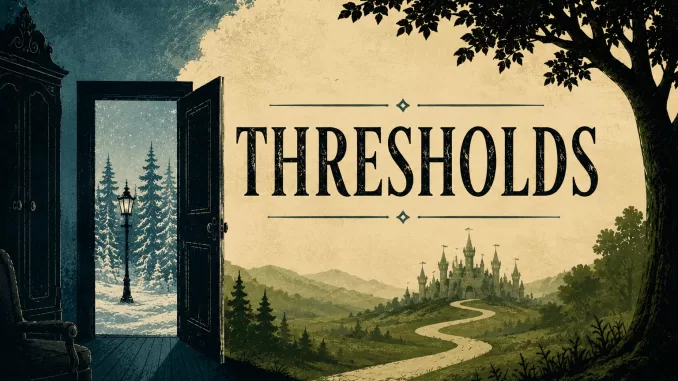
The secret of good fantasy is a threshold you can believe in, one that smoothly connects our own reality to an alternate reality, inviting us to step inside and be dazzled. Be it a doorway, a tunnel, or a phantasmagoric transmogrification (try saying that three times fast!) it gets you from here to there—and if you’re lucky, back again—without a bitter divorce between the fantastic and the mundane. It is that spoonful of sugar that helps the travelling go down.
There are two basic kinds of portals, which I call the AH, and the OH.
AH PORTALS
AH portals—the ones that make you say AH—just feel right, and frequently the reader has little idea what makes them work, and that’s fine.
One particularly interesting one of the AH variety was in Lewis Caroll’s Through the Looking Glass, with the rather alluring suggestion that what you can see in the mirror’s reflection is a reversed image of what we see in our own world, otherwise identical and consistent with the movements of our mundane reality. Yet when one might climb through the mirror frame into the reversed room, doors and hallways open onto radically different destinations. It’s easy to believe, and a bit spooky.
The Talking Parcel, a story by Gerald Durrell, is also of the AH variety, yet it only aspired to charismatic and bizarre imagery, such as a flying steam train that would take you to an alternative world where your help was urgently needed. What it had in superficial charm it lacked in any plausibility. Why a flying steam train? If it were abandoned for years in a forest without maintenance, would it still work? A talking owl came to summon children to his world to free it from domination by the forces of evil. You know, one of those things kids do when they’re not at school.
Earl Hamner Jr. of The Waltons fame actually dabbled in fantasy. He wrote a screenplay for The Twilight Zone called “The Bewitchin’ Pool.” Here the premise is that two emotionally abused children escaped their self-centered, battling parents by jumping into their swimming pool and coming up in a swimming hole to be cared for by a generous, gentle “Aunt T.” Here the children were also chosen ones, but they were chosen to receive help rather than render it.
As Narnia fans, we have our own favorites. One that I cherish most is the Wardrobe in, of course, The Lion, The Witch, and The Wardrobe. It relies on magic, but rather than being a one trick pony, it is more than visually astounding. You feel the fur coats turning into fir trees, the cold crispness of the air and the wet, clinging crumbliness of snow. It’s what old video technicians like me call a cross dissolve, and it’s masterfully done. And what makes it so amazing is the separateness of the timelines. The Pevensie children returned to their world, but also to their time, their bodies rolled back to their original age whilst they retained their education and memories.
Lewis used an underappreciated threshold in Voyage of the Dawn Treader. A painting of a Narnian ship on the sea began to move. As the realities began to merge, seawater poured through the frame into the room, threatening to drown its occupants who were forced to swim toward the boat.
What is underappreciated is how this threshold ties into the Orthodox Christian tradition of Icons, images of saints which are not meant as much to be depictions as windows into a greater spiritual reality. Except these children did not merely gaze through the window spiritually, they moved through it bodily.
OH PORTALS
On the other hand, OH portals—the ones with an explanation that makes you go OH—rely on alien ideas…alien to earth or to ordinary people who wonder what goes on in Area 51 and Livermore National Laboratory. These stories tend to blur the line between fantasy and science fiction.
Fifth dimensional travel has the appeal that it’s available from anywhere…science tells us that there are actually nine dimensions in three groups of three…and that it’s not violating physical laws to pass into it. Most people think of this in terms of wormholes in space, such as Star Trek: Deep Space Nine, connecting two incredibly vast distances by a short tunnel. Such wormholes would require vast amounts of energy to pull off. These pass the buck by simply writing in a mysterious and ancient civilization to fill the gap. It’s the literary equivalent of saying, “trust me” or “and then a miracle happened.”
Yet it is also available normally, without technology or unimaginable force, and might be blundered into, such as in the Twilight Zone episode Little Girl Lost, written by Richard Matheson. Here a girl passes into an alternative universe simply by resting against a wall of her room where synchronicity between disparate realities formed a bridge.
In the book Bid Time Return also written by Matheson (You may have seen its film adaptation “Somewhere in Time”) the journey is one out of linear time made possible simply by intense and focused meditation. It is whatever time you think it is. This story relies neither on alien technology nor magic but simply having an advanced take on how the universe functions.
Stargate, written by Roland Emmerich and Dean Devlin, presumes that our entire galaxy was connected by an alien race that at one time ruled Egypt under the guise of the Kemetic Pantheon. As Osiris and Apophis, they demanded…and got…slave labor and materials from Earth as well as a few dozen other prey populations.
As you can tell, AH portals tend to be more positive experiences than OH portals.
CONCLUSION
Now that we’ve covered the AH and OH of it, thresholds are an important plot element in fantasy if we are to put ourselves in the action and identify with a character. But by far my favorite thresholds are those AH portals operated by divine providence for a greater good. And after all, that has worked before. The Prophet Isaiah beheld the Glory of God firsthand, as did the Apostle Paul. There is also a tantalizing reference in Acts to Philip finishing his baptism of the Ethiopian Eunuch and then being carried away by the Spirit of God and suddenly finding himself at Azotus. And, according to the tradition I hold dear, you, I, my parents, and everyone else will pass through a doorway in God’s good time, which makes the topic of thresholds both important and personal.

Be the first to comment