
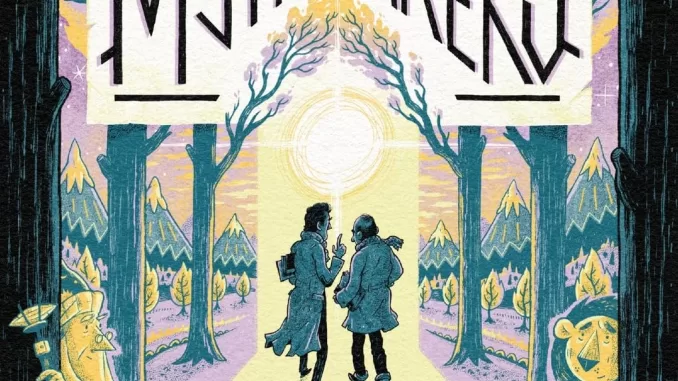

Hey, everybody! Welcome back to Tumnus’ Bookshelf, where we review any and all books written by, about, and inspired by CS Lewis, The Land of Narnia, and The Inklings. For today’s review, we will be looking at the graphic novel The Mythmakers: The Remarkable Fellowship of CS Lewis and JRR Tolkien by John Hendrix.
TITLE:The Mythmakers: The Remarkable Fellowship of CS Lewis and JRR Tolkien (A Graphic Novel).
AUTHOR/ILLUSTRATOR: John Hendrix
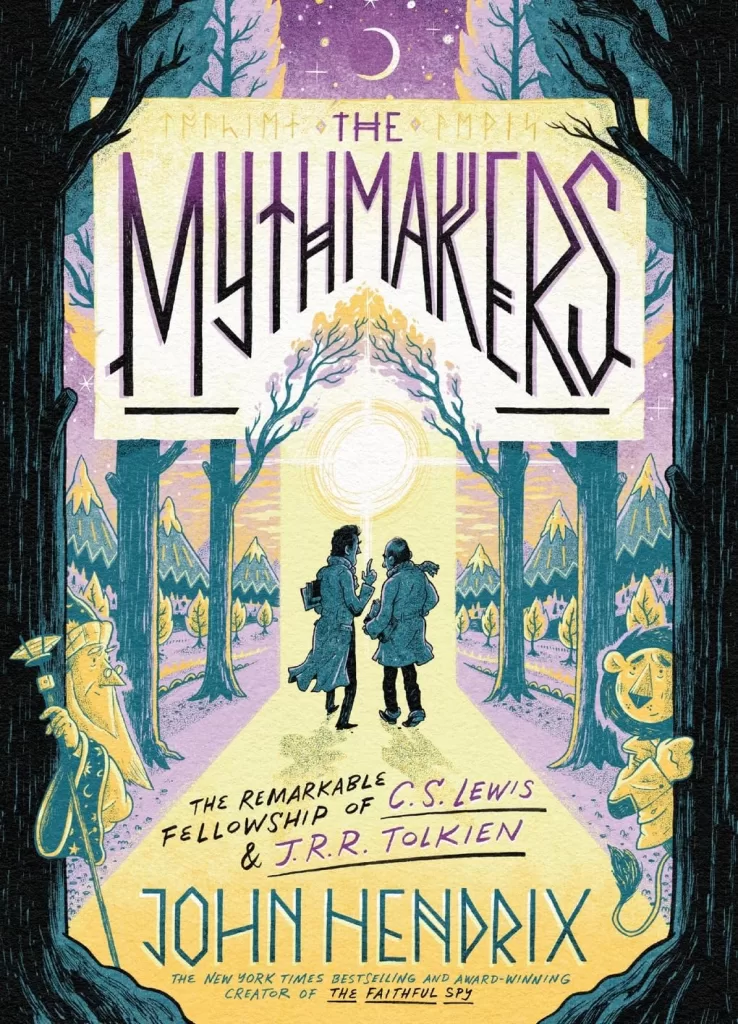
PUBLISHER: Harry N. Abrams
PUBLICATION DATE: September 24, 2024
ISBN-10 : 1419746340
ISBN-13 : 978-1419746345
SUMMARY:
Witness the timeless story of the life, work and friendship of two of the 20th Century’s greatest fantasy writers in a brand-new way! From John Hendrix award-winning creator behind the graphic novels The Faithful Spy: Dietrich Bonhoeffer and the Plot to Kill Hitler, and The Holy Ghost: A Spirited Comic, comes The Mythmakers: The Remarkable Fellowship of CS Lewis and JRR Tolkien.
Join new friends Mr. Wizard and Mr. Lion as they embark on a quest to dive deep into the meanings of myth, story and fantasy. Along the way, they and readers encounter the lives of two seminal mythmakers CS Lewis and JRR Tolkien and learn how their lives and their friendship would go on to change the shape of the fantasy literary landscape forever.
REVIEW:
In “Unreal Estates” (featured in the essay collection On Stories) a conversation between CS Lewis, Kingsley Amiss and Brian Aldiss, as they discussed the future of fantasy and science fiction, the talk very briefly turned to the matter of comic books. Lewis commented briefly that it felt that by that point, sometime in the late 1950s and early 60s that the comic book had overshadowed science fiction and fantasy novels. Aldiss countered that it probably wasn’t a problem as the cheap dime romance novels hadn’t overshadowed the likes of Austen, while Amis saw the same themes in the science fiction novels popping up in comic books. Lewis conceded their points, feeling the real problem most had was some of the unappealing art that led to Fredric Werthem’s salacious accusations in Seduction of the Innocent, and felt that based on what he saw from David and Douglas Gresham that the same kids who read comic books were just as likely to read other great myths.
What none of them knew, especially when one considers how long it would take to print and ship an American comic book in England back then is how the genre would grow. Not only as the world of the comic books seen such landmark stories as The Death of Superman, Batman: Knightfall, Spider-Man: The Night Gwen Stacy Died, X-Men Days of Future Past that force our heroes to face their ultimate battles, while larger than life stories like Crisis on Infinite Earths, The Galactus Trilogy and The Infinity Gauntlet that forced some of the greatest heroes in comic books to fight for all existence itself. Meanwhile other books such as Alan Moore’s Watchmen, Frank Miller’s The Dark Knight Returns, Mark Millar’s Civil War and Mark Waid and Alex Ross’s Kingdom Come deconstructed the superhero mythos and took a closer look at the never ending battle of good and evil, while Darwyn Cooke’s DC The New Frontier and Millar’s The Ultimates reexamined the origins of the Justice League and The Avengers. However, it would be Art Spiegelman’s Maus that would truly show the potential of the graphic novel as it grippingly examined the horrors of the Holocaust and showed that “comic books” could be about more than just superheroes.
Thus, while it may have begun as a medium for superhero comic books the genre has taken on new life as it has now gone so far as to dive into the realm of real-life heroes and heroines. With sports figures and politicians and pop stars, including flavor of the week boy bands getting graphic novels, it stands to reason that the story of CS Lewis and JRR Tolkien could be retold through that medium. Tolkien felt that mythology reflected the language of it’s people, and crafted the stories of Middle-earth first by developing a language and culture and then framing the myth around it, while Lewis’ stories began with “pictures in his head’. When comic books and graphic novels are both “pictures in the mind” conveyed on the page, and the mythical language of the 21st century, it makes for the perfect medium to tell their story.
Like Jerry Siegel, Joe Shuster, Bob Kane, Bill Finger, Jack Kirby, Joe Simon, Stan Lee, Steve Ditko, Steven Spielberg and George Lucas, the stories, characters and worlds that Lewis and Tolkien created are on par with the bards and poets of old who gave us the legends of Odysseus, Hector, Achilles, Thor, Robin Hood, and King Arthur. John Hendrix the author and illustrator behind The Mythmakers, is no stranger to the world of faith based graphic novels having produced the books Holy Spirit and the New York Times best seller “The Faithful Spy: Dietrich Bonhoffer and the Plot to Kill Hitler, admits that when it comes to Tolkien and Lewis thanks to their literary creations there is something about them that appears larger than life.
Considering how surprised those who met them were by how unassuming they appeared, maybe it’s natural. Perhaps like Homer with the story of the Trojan War, these stories of Middle-Earth and Narnia have taken on a life of their own that’s become far greater than their creators could have imagined. Thus, we imagine them to be every bit as rugged, grand and heroic as the very heroes they created. And yet, while a lesser artist may attempt to make “Jack and Tollers” (as they are referred to throughout the text of the story) look too “glamorous” by using only images of them in their youth, or make them appear larger than life, Hendrix avoids that trap. His illustrations of Jack, Tollers, Joy, Edith, Charles, Warnie, and the rest of the Inklings “look” like them. Humble, unassuming and ordinary.
Yet the driving force for this story isn’t just an ordinary biography. Unique to this story is how it is framed. Readers are introduced to “Mr. Wizard’ and “Mr. Lion” avatars of sorts for their respective creators JRR Tolkien and CS Lewis. We follow them on a quest to understand the power of story and myth and through it the lives of Tolkien and Lewis. Since they had been mere school boys, both men were drawn towards myth, legend and story, and thus it seeped into every fiber of their respective beings, forged their friendships and defined their lives works. Yet at the same point both men never stopped examining and wondering what it was that kept drawing them back to those great tales.
When it comes to the biographical information on Tolkien and Lewis, Hendrix devotes a chapter a piece to the early years of Tolkien and Lewis followed by their experiences during World War I. We see through this structure how their lives were almost mirrors to each other, and how they overlapped. Even difficult aspects of their lives, like the respective deaths of their mothers, their experiences at boarding school, and the breaking of the Fellowship of the Inklings are covered.
The book is meticulously researched. Hendrix includes a two-page bibliography of over fifty-four sources, including Jack and Tollers own respective works. As a result, he perfectly captures the “voices” of these men and their respective circle, and thus even if the dialogue may be imagined for the reader if feels almost as if we are right in that pub with the Inklings or going on Addison’s Walk with Jack and Tollers. He resists the urge to “simplify” the language and make it more palatable to the modern reader, allowing the reader to meet these great writers in the time in which they lived and better understand them and their world.
I even learned somethings through this book I hadn’t before. For example, I never knew that Jack’s brother Warnie had been one of the thousands of British soldiers trapped in Dunkirk. I was also surprised to discover that unknown to Jack and Ronald at the time they were admitted, but Joy Davidman and Edith Tolkien were actually in hospice together at the same nursing home. Further, Hendrix goes above and beyond the typical narrative of a biography. Usually, the story of Lewis and Tolkien ends in their deaths. However, Hendrix, firmly believes, as Lewis and Tolkien did that the true consolation that they sought in those great tales came not in this world, but in the one to come in the place of “the great story which no one has ever read”, “beyond the circles of this world”, and it is here that the story ends in a heartrending moment in which Jack and Tollers are completely reconciled to one another and admit how much their friendship meant to each other. It feels so perfectly gleaned from their letters and journals that one can almost picture them having a similar conversation in their Heavenly home.
Readers are also treated to interactive “portals” at select moments in the story. In any other book perhaps, it could be distracting to the narrative, but given the epic nature of the story, and how it follows along the narrative formula of the quests that Tolkien and Lewis penned it feels natural. Every great quest is filled with detours, side missions, and roundabouts and this story is no exception. These asides end up making the story feel more alive, more vibrant as it creates an almost interactive feel for the story, truly inviting the reader along for the quest. We even meet some additional friends along the way in the form of Dr. Thistle and Professor Badger, experts on stories and on the Inklings.
A caveat to connoisseurs of graphic novels. Typically, when one pictures a graphic novel, they usually imagine it featuring the standard panels of a comic book. While this is certainly the case, and at certain points Hendrix employs the “Splash panel” at key moments in a story to emphasize a point in the story, it could be considered more of an “illustrated novel” due to its hybrid narrator as Hendrix does use regular prose writing for much of the biographical information on Lewis and Tolkien. However, this is one of the strengths of the genre, in that there is no limit to how the information in the story can be conveyed to the reader. In fact, if Hendrix didn’t use regular prose to cover the stories of CS Lewis and JRR Tolkien it would have ultimately had to be split into a trilogy akin to The Lord of the Rings itself in order to cover everything perfectly. Further, some form of narration would still be needed to move the reader along and regular text boxes or thought bubbles wouldn’t cut it.
I must confess, typically for my book reviews I usually go strictly off of first impressions only for a book. That is not the case for a graphic novel. Having been around the world of comic books and graphic novels since the tender age of three, I learned that the reading of a comic book or graphic novel is as much a chance to appreciate the visual art as it is to read a cool story. Thus, I read it once to just appreciate the art, a second to follow the story, a third time to put them together, and a fourth time just to see if there was anything I missed. With each reading I grew to love it more and more.
Unlike other glossy celebrity focused graphic novels, Mythmakers doesn’t feel like a soulless cash grab. The fact that The Mythmakers was nominated for an Eisner Award in 2025, the most prestigious award in comic books, elevates it above the slew of books that come out about pop stars and celebrities like Taylor Swift, Beyonce, or Stephanie Meyer that haunt the back issue bins and bargain sections of comic book stores. Being nominated for an Eisner places Hendrix and The Mythmakers on the same pedestal as such landmark works as Watchmen, Maus, The Marvels, Kingdom Come, Batman: The Long Halloween, All-Star Superman, Captain America: The Winter Soldier, Marvel’s The Ultimates, DC: The New Frontier, and, perhaps most fittingly, Hope Larson’s graphic novel adaption of Madeleine L’Engel’s A Wrinkle in Time. These are works that elevate the genre, proving that comic books could be literature, and demonstrated the power of the medium as a story telling tool, and The Mythmakers deserves all the accolades it’s received. Like Watchmen proving superhero graphic novels could be more than “wham, pow, bam!”, The Mythmakers proves that a biographical graphic novel can be spiritually deep, intellectually stimulating, narratively rich, emotionally moving, and in a word “epic”.
With his lengthy bibliography and meticulous research, warm illustrations, and delightful characters of Mr. Wizard and Mr. Lion, John Hendrix tells this timeless story to a new generation. It’s a labor of love by a fan for the fans, that translates this timeless story of two of the twentieth centuries greatest literary mythmakers into the mythic narrative of our time. This is one literary journey I can’t wait to take again, and is sure to be a hit for fans of Tolken and Lewis who love great graphic novels with larger-than-life stories of unlikely heroes.
FIVE OUT OF FIVE SHIELDS:

Order the Book from Amazon.com
*This article contains a link where we may earn a commission from your Amazon purchase at no additional cost to you as a small way to support the cost of this website.

Be the first to comment