
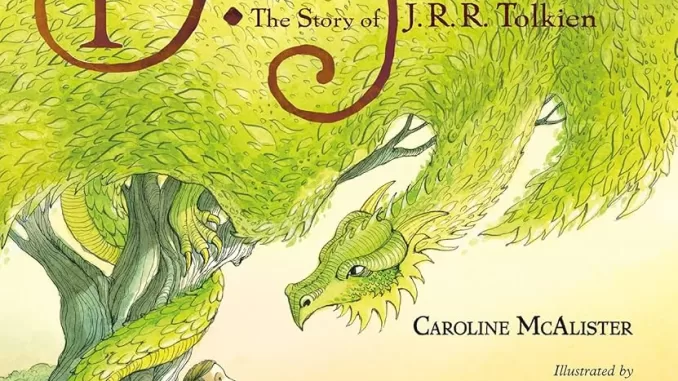
Hey, everybody! Welcome back to Tumnus’ Bookshelf, where we review any and all books written by, about, and inspired by CS Lewis, The Land of Narnia, and The Inklings. For this special edition review we will be looking at Caroline McAlister and Eliza Wheeler’s picture book biography John Ronald’s Dragons: The Story of JRR Tolkien.
TITLE: John Ronald’s Dragons: The Story of JRR Tolkien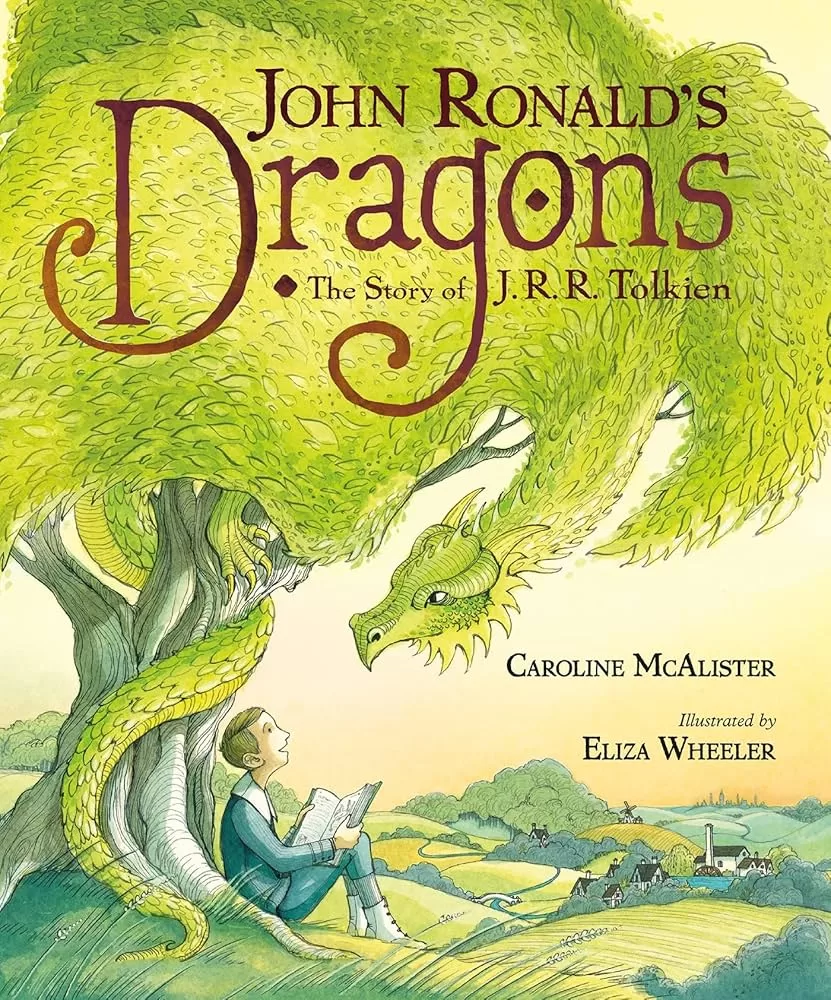
AUTHOR: Caroline McAlister
ILLUSTRATOR: Eliza Wheeler
PUBLISHER : Roaring Brook Press
ISBN-10 : 1626720924
ISBN-13 : 978-1626720923
Summary:
Join young John Ronald as he embarks on a quest, to find a dragon. A young man who loved stories, languages and dragons, he dreamed of adventure. A long the way he discovered friendship, love, and a faith that would shape him forever leading him to become one of the 20th centuries greatest mythmakers, JRR Tolkien.
Review:
Children love dragons. It’s an irrefutable fact, one seemingly verified by the success of movies like How to Train your dragon. Fierce, menacing, and terrifying, and at the same time majestic they capture the imagination like no other. The fact they are fictional makes them safer than other fierce creatures like sharks or wolves, as there’s little chance of ever running into one in the real world. But somehow, they make the stories in which children may encounter them more exciting and serve as a greater challenge for the heroes.
But what if children could not only encounter dragons, but meet a child who loved dragons and stories as much as they do? More over what if they could learn how he went on to introduce into the world one of the greatest dragons in modern literature, one who stood the test of time. And, what if as a result, they learned that this boy went on to become one of the greatest visionary minds of fantasy literature in the 20th century.
That’s the focus of the book, John Ronald’s Dragons: The Story of JRR Tolkien. Written by Caroline McCalister, an English professor at Gilford College, she has a long history and love with Tolkien and his lore. McCalister even takes students once a year to Oxford on tours so they can better immerse themselves in Tolkien and his world and as a result better understand his rich mythology.
Her love and passion for Tolkien is clearly on display in this book as we witness all the key moments in his life, including meeting and marrying Edith, his time in World War I, and the importance of his faith. It’s far too easy at times for storytellers to ignore that part of his life, but McCalister addressed it perfectly, pointing out how it gave him a sense of peace in his life, one that would sustain him forever. Further, the picture of Tolkien in church makes it feel as if he’s reached a Rivendell or even a Lothlorien in his life’s journey, a place where he can find rest along his journey, peace from his pain, and answers to his questions.
One thing that never ceases to amaze me with the children’s picture books about some of my favorite authors is how meticulously researched the books are, to the point I find myself learning facts about them and their life I never knew before. For example, I never knew about Tolkien’s cousin Mary, with whom he developed languages. And I was even moved to tears to learn that his aunt destroyed letter that his mom had written or Tolkien and his brother, as well as maps he had drawn, making his persistence in pursuing his dragons, and finally finding Smaug all the more rewarding. Any other kid would have turned their backs on their dreams with such discouragement, but like the heroes of the great stories of which Tolkien wrote so passionately, he kept following along on the path before him.
Appropriately Eliza Wheeler’s art work for the book perfectly emulates some of the great illustrators of the past, in particular Tolkien’s own art work as lush water color brush strokes give the skies atmosphere and the mountains their texture. The country side feels pastoral, the city feels crowded, and the war feels like we’ve simply wandered into Mordor. Further we see hidden dragons throughout the story, as we follow John Ronald on his search for dragons. CS Lewis even makes an appropriate and delightful cameo in the Eagle and Child Pub as John Ronald shares an early draft of The Hobbit.
Unlike many children’s picture books, especially those about induvial who have long sense passed, is hat this book doesn’t tell the entire story of Tolkien’s life. McCalister and Wheeler only go as far as the writing and publication of The Hobbit, and while for some celebrity biographies for children it may feel cheap, as if they are trying to cash in on a popular trend and revise it later as more of the story unfolds, for Tolkien’s story it feels like a great first chapter. Considering Tolkien himself saw the story of the One Ring as but one small chapter of a much greater story, so too is it with the writing of The Hobbit.
Further of the books he wrote, it remains the one best known by children, making it a far more appropriate entry point for them to learn about him in a biography geared towards young readers then say learning about The Lord of the Rings, The Silmarillion or his scholarship of Beowulf. Other parts of his life, his concern for Christopher during the war, Edith’s health concerns, and his estrangement from Lewis, would probably not be of interest to children, while Hugo Dyson’s exasperated reaction of “not another (redacted) elf!” during another meeting of the Inklings would not be appropriate for young readers.
As a result of focusing on just The Hobbit, it gives the story the feeling of just the start of quest. We feel as we follow John Ronald from his childhood to is adulthood that he is searching for something and hope he finds it. Thus, when he finally meets his dragon, Smaug, we feel as though he’s reached his goal. It is a powerful, rewarding experience for young readers, one that reminds them that with time, effort and patience they do can reach their goals. Distractions and challenges may come their way, life itself may try to divert them, but somehow, if like the heroes of the “great stories” hey keep pressing towards the goal, they too can not only conquer those obstacles but find that treasure.
To that end McCalister and Wheeler include notes for the readers, not only detailing the life of Tolkien and some of the story telling choices they made in adapting Tolkien’s life to a children’s book. Through this section we see how they handled the subject matter with great sensitivity, not only to the young readers, but towards Tolkien himself. We see just how Tolkien’s life in the English countryside could have led to the creation of the Shire, how the fellowship he experiences in the war, the TCBS and the Inklings forged his own fellowships in his legendarium, and just how certain moments would have captured his imagination and made his world come to life. There’s even a handy index of dragons in the back of the book, not only Fafnir and the dragon from Beowulf that inspired his love for dragons, but a list of the dragons from his mythology and some of his more memorable quotes from essays and appears about dragons.
Brilliantly written by Caroline McCalister and lovingly illustrated by Eliza Wheeler, John Ronald’s Dragons is an appropriately magical retelling of the life of JRR Tolkien that embraces the imagination, magic, wonder, faith, and fellowship that has made his mythology such an integral part of the literary canon. More importantly John Ronald’s Dragons is certain to inspire a whole new generation of young mythmakers, adventures and writers, just as Tolkien had been inspired by the great stories of the past.
Five out of Five Shields.
Order the book from Amazon.com


Be the first to comment