
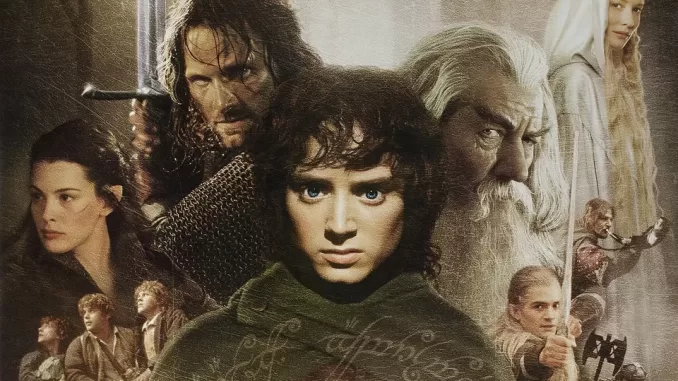
This year marks the 25th anniversary of The Lord of the Rings: The Fellowship of the Ring, and I’ve decided to take this opportunity to revisit and review every Middle-earth film released so far. One film per week.
J.R.R. Tolkien, who wrote The Lord of the Rings, and C.S. Lewis, who wrote The Chronicles of Narnia, were close friends. Their conversations about myth, faith, sacrifice, and redemption helped shape two of the most enduring fantasy worlds ever created. Middle-earth and Narnia are distinct in tone and scope, but both are rooted in moral imagination and the belief that courage, humility, and sacrifice matter.
As a lifelong fan of both writers and the worlds they created, this anniversary feels personal.
The Lord of the Rings films hold a special place in my heart for many reasons. This was the first major cultural milestone that felt like it belonged to my generation. I’m a huge Star Wars fan, but when the prequels were releasing, it still felt like something inherited. Lord of the Rings felt like something happening now — something we were discovering together.
I remember conversations at work before Fellowship released. Some friends were convinced another fantasy film releasing a month earlier would dominate the box office. That film was Harry Potter and the Sorcerer’s Stone. And yes, it was a phenomenon. But I remember insisting that The Lord of the Rings had the depth, the scale, and the staying power to go head-to-head.
The box office race was close. Ironically close. Close enough that I counted it as a personal victory.
And now, with the recent re-release pushing it officially ahead, it feels like history nodding in agreement. And Bill the Pony nodded as if he understood.
Anyway, let’s dive in.
We begin where the cinematic journey started: The Fellowship of the Ring.
There are movies you watch.
And then there are movies that become part of you.
The Fellowship of the Ring is one of those films for me.
I didn’t walk out of the theater thinking about cinematography or pacing. I walked out feeling like I had stepped into something ancient and true. It didn’t feel like a fantasy film. It felt like a world I had been invited into.
From the opening narration covering the history of the Ring, to the first visit to the Shire, Middle-earth feels tangible. The homes carved into hillsides. The warmth of Bag End. The careful detail in wood, stone, and earth. This is not fantasy decoration. It feels inhabited. It feels cultivated. It feels like somewhere worth protecting.
Howard Shore’s score establishes that truth almost immediately. The Shire theme is not simply beautiful — it is identity. It sounds unmistakably Hobbity. Rooted. Humble. Warm. It carries comfort without softness, innocence without fragility. Across the entire trilogy, Shore’s music becomes emotional architecture, and here it lays the foundation.
The pacing of The Fellowship of the Ring is intentional. The filmmakers understand that mythology must be built before it can be tested. It allows Rivendell to breathe. It lets Moria feel ancient and heavy. It lingers in the quiet moments so that the coming trials carry weight. Nothing feels rushed. Nothing feels unnecessary.
The moral heart of the story emerges in the Mines of Moria. Frodo, overwhelmed by the burden he carries, says:
“I wish the Ring had never come to me. I wish none of this had happened.”
It is a line that resonates more deeply with each passing year. Many of us have felt some version of that — wishing the burden, the uncertainty, the darkness had simply passed us by.
Gandalf answers with the defining words of the trilogy:
“So do all who live to see such times, but that is not for them to decide. All that we have to decide is what to do with the time that is given to us.”
That line is the anchor. We do not choose the times in which we live. We choose how we respond within them. Shore’s score beneath that exchange is restrained and reverent, allowing the weight of the words to settle without manipulation.
When Gandalf falls, it is devastating — not merely because of the spectacle, but because of what he represents. Wisdom. Stability. Guidance. The Fellowship theme fractures, and the music itself seems to mourn. Shore’s use of leitmotif throughout the film is masterful. Themes evolve as characters do. Nothing is static.
The formation of the Fellowship in Rivendell remains one of cinema’s great assembling-of-destiny moments. As each member commits, the score swells not with bombast, but with resolve. When Frodo says, “I will take the Ring, though I do not know the way,” it captures Tolkien’s spirit perfectly. Courage and humility intertwined.
Boromir’s redemption is earned. He begins desperate for the Ring, believing it could save his people. He ends while defending the hobbits, reclaiming his honor with his final breath. It is powerful because it is honest.
And then there is Sam. On the Anduin, when Frodo attempts to leave alone, Sam’s promise becomes the emotional spine of the entire saga:
“I made a promise, Mr. Frodo. A promise. ‘Don’t you leave him, Samwise Gamgee.’ And I don’t mean to. I don’t mean to.”
The music in that moment is gentle, not epic. Because the true heroism of this story is not spectacle but faithfulness. As the Fellowship divides, the tempo subtly shifts. Percussion builds beneath the melody, pushing the narrative forward as each member steps into the next chapter of the journey.
When the credits roll, Enya’s “May It Be” closes the first act with something almost sacred. The trilogy would go on to feature three female vocalists — Enya, Emilíana Torrini, and Annie Lennox — each bringing a haunting, ethereal quality that feels deeply aligned with Tolkien’s world. These songs are not commercial add-ons. They are tonal extensions of the story itself.
Both the theatrical and extended editions function flawlessly. The extended edition deepens character and texture, but the theatrical cut already stands complete.
As an adaptation, this film does something extraordinary. It does not replicate Tolkien word-for-word. Instead, it captures the weight, tone, and moral gravity so completely that it stands beside the book as an equal artistic achievement.

Be the first to comment