
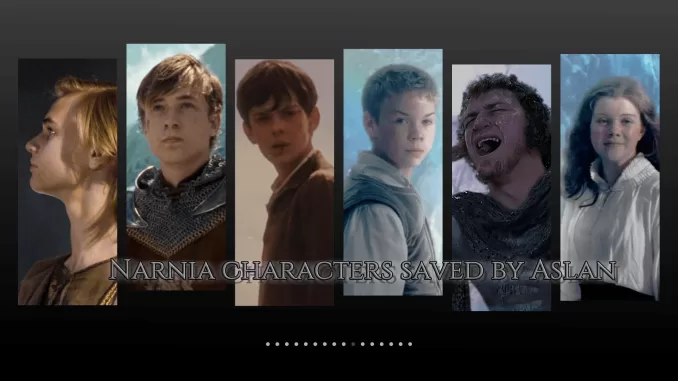
A supposal, a what if. C.S. Lewis, the author of The Chronicles of Narnia defined his work as a supposal rather than an allegory. “What might Christ become like if there really were a world like Narnia and He chose to be incarnate and die and rise again in that world?”
As we remember the greatest love story ever told to mankind, we are reminded as well of this sacrifice that saved every sinner in the world and that includes you and I.
Shasta, The Horse and His Boy
The saving of Shasta is deeply rooted in biblical parallels, highlighting Aslan as a Christ-figure:
- “I AM” (Divine Identity): When Shasta asks who he is, Aslan responds “Myself” three times (deep/low, loud/clear, whispered). This mirrors God’s declaration to Moses, “I AM WHO I AM” in Exodus 3:14.
- God’s Sovereignty & Providence: The central theme is that Aslan works behind the scenes, turning dangerous situations into good, even when the characters cannot see it, reflecting Romans 8:28.
- The Good Shepherd/Protector: Aslan’s watchful care, particularly his protection of Shasta from jackals, mirrors Jesus as the shepherd protecting his sheep (John 10).
- Personalized Relationship: Aslan declares, “I tell no one any story but his own.” This highlights a personal, direct relationship with God rather than comparing one’s journey to others, similar to Jesus’ instructions in Matthew.
- “Living Water”: After meeting Aslan, Shasta drinks from a lion’s footprint overflowing with water, baptizing himself and drinking, reminiscent of Christ as the “Living Water” (John 4).
- Moses Parallel: Like Moses, Shasta was spared as an infant and delivered to a foreign land to be raised, so that he could later return to save his people (Archenland).
Aravis, The Horse and His Boy
- The Wounding & Compassion: Aslan scratches Aravis to teach her empathy, inflicting ten scratches—one for each lash the slave girl received because of Aravis’s escape. This parallels the biblical concept of reaping what one sows and the necessity of enduring discomfort to develop righteous character, akin to Jacob wrestling with the Angel.
- Mercy in Discomfort: While the action is harsh, it is also mercy—saving Aravis from her own pride and selfish actions. Aslan explains his actions later, guiding her toward true repentance and empathy.
- Atonement and Hidden Providence: Aslan reveals he was the lion chasing them the whole way, not to destroy them, but to spur them forward and protect them. This reflects the Christian theme of a providential God who guides and disciplines those He loves to ensure their ultimate good, even through suffering.
- The “Not Tame” Lion: This scene reinforces that Aslan, representing Jesus, is not “safe” but “good,” focused on transforming characters rather than just making them comfortable.
Caspian X, Prince Caspian
- Restoring the Faithful Remnant: The Biblical Connection: This symbolizes the “faithful remnant” in the Bible—believers who, despite persecution and being marginalized, keep their faith in God and are eventually vindicated (reminiscent of the early Christians hiding in catacombs).
- Aslan’s “Invisibility” and Faith: The Biblical Connection: This mirrors the Christian journey of trusting God in times of silence or invisible presence. It directly corresponds to Jesus saying, “Blessed are those who believe without seeing me” (John 20:29).
- Divine Authority and Humility: The Biblical Connection: This highlights the biblical principle that God’s strength is made perfect in weakness (2 Corinthians 12:9). It aligns with the theme that “the humble will be exalted”.
- The Second Adam and Daughter of Eve: The Biblical Connection: This directly references Genesis and the belief that humanity holds a unique place in God’s creation—both broken by sin (“shame enough to bow the shoulders of the greatest emperor”) and dignified as image-bearers of God (“honor enough to erect the head of the poorest beggar”).
- The Liberation of the Land: The Biblical Connection: This represents the liberation that Christ brings—breaking the bonds of sin and oppression. It also echoes the “creation groaning” for liberation in Romans 8:22 and the promise of a renewed heaven and earth.
Prince Rilian, The Silver Chair
 Aslan’s rescue of Prince Rilian is a pivotal narrative moment laden with Christian symbolism, highlighting themes of liberation from darkness, the power of truth, and divine grace.
- Following the Signs (Word of God): Aslan tells Jill, “Nothing else matters,” except remembering the signs. This mirrors the Christian obligation to rely on Scripture and divine truth over “appearances” or worldly logic.
- The Binding of Rilian (Spiritual Bondage): Rilian’s bondage to the chair represents being shackled by sin or deception. His freedom comes only when he appeals to a higher power (Aslan/Christ).
- The Witch as Satan: The Green Lady, a seductive, lying serpent (who transforms into a snake), represents Satan, who seeks to deceive and “steal” the rightful ruler (Rilian/mankind).
- The Power of Truth: Puddleglum’s stand against the witch, declaring he will follow Aslan even if Narnia is a dream, emphasizes faith over empirical evidence, a key theme in Hebrews 11.
- Resurrection Theme: The story features themes of restoring life and light to a dark place, with a connection to the “fountain of the water of life” in Revelation 21. restore rightful authority, reward faithful endurance, and bring, as Aslan says, “All of Narnia” back to life.
Jill Pole, The Silver Chair
- The Calling (Divine Initiative): When Jill is terrified and thirsty on a high, dry mountain, she meets Aslan. He tells her, “You would not have called to me unless I had been calling to you,” a direct echo of John 15:16 or the concept that God initiates the relationship, as explained in 1 John.
- “There is No Other Stream”: Jill initially fears Aslan will eat her, but she is desperate for water. Aslan refuses to promise not to eat her, insisting, “There is no other stream”. This scene heavily symbolizes John 4 and John 14:6, where Jesus offers himself as the only source of “living water” and the only way to salvation, demanding trust over self-protection.
- The Four Signs (Holy Scripture): Aslan gives Jill four signs to guide her mission. He warns her to memorize them, saying them when she wakes, sleeps, and in the middle of the night. This acts as a clear allegory for Deuteronomy 6:7, where God commands the Israelites to keep His commandments in their hearts at all times.
- “Aslan is on the Move”: When the quest becomes difficult, and temptation threatens to make them forget the signs, the characters rely on reciting what Aslan said. This mimics the Christian practice of relying on Scripture to resist temptation, even when “the air is thick,” and memory is clouded, as described in Psalm 119:11 (“I have hidden your word in my heart that I might not sin against you”).
- Repentance and Grace: After Jill misses the first sign, she is humbled. Aslan tells her that her task will be harder, but he still trusts her with it, illustrating the biblical theme of God allowing consequences for mistakes while still providing grace and redeeming the mission.
Peter Pevensie, The Lion, the Witch and the Wardrobe, Prince Caspian
- Jesus and Saint Peter: Peter Pevensie represents the Apostle Peter. Just as Jesus gave Peter the “keys” to the kingdom (Matthew 16:19) and tasked him with leading the church (“feed my sheep,” John 21), Aslan tasks Peter Pevensie with leading his army and later authorizes him to close the door of Narnia.
- The Servant Leader: Peter’s journey from a terrified boy to a courageous leader who relies on Aslan mirrors the Apostle Peter’s transformation from a fearful disciple to a confident leader following the Resurrection.
- Wolf’s Bane vs. Shepherd: Peter as “Wolf’s Bane” (defender) mirrors the Biblical role of a pastor/apostle protecting the flock from spiritual dangers.
Grace and Redemption: Just as Jesus forgave Peter for his denial, Aslan forgives Peter for his moments of pride and failure, showing that salvation and leadership are gifts of grace.
 Digory Kirke, The Magician’s Nephew
- The Apple of Life (Healing and Salvation): Aslan commands Digory to retrieve an apple from a mystical garden to plant a tree that will protect Narnia. However, he permits Digory to give a part of that apple to his dying mother. This mirrors the biblical theme of God providing the “fruit” of life (the tree of life) that brings healing and salvation to the world.
- Compassion and Shared Grief: Aslan validates Digory’s grief, saying, “My son, my son… I know. Grief is great,” and weeping “great shining tears”. This parallels Hebrews 4:15, which states that Christ understands our weaknesses because He endured them, and John 11:35, where Jesus weeps before raising Lazarus.
- Temptation to Misuse Power: The Witch Jadis tempts Digory to steal the apple for his mother instead of obeying Aslan. This acts as a reversal of the temptation in the Garden of Eden, where Adam and Eve took forbidden fruit. Digory’s obedience to Aslan, rather than taking the easier path, shows faith.
- “All Get What They Want”: Aslan notes that stealing the apple to save his mother might have made her live, but not to their joy, as she would have eventually regretted it. This mirrors the spiritual truth that choosing one’s own path over God’s path (even for a “good” reason) leads to spiritual death.
- Resurrection Power: Aslan’s power is shown as the ultimate force that can turn back death (the “deep magic”). The saving of the mother represents the power of God to heal, and ultimately, to make all things new, promising the final destruction of death (Revelation 21:4).
Lucy Pevensie, The Voyage the Dawn Treader
- Unique Creation (Psalm 139:13-16): Just as Aslan tells Lucy she is valuable, the Bible says we are “fearfully and wonderfully made” by God, specifically designed with a purpose.
- Identity in Christ (Ephesians 2:10): We are God’s “workmanship” (masterpiece), not needing to compare ourselves to others or look like someone else to have value.
- Refusal to Fear/Doubt (Romans 8:16-17): Aslan encourages Lucy to trust her value despite her doubts. Similarly, the Bible encourages believers to trust their identity as children of God, rather than running toward the “tempter” or worldly desires.
- Repentance and Grace: In Prince Caspian, Aslan reminds Lucy that she has “work in hand” (tasks yet to do) and urges her to keep going and follow him, reflecting the Christian concept of repentance—turning away from doubt/wrong choices to follow God.
Mr. Tumnus, The Lion, the Witch and the Wardrobe
- Aslan as Savior (Jesus Christ): Aslan is a direct allegory for Jesus Christ, often referred to as the “Lion of the tribe of Judah” (Revelation 5:5), embodying both high authority and immense love.
- Reversing Death (Genesis 2:7 / John 20:22): Aslan’s action of breathing life into the statues directly mirrors God breathing life into Adam in Genesis 2:7, and Jesus breathing the Holy Spirit upon his disciples in John 20:22.
- The “Deeper Magic” (Substitutionary Atonement): Aslan dies on the Stone Table to pay for Edmund’s treason, fulfilling the “Deep Magic” (law) and invoking a “Deeper Magic” (grace). This mimics Jesus taking the penalty for human sin.
- Resurrection and Victory (John 11:25): Just as Jesus triumphed over death, Aslan’s resurrection enables him to destroy the Witch’s curse, showing that “death itself worked backward”.
Eustace Clarence Scrubb, The Voyage the Dawn Treader
- Salvation and Sanctification (Transformation): Eustace’s story represents a sinner who cannot fix their own sinful nature (“dragon skin”) and needs God’s intervention to become a “new creation”. This aligns with 2 Corinthians 5:17 (a new creation in Christ).
- Repentance and Baptism: The act of lying down before Aslan to be changed is a picture of repentance. The deep pool where Aslan throws Eustace after tearing off the skin symbolizes baptism—a cleansing and burying of the old self to be raised as new.
- The Cost of Following Christ: The “undragoning” is painful, illustrating that sanctification—the process of being made holy—often requires letting go of selfish, “fleshly” desires, which can be agonising.
- Only Christ Saves (Not Self-Help): Eustace’s attempts to remove his own scales fail, reinforcing the biblical theme that salvation is a gift from God and not earned by human effort, as discussed in Ephesians 2:8-9.
Edmund Pevensie, The Lion, the Witch and the Wardrobe
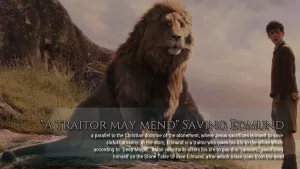 Aslan as Christ: Aslan is the creator and sovereign of Narnia, just as Christ is the Creator and God in Christianity.
- Edmund as Fallen Humanity: Like the traitorous Edmund, humanity is represented as having fallen into sin and needing salvation, as Edmund betrayed his siblings for temptation (Turkish Delight).
- The Stone Table as the Law: The Stone Table, which demands the blood of a traitor, symbolizes the Old Testament Law of Moses, which demands death as the penalty for sin.
- The “Deeper Magic” as Grace: When Aslan dies for a traitor, the table breaks, symbolizing that the Law is fulfilled and replaced by grace. This parallels how Jesus’s sacrifice on the cross broke the power of sin and death.
- Resurrection: Aslan rises from the dead to defeat the White Witch, mirroring the resurrection of Jesus and his victory over Satan.
- Substitutionary Atonement: Just as Jesus died in place of sinners (“The Just for the unjust”), Aslan died in place of Edmund.
Aslan’s sacrifice emphasizes that, while he loves all of Narnia, his sacrifice was a personal act to save a single repentant sinner, reflecting the Christian belief that Jesus would have died even for one individual.
special thanks to
arts from Elykrindon and Pauline Baynes
The Chronicles of Narnia films distributed by Walt Disney, Walden Media, and Fox
BBC Narnia
Logos Theater The Horse and His Boy and The Silver Chair
audio from William Maytook
all rights reserved and no copyright infringement intended
Be the first to comment